
ARTISTS
Kimberly Callas
Amy Feger
Beth Fein
Maru García
Tanja Geis
Alisa Gorshenina
Laura Green
Stacy Levy
Patricia Miranda
Abby Spangel Perry
Joanne Ross
Priscilla Stadler
Mikala Aragón Sterling
Cindee Travis Klement
Jen Urso
Shelley White
Melanie Zurba
Editor’s note: All artworks and images are credited to the artist in each section unless otherwise noted.
Kimberly Callas Brooks, Maine
-
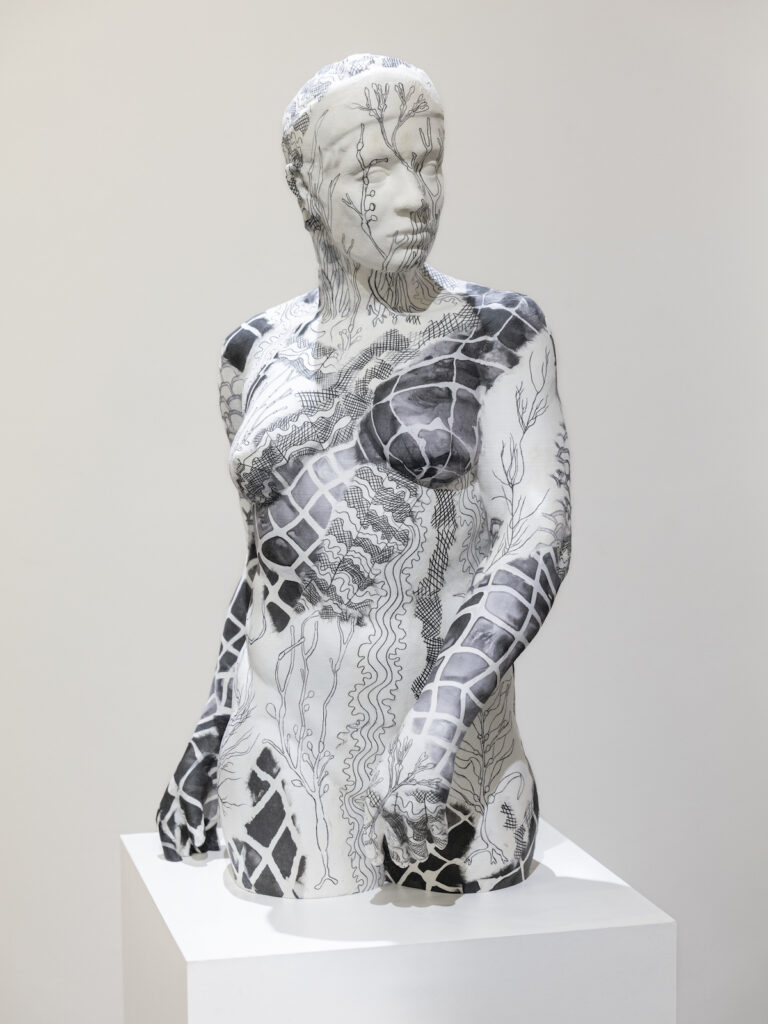
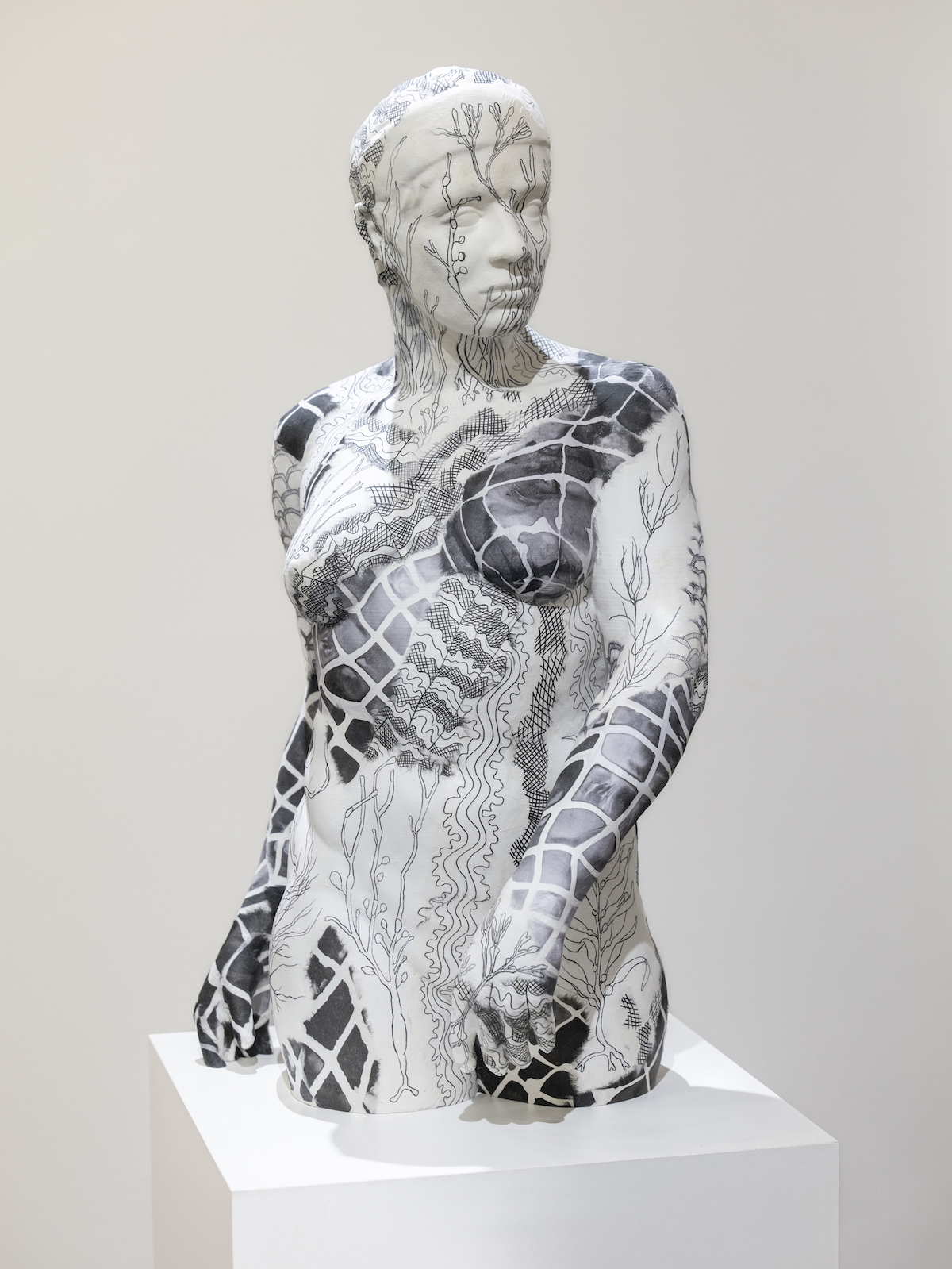
- Rosetta, digital print of Kuzo paper on 3D printed bio fillament, 48″ x 16″ x 12″, 2025.
-
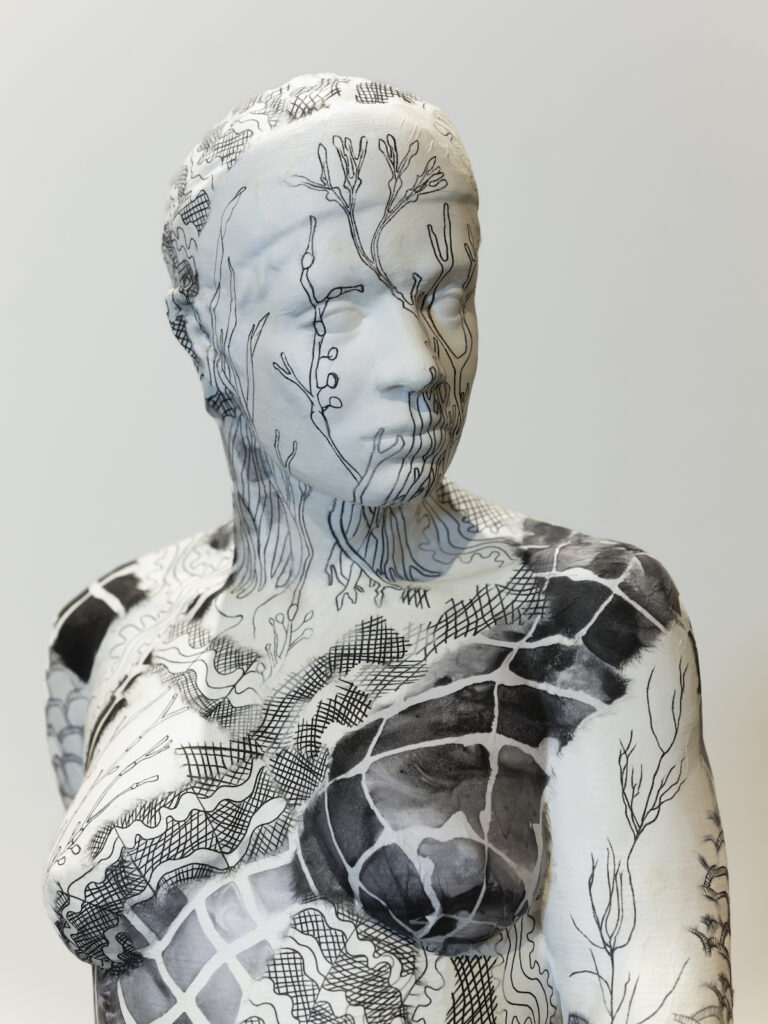
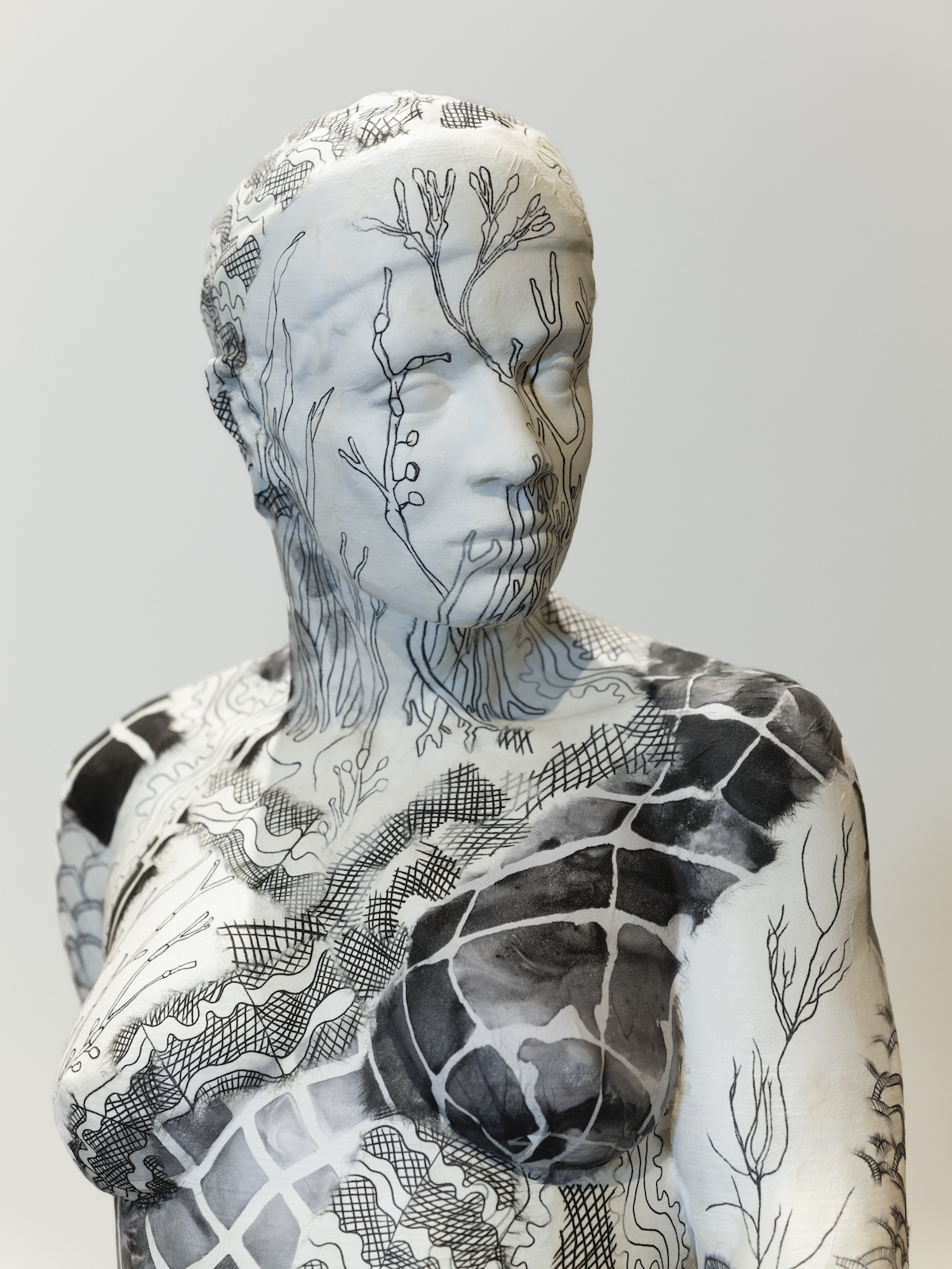
- Rosetta (detail).
Rosetta
I am drawn to patterns and how they repeat across landscapes and species. A whale’s fin, a bird’s wing, and the bones of a human hand each echo a shared blueprint of life. Rosetta emerges from this fascination. The title was inspired by the Rosetta Stone. The sculpture acts as an ecological relic by inviting viewers to decipher meaning not through written language but through the body’s embeddedness in the natural world.
Rosetta is a life-size half figure, positioned as if standing in water. The figure is layered with hand-drawn patterns from ocean currents, nets, and seaweed. The drawings were scanned and digitally printed onto kozo paper, then collaged onto the 3D-printed sculpture. This surface becomes a kind of map; a code etched into skin. The work suggests that ecological knowledge is carried in the body. By understanding its patterns, we may unlock new ways of knowing.
I am interested in the body as both medium and empath, porous, expressive, and responsive to the more-than-human world. As in Rosetta, the body carries the text: a sacred, fragmentary codex of environmental and psychic entanglement.
Amy Feger Montevallo, Alabama
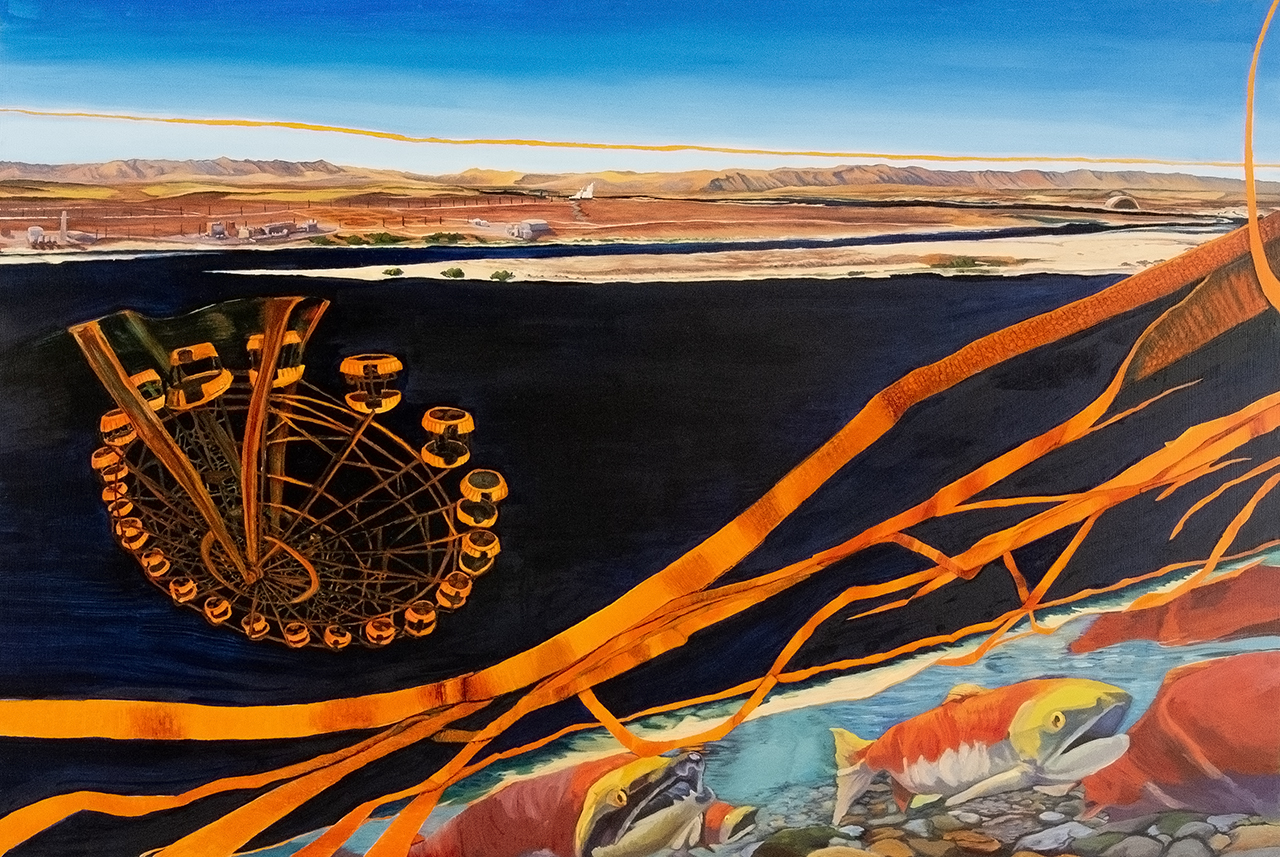
I Saw a Wheel, oil on panel, 28″ x 42″, 2025.
I Saw a Wheel
Since 2013, I have been exploring inaccessible mining and power production sites using Google Earth to explore hidden landscapes virtually. These digital excursions provide source images for an ongoing and ever-evolving series of metaphorical landscape paintings that reveal the layered histories of toxic relationships between industry, culture, and local ecologies. In I Saw a Wheel the Pripyat Ferris wheel plummets into the Columbia River near the Hanford Nuclear Reservation.
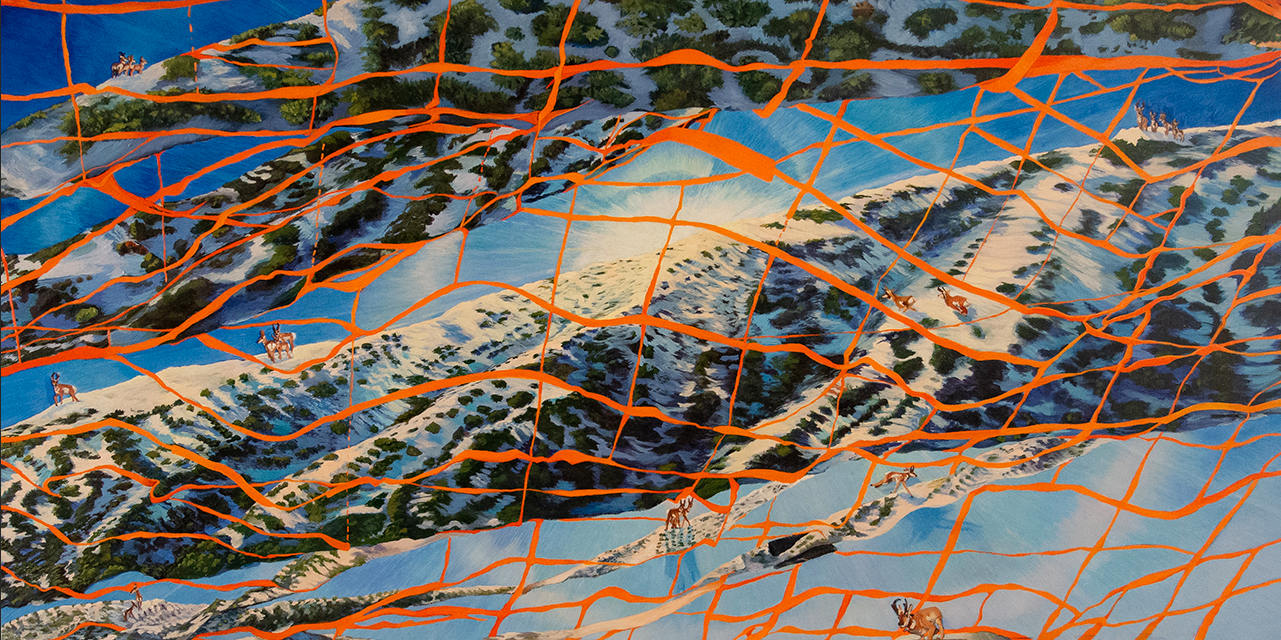
Entangled in the Web of the Floating World, oil on panel, 24″ x 48″, 2025.
Entangled in the Web of the Floating World
My fascination with maps as representations of the landscape led me to Jorge Borges’ parable, “On Exactitude in Science,” a chronicle of the creation of a 1:1 map of the world that became a separate and distinct reality. The story prompted me to recontextualize the internet, Google Earth in particular. Current technologies, including artificial intelligence and efforts to colonize Mars, manifest humankind’s excessive drive to advance knowledge, achieve power, gain wealth, and construct irrational and self-serving real and virtual monuments that attest to the merciless human indifference of these pursuits. The real world is being marginalized and treated inhumanely because reality, like Borges’ map, is “Unconscionable,” unwieldy, obsolete, and out of fashion.
Beth Fein Berkeley, California
-
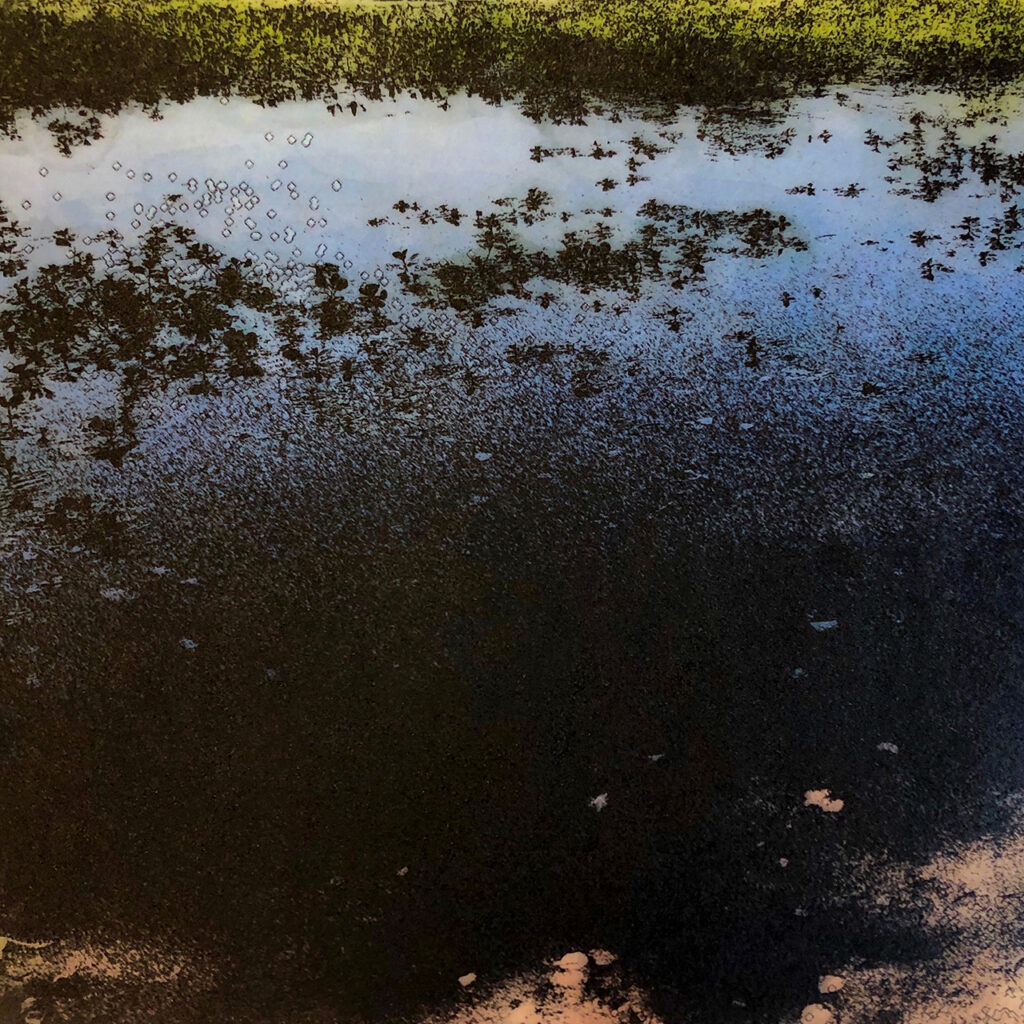
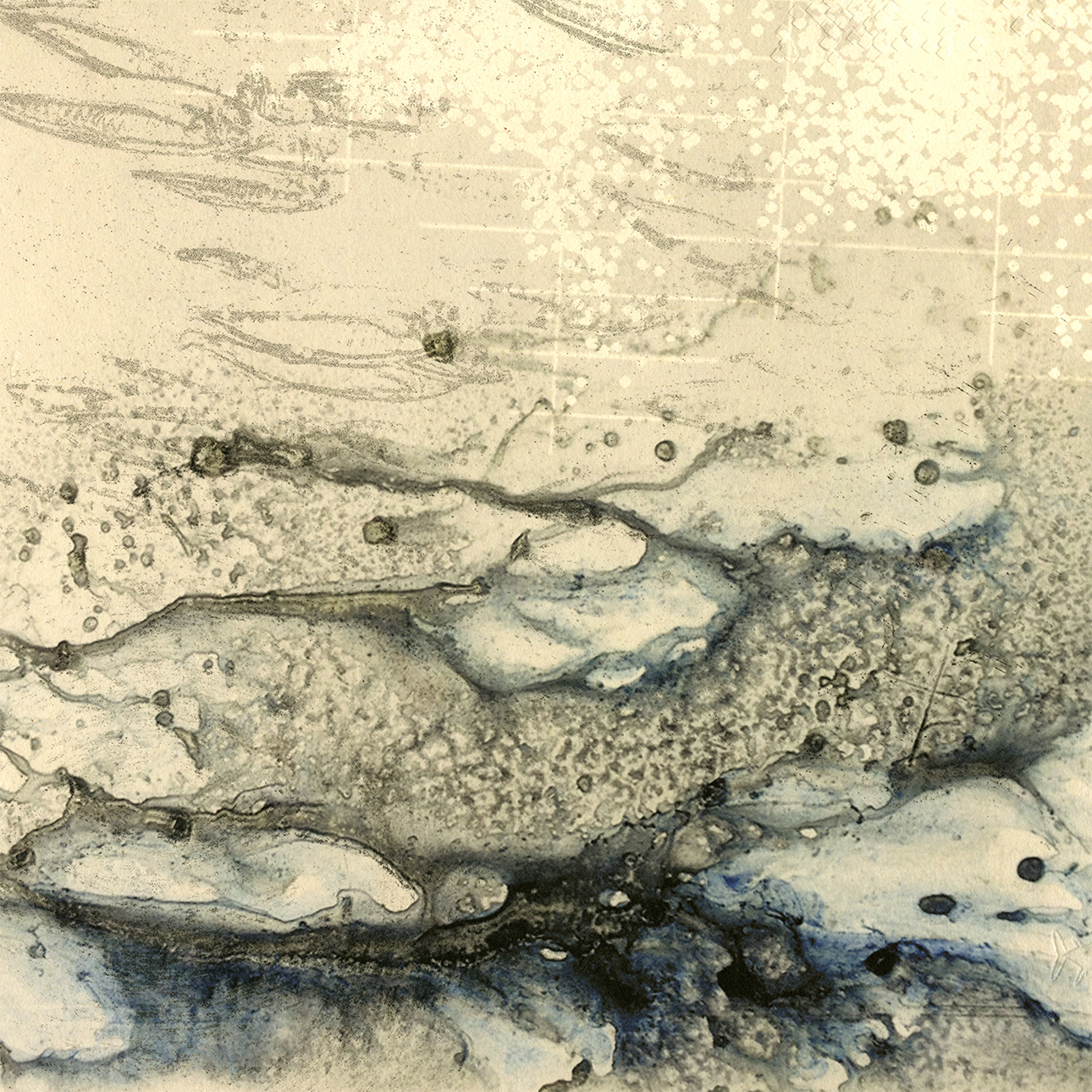
- Reclamation #7, photo etching with kozo chine collé and blind emboss relief print, 28″ x 25″, Sonoma County, 2020.
-
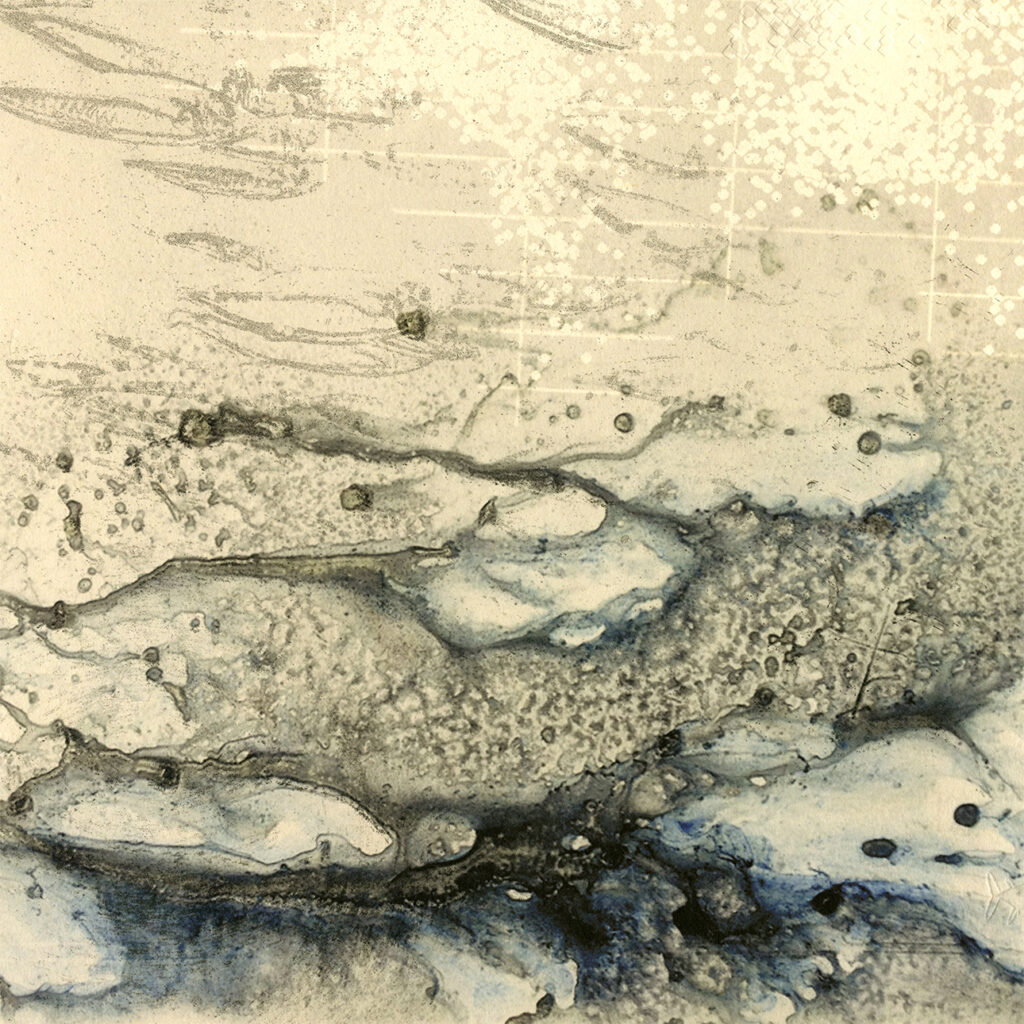
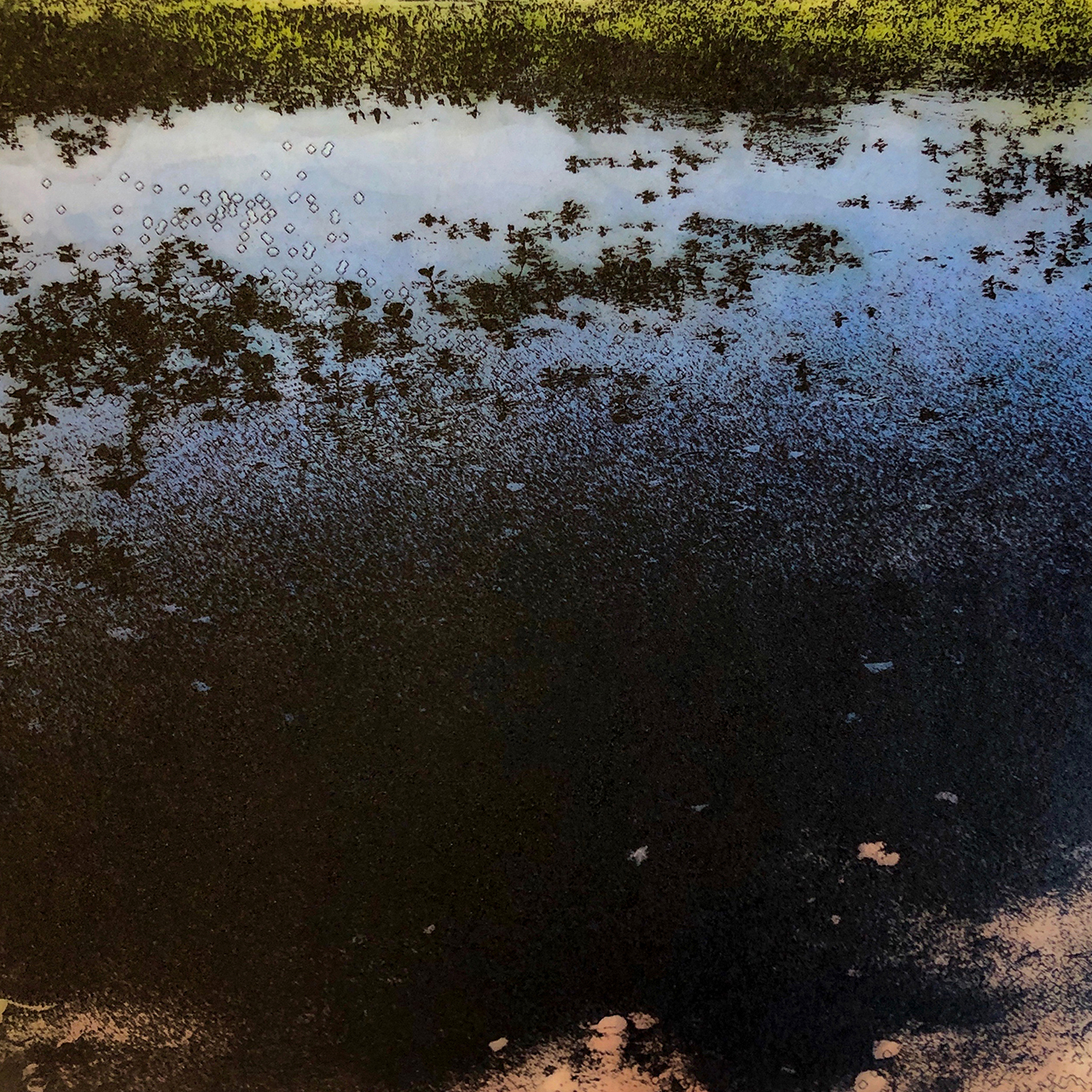
- Reclamation #1 (abstraction of the steel head trout), photo etching with kozo chine collé & blind emboss relief print, 28″ x 25″, 2018.
Reclamation Prints
These photo etchings reference both extraction and water reclamation, integrating art and science. This series of artworks emphasizes the importance and future of water in the overall context of our environment and global warming. Climate change, growing population, and overuse are making water shortages occur more frequently. Clean, reclaimed water that is put back into streams and aquifers will help mitigate the competition for water and preserve the natural environment needed by both humans and wildlife. These works were inspired by a California central coast power company’s water project that was specifically designed to introduce reused clean water (previously extracted groundwater) into a specific stream, so that steelhead trout could continue to spawn. These deconstructed photos are re-imagined as photo etchings with blind emboss that include abstracted scientific data used in actual water reclamation projects.
My art practice embraces chance and choice as essential elements of my process. Moving from conceptual to material, my ideas evolve from my inner emotional climate, allowing my intentions to be deeply embedded in my work. It is important that my art has its own presence without words or explanation. I work from an inner embodied awareness, allowing my changing consciousness to speak through my art. My art practice reflects my sense of the impermanence of existence, while seeking to locate myself within the chaos of our contemporary world. Ephemeral elements filter into my art, magnifying the unpredictability of time and outside forces that permeate the essence of my artistic intent.
Maru García Los Angeles and Venice, California
-
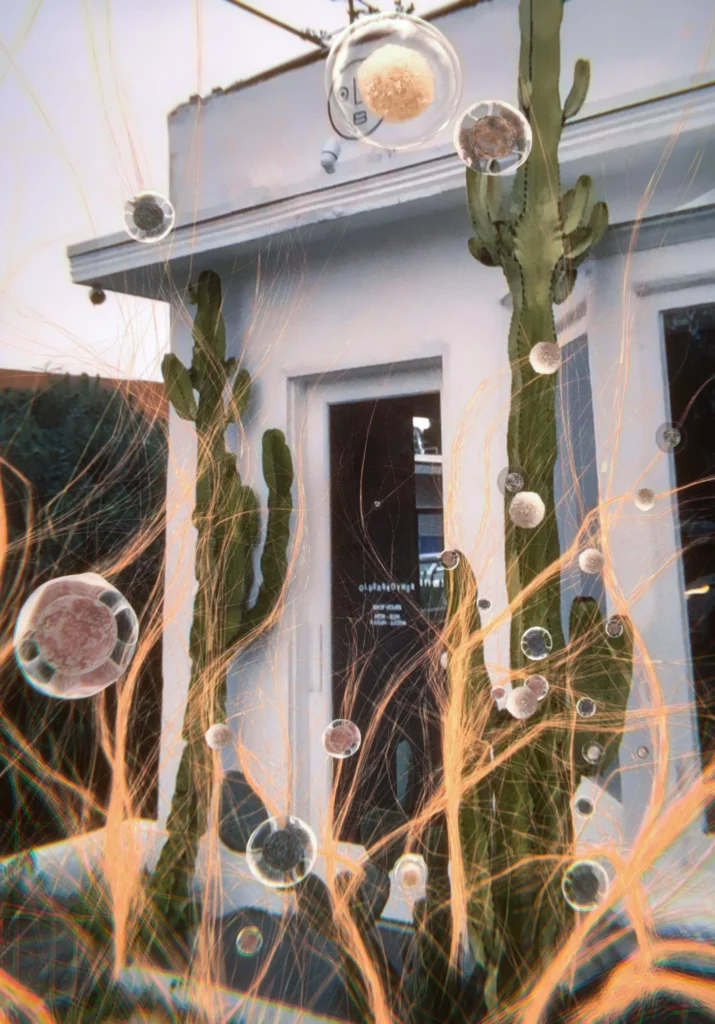
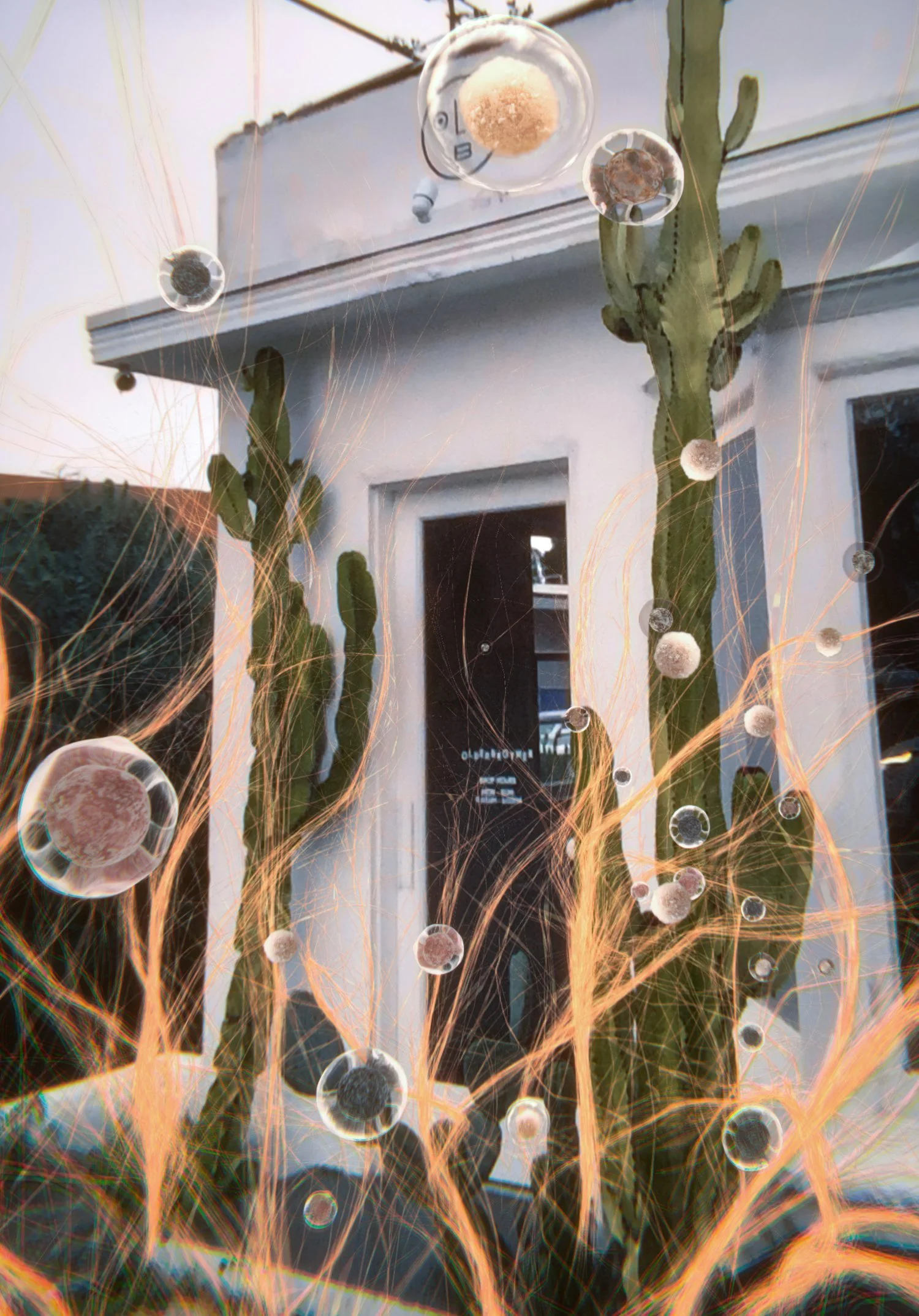
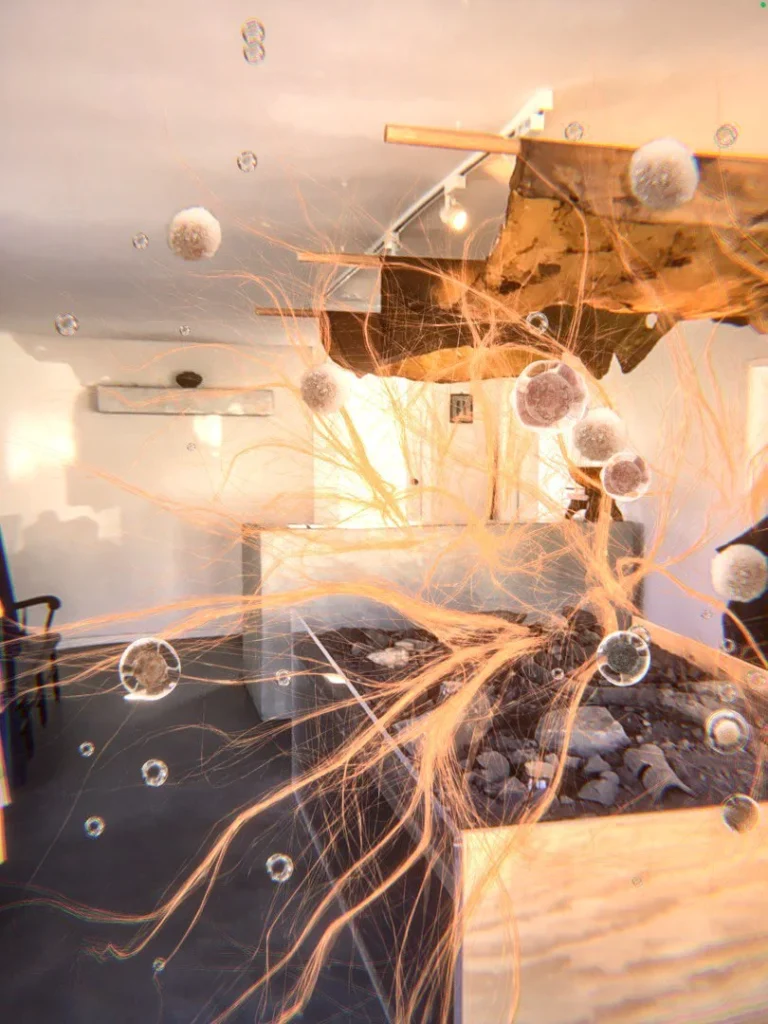
- Fermented Reality (view from outside ), installation and augmented reality app, Olderbrother Flagship Store, 2023.
-
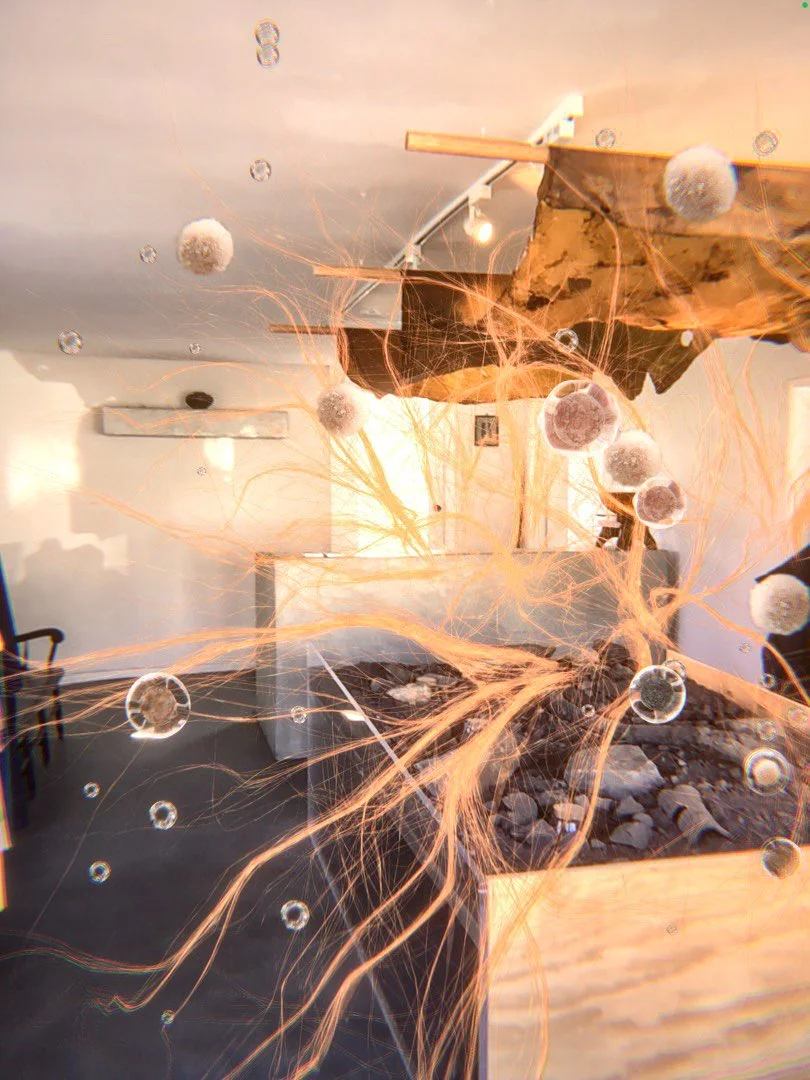
- Installation view.
Fermented Reality
Fermented Reality is an installation that allows one to experience the environment through the lens of the microscopic organisms that surround us—both inside and out.
The piece brings the bubbling process of fermentation to the center. A reality that is not available to human eyes unless we use magnifying instruments or learn to identify their presence by their resulting products. Different cultures have learned through time to cohabitate and develop relationships with microbes, experiencing their environments through fermentation. During fermentation, organisms orchestrate a symphony of chemical reactions that lead to common products like bread, wine, beer, vinegar, cheese, yogurt, pickles, kombucha, and more. This work also speaks about a reality that is in constant change, where collaboration between diverse organisms brings cultures to develop new flavors, new environments, and new worlds.
The fermentation process demonstrates how microbes are collaborators that can provide sustainable solutions, from the creation of food to plastic alternatives and soil amendment (Bokashi composting).
Parallel to the installation, we created the Fermented Reality App. We invite you to explore your surroundings through the app and see the world through fermentation on your own iOS device here.
Fermented Reality is a collaboration between Joteva Studio, Maru García, and Olderbrother with sound design by Kati Milano.
Tanja Geis Oakland and San Francisco, California
-
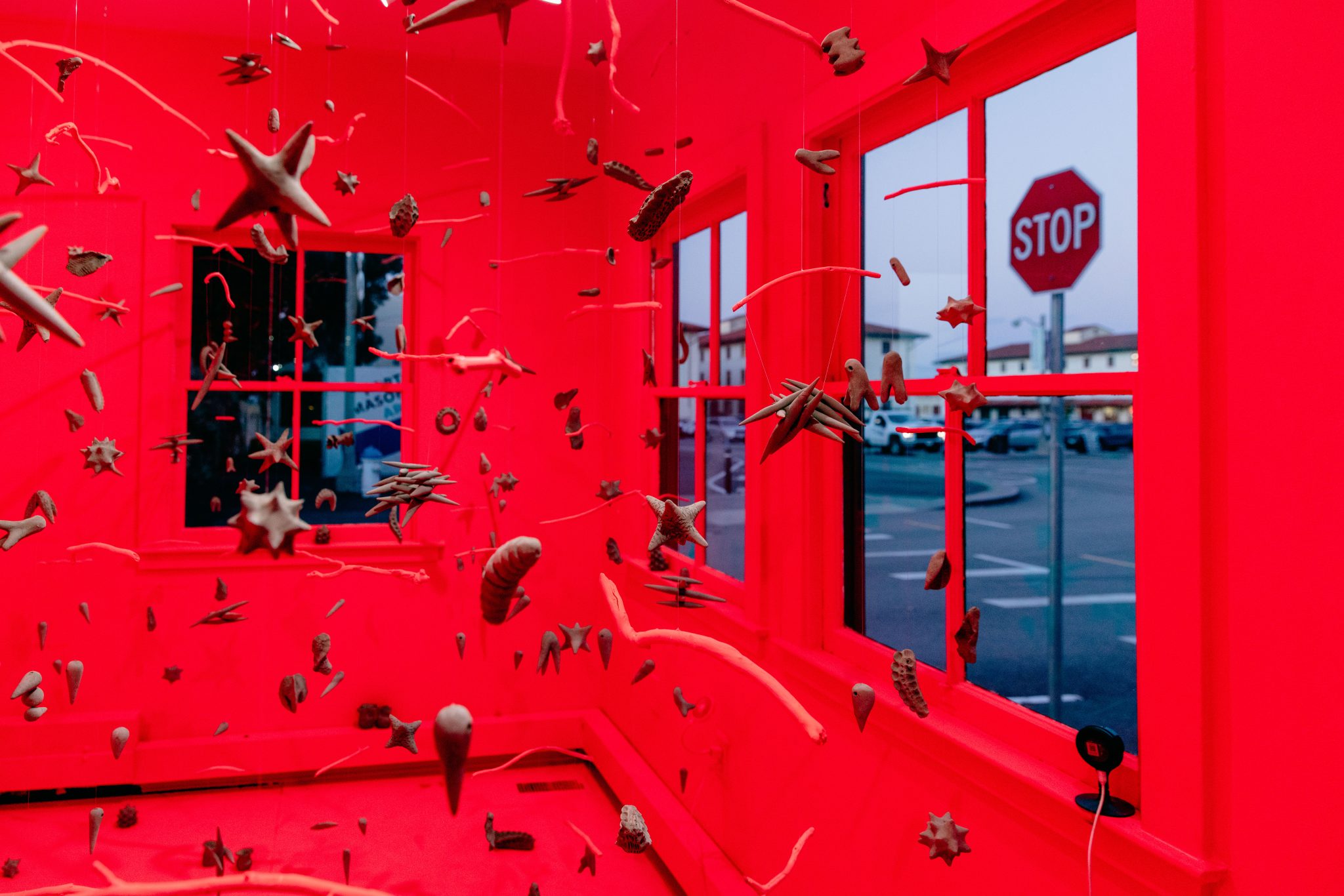
- Mud Will Remember Us (installation view), San Francisco Bay mud, fishing line, driftwood, oil paint, acrylic paint, and metal, 110″ x 96″ x 180″, The Guardhouse, Fort Mason Center for Arts and Culture, 2023.
-
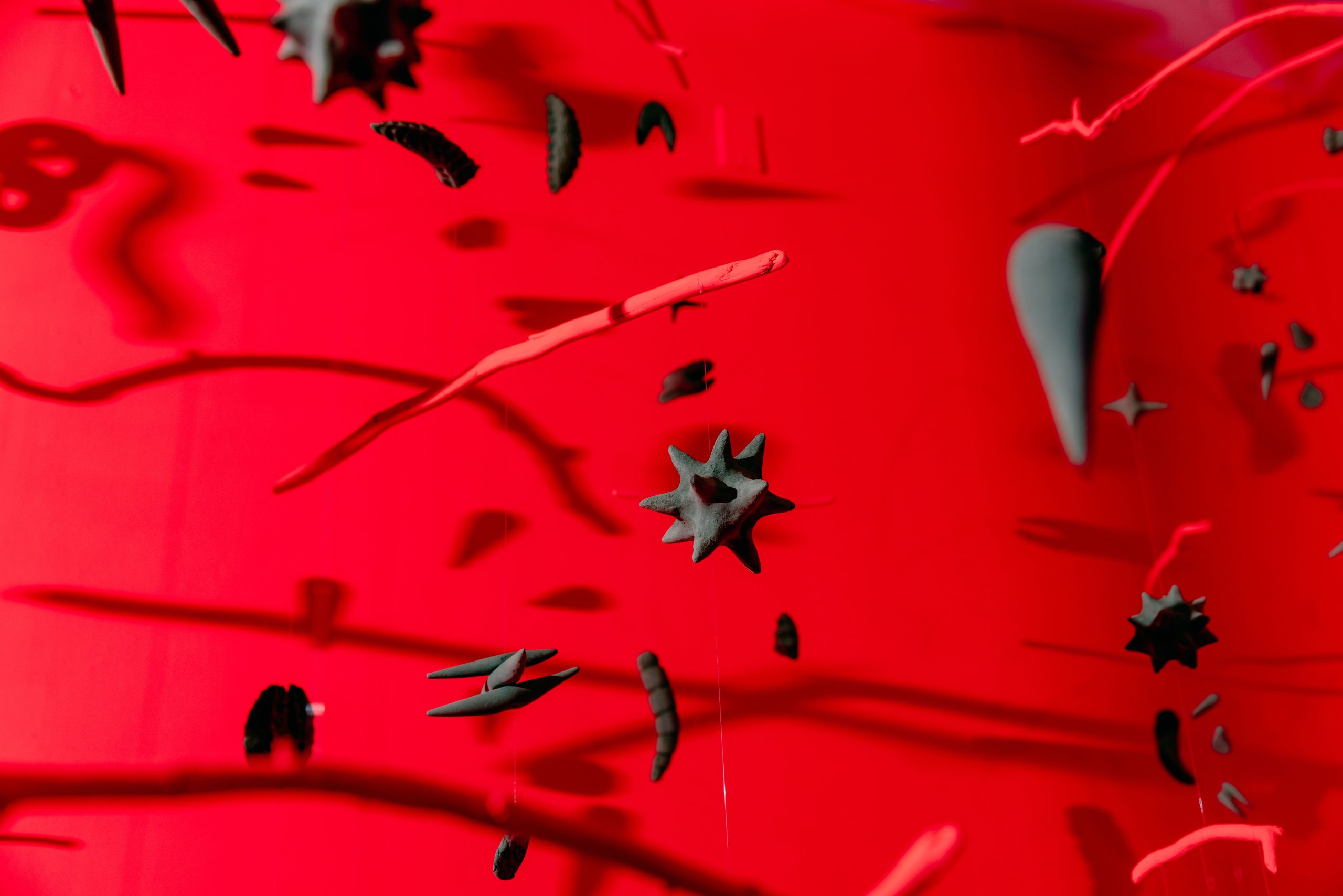
- Detail view. Photos by Andria Lo
Mud Will Remember Us
Mud Will Remember Us proposes a speculative future in which a submerged former military guard station is home to new marine life forms adapted to and thriving amidst polluted, warming, acidifying, and rising oceans.
To create this installation, foraged local San Francisco Bay mud—containing byproducts of human activity such as plastics, heavy metals, and chemicals—was hand-formed into hundreds of sculptures suggesting simple-bodied organisms in evolutionary transformation. These objects were incorporated into a swarm of mobiles set against fluorescent red walls, playfully beckoning us to imagine this site beyond human memory.
Alisa Gorshenina Nizhny Tagil, Sverdlovsk Oblast, Russia

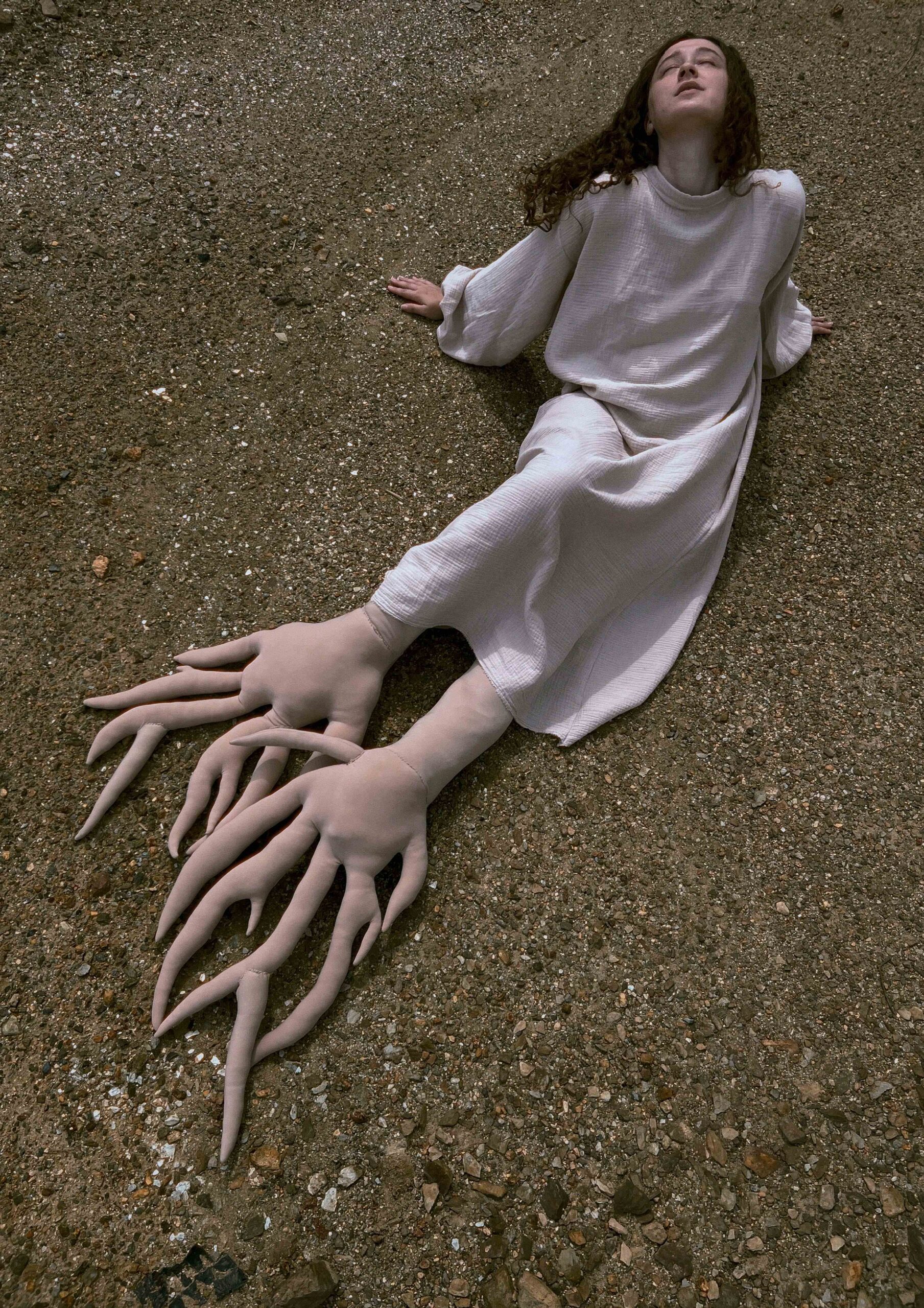
A body that does not belong to me, 2023. Photo by Sergei Vlasov
A body that does not belong to me
I often feel like my body doesn’t belong to me. He has his own life that he has to adapt to. The body has power over the mind, a body that has partially separated some forms from itself, while forcing me to carry them on myself. There is a theme of formlessness and metamorphosis. Sometimes I look in the mirror and don’t understand if this is my body at all, or if someone replaced it at night, and now I’m walking around with someone else’s. Through this possibly banal image of a “womb suit,” I wanted to convey the feeling when you yourself feel like one huge uterus, since you place great emphasis on the sensations inside it. Or people see you not as a person, but as a walking reproductive system. So, for example, now the state of my country is looking at me. It stretches its sticky hands into my personal space, shamelessly intrudes, and touches where I would not like. It reminds me of how man exploits nature.
The Gardener, 2023. Photo by Sergei Vlasov
The Gardener
In this project, I try on different images. Here I am, an artist/gardener who grows her heart in the garden, makes a plantation of her tears in a greenhouse, and turns herself into a weed, a cultivated plant, or a tree that was pulled out of the ground. Each photo is a separate story of interaction with nature and myself, my worldview, my emotions. I literally germinate my states, dress them in plant forms. Sometimes, I myself become part of the plant world. The relationship with the place where I live is a very important part of my art. All the photos from the project were created in the Urals, in my husband’s grandmother’s garden, where I spend a lot of time. Every blade of grass in this garden knows me. Here I work, relax, eat fresh vegetables and berries, and help grow flowers. Whenever I have such love for space, I want to consolidate it with art. Through my work, I have a dialogue with the world, not only with people, but also with the places that surround me. My garden has absorbed many tears, laughter, grief, and joy; it is a place to which I have given many of my feelings and will give many more.
Laura Green San Diego, California

Late Summer, acrylic paint, 12″ x 12″, 2025.
Late Summer
A vibrant, expressive scene with abstracted figures in a stylized landscape. A mountain rises against a pink sky, evoking the late summer day and the excitement of what they found.
My work explores the relationship between people and the natural, and it’s not a direct representation of the natural world or childhood, but instead an emotional landscape shaped by memory and a sense of nostalgia for what is rapidly disappearing. Through these constructed scenes, I want to showcase the beauty of wildlife and the wonder children find in nature, while also questioning the meaning of these experiences in an increasingly artificial world. The purpose of my artistic practice is to invite viewers to question how we experience nature— nature can inspire us, especially for children, and children need experiences outdoors to learn about where they live and their role in the ecosystem. I see childhood as a time of exploration, and I use that lens to examine how we construct meaning from our encounters with the environment.
I begin by photographing my real experiences and then use digital tools to compose dynamic scenes in my studio. By arranging shapes and colors with expressive brushstrokes, I aim to capture the motion and the fleeting moment with the thrill of interacting with the wilderness. My impressionistic approach prioritizes emotion and movement over detail, and echoes the fragile, vanishing environments that surround us. For me, painting is an act of reassurance in uncertain times—a way to navigate the tension of an uncertain future and the desire for genuine connection. Ultimately, my art practice is rooted in a personal struggle: to remain meaningfully connected to the natural world.
Stacy Levy Spring Mills, Pennsylvania, and Santa Fe, New Mexico
-
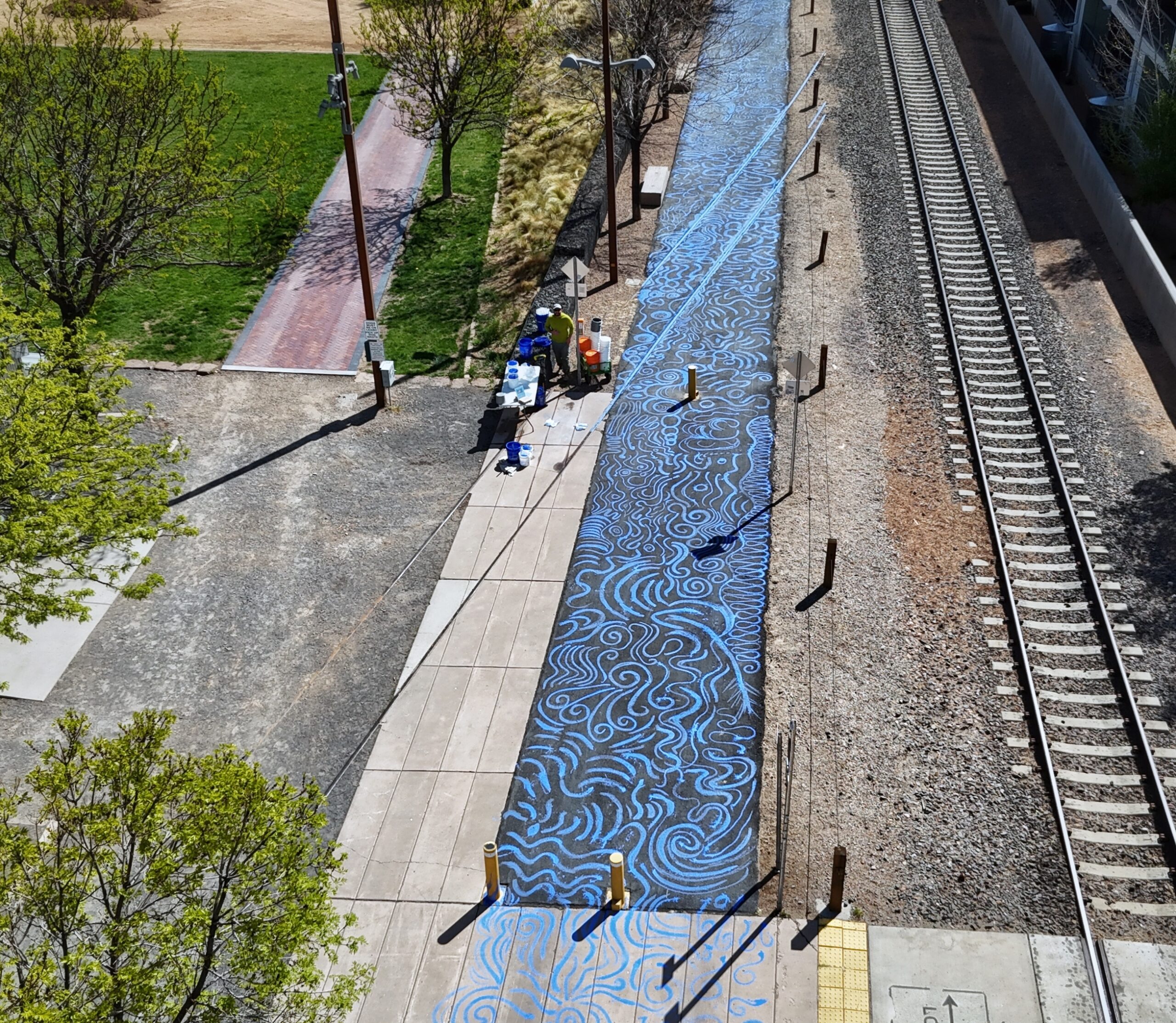
- Missing Waters, surveyors’ chalk (calcium carbonate) and water, Santa Fe, New Mexico, 2025.
-
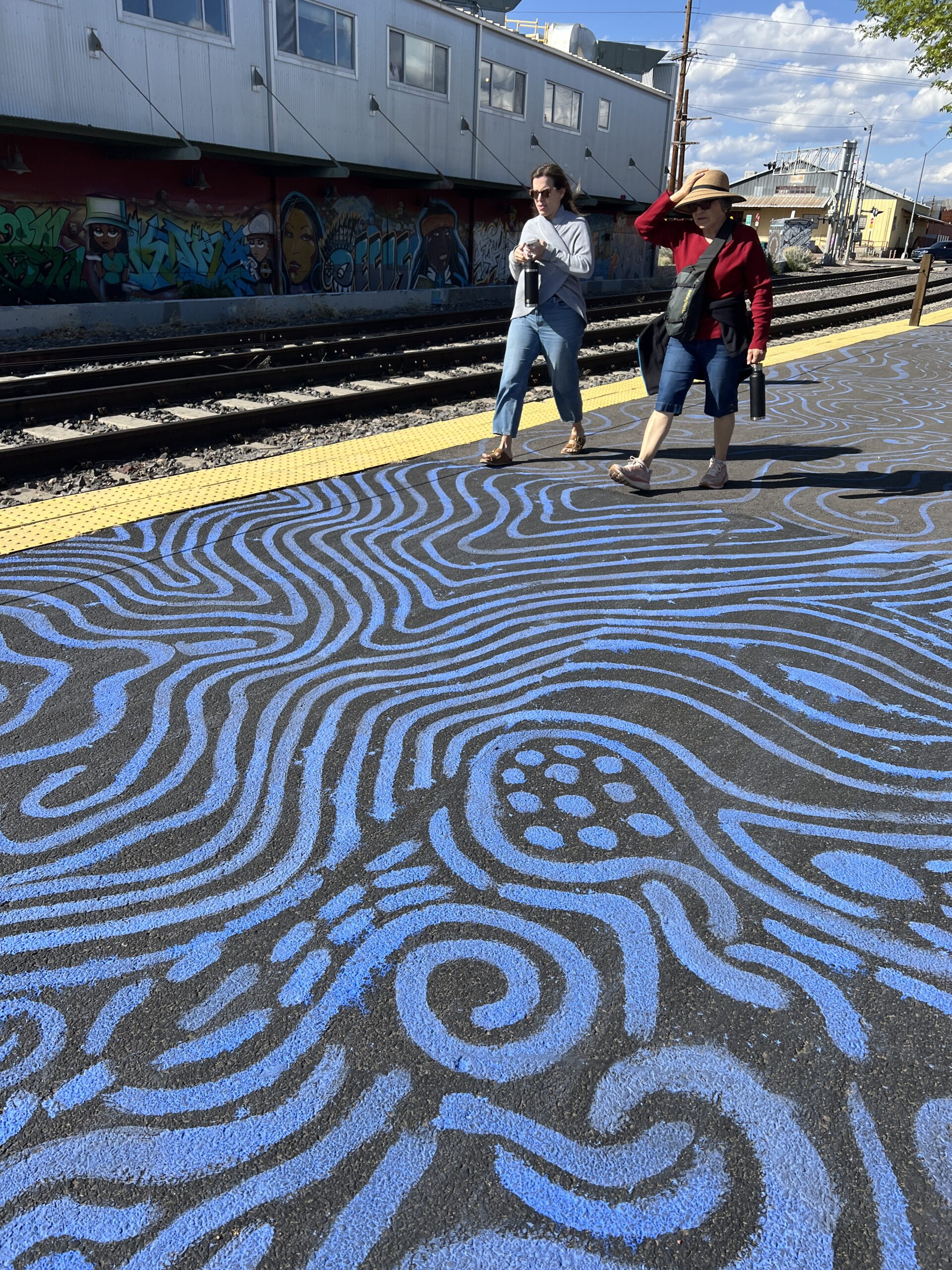
- Detail view
Missing Waters
The Railyard Park Conservancy and ecoartspace invited site-based water artist Stacy Levy to create a Missing Waters project along the length of a pathway in the Railyard Park in Santa Fe, working with students attending the New Mexico High School for the Arts and volunteers, some of whom joined as they walked past the project. Everyone made marks informed by the patterns of hydrology, to conjure the waters that once flowed freely in the landscape before it was paved over and developed for human-based uses like buildings, rail yards, and parking lots.
It was not always so dry in this high desert town. Over forty acequias once flowed through the land that is now Santa Fe. Now there are only four irrigation streams in the city. It is important to conjure these missing waterways to get in touch with Santa Fe’s more watery past. Stacy Levy has been working to tell the story of ghost waterways—at full scale and on the very sites where the waters had actually flowed. She has orchestrated these maps, temporarily painted on the ground surface in Brooklyn, New York; Philadelphia, Pennsylvania; Akron, Ohio; and Charlotte, North Carolina. This was her first Missing Waters painting west of the Mississippi.
Patricia Miranda Port Chester, New York, and Breno, Italy
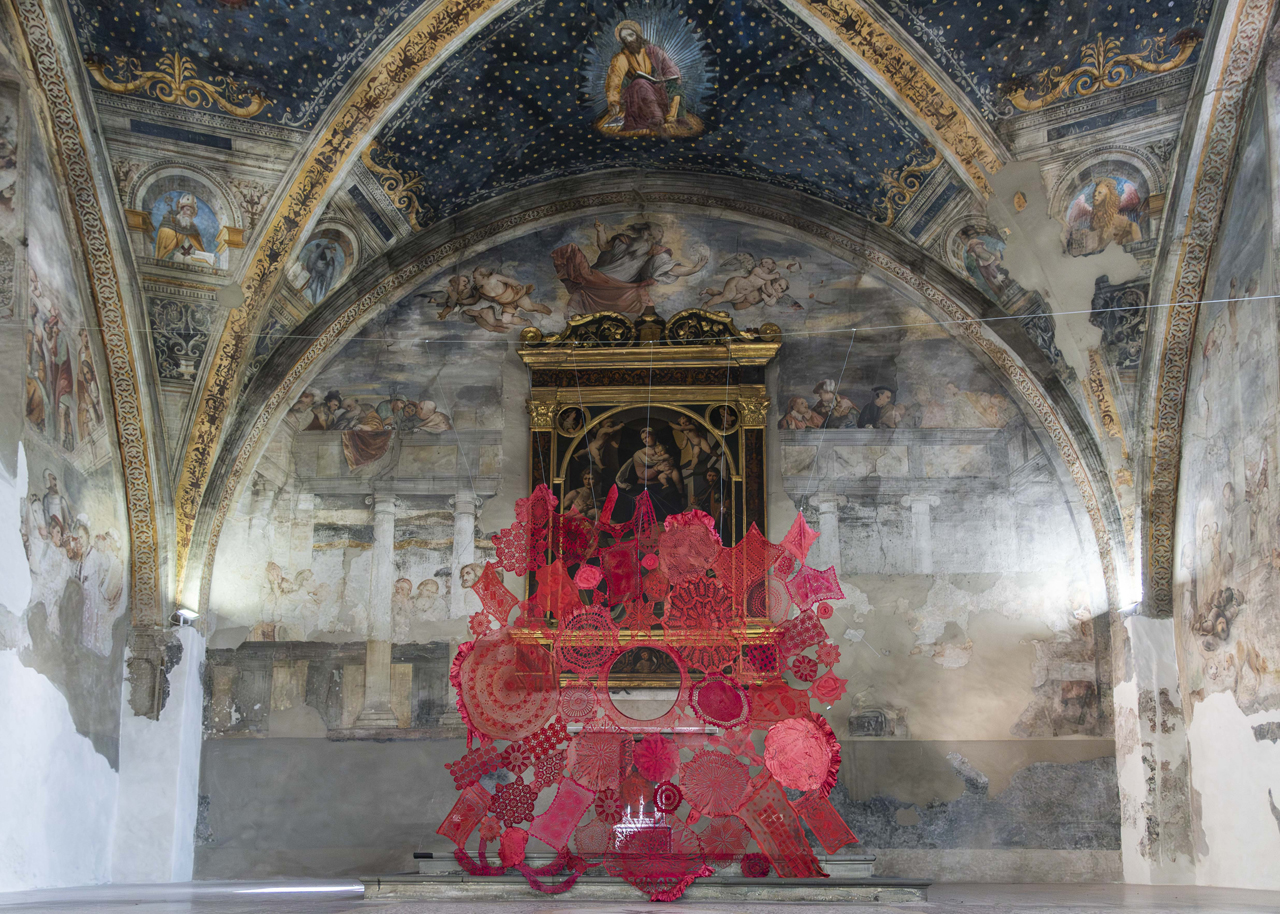
Supplica; A Pin that Pierced a Memory (suplica, una spilla che ha trafitto un ricordo), (installation view), donated vintage lace hand-dyed with cochineal insect dye, thread, wire, tacks, 135” x 135” (variable), Chiesa Sant’Antonio, hosted by Museo Camuno, 2025. Photo by Sabrina Zanardini
Suplica, A Pin that Pierced a Memory
Composed of donated vintage lace hand-dyed with cochineal, A Pin that Pierced a Memory forms a porous but insistent barrier between viewer and altar. Suspended in the sanctuary of Chiesa di Sant’Antonio, the work claims space once reserved for the sacred masculine, inserting a monument of son, feminine resistance, and collective memory.
Each piece of lace carries a story, donated, preserved, and transformed, stitched into a body that is both shelter and provocation. The crimson hues, drawn from the bodies of insects, evoke blood, labor, and sacrifice, marking the work as both devotional and defiant. At once tender and confrontational, the installation reframes the act of veneration through a feminist lens. It stands not in opposition to faith, but as an alternate offering, an invocation of care, matrilineal wisdom, and the quiet power of women’s hands made visible at the threshold of the sacred.
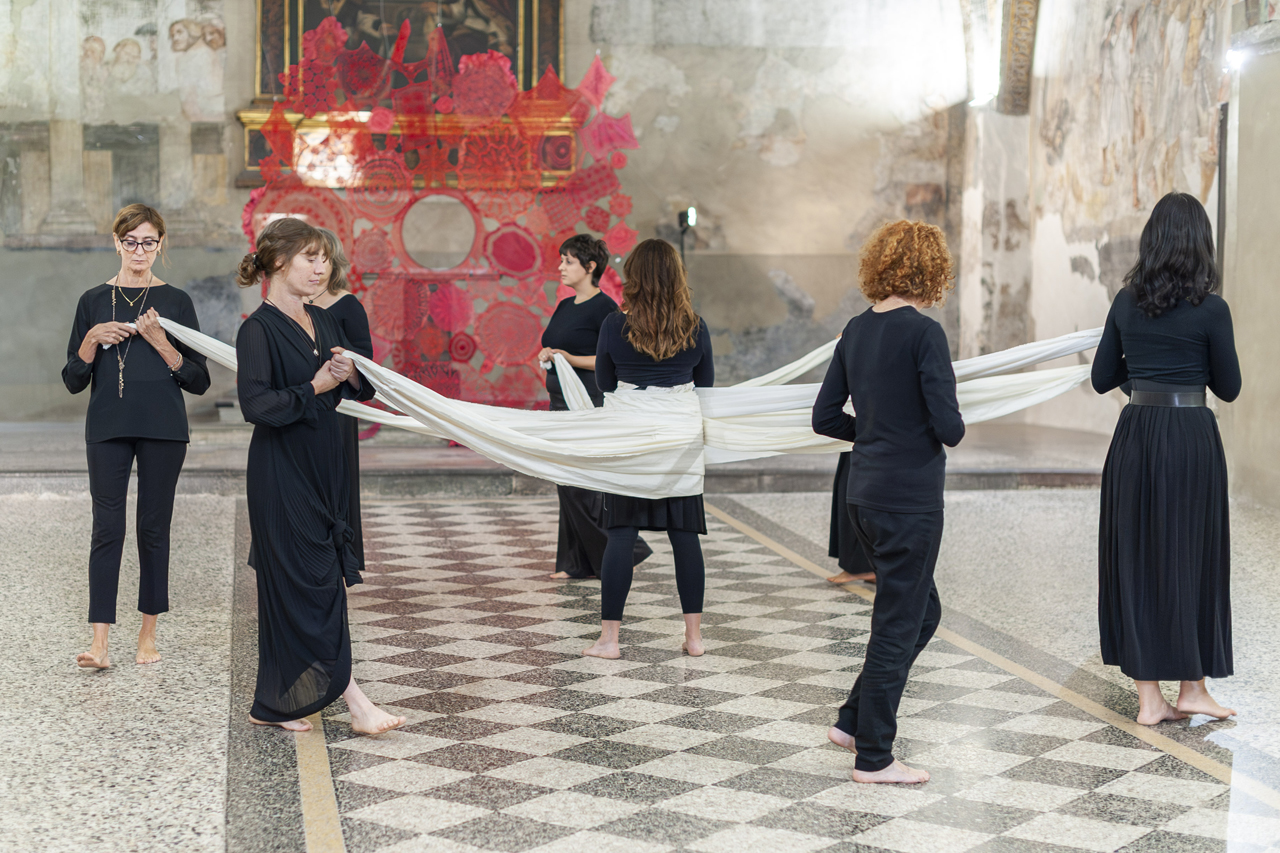
Legato al Respiro (Bound to the Breath), collaboration with Christopher Kaczmarek, live performance at Chiesa di Sant’Antonio, Museo Camuno, 2025.
Legato Al Respiro
Performed within the sanctuary of Chiesa di Sant’Antonio, Legato al Respiro unfolds as a slow, choreographed ritual. Nine women, eight encircling one, are connected by long strips of white cloth, extending from the center figure outward in radical formation. Through coordinated movement, the performers spiral inward and outward, bind and unbind, ribbons of textile tracing cycles of closeness and release. Their motion mirrors respiration, an inhale, an exhale, rendered as a collective and connected gesture.
An homage to Maria Lai’s Legarsi alla Montagna, the work carries forward her legacy of poetic binding, transforming it from geography to breath, from village to body. In this gesture of communal tethering, Legato al Respiro invokes intimacy, interdependence, and the power of slowness. The performance becomes both meditation and metaphor, an embodiment of strength manifested through the delicate ways we are held together.
Abby Spangel Perry Wilmington, North Carolina
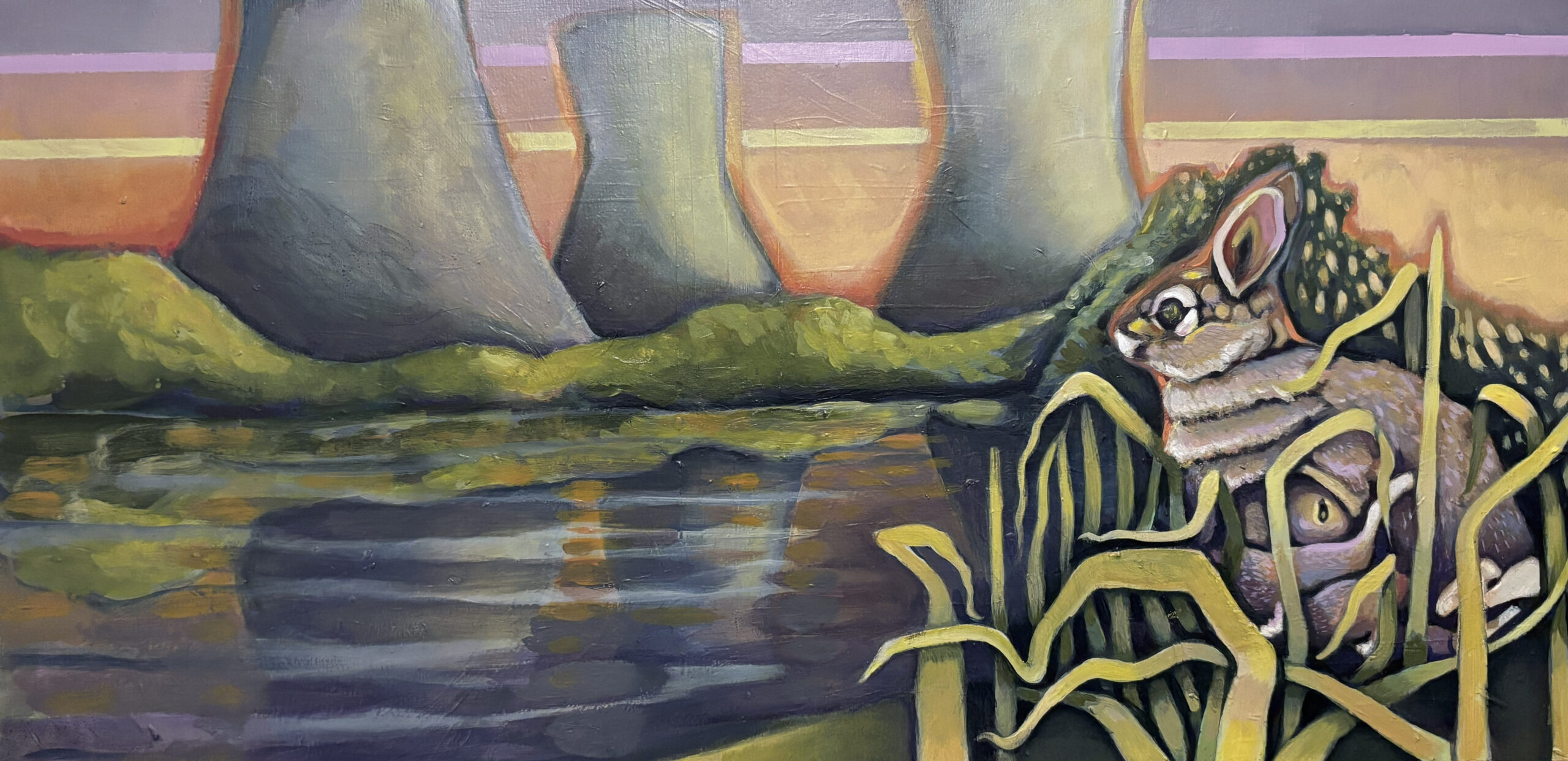
Mother’s Milk, acrylic on board, 12″ x 21″, 2025.
Mother’s Milk
In Mother’s Milk, a rabbit is nursing her young on the banks of the Susquehanna River under the shadow of the Three Mile Island nuclear power plant. Her act of nurturing is an act of survival in a landscape shaped by contamination and industrial risk and represents how bodies and environments are inseparably entangled through what is taken in and passed through them.

Turkey Tail, acrylic on board, 20″ x 24″, 2023.
Turkey Tail
Turkey Tail reflects the cycle of the mushroom, which thrives on what has fallen, transforming decay into renewal. Geometric shapes suggest human order, yet the mushrooms grow beyond it, following the quiet logic of nature. Their iridescence reminds us that decay is not an ending, but a redistribution of life, continually emerging from what came before.
Joanne Ross tri-state region of New York, New Jersey, and Pennsylvania
-
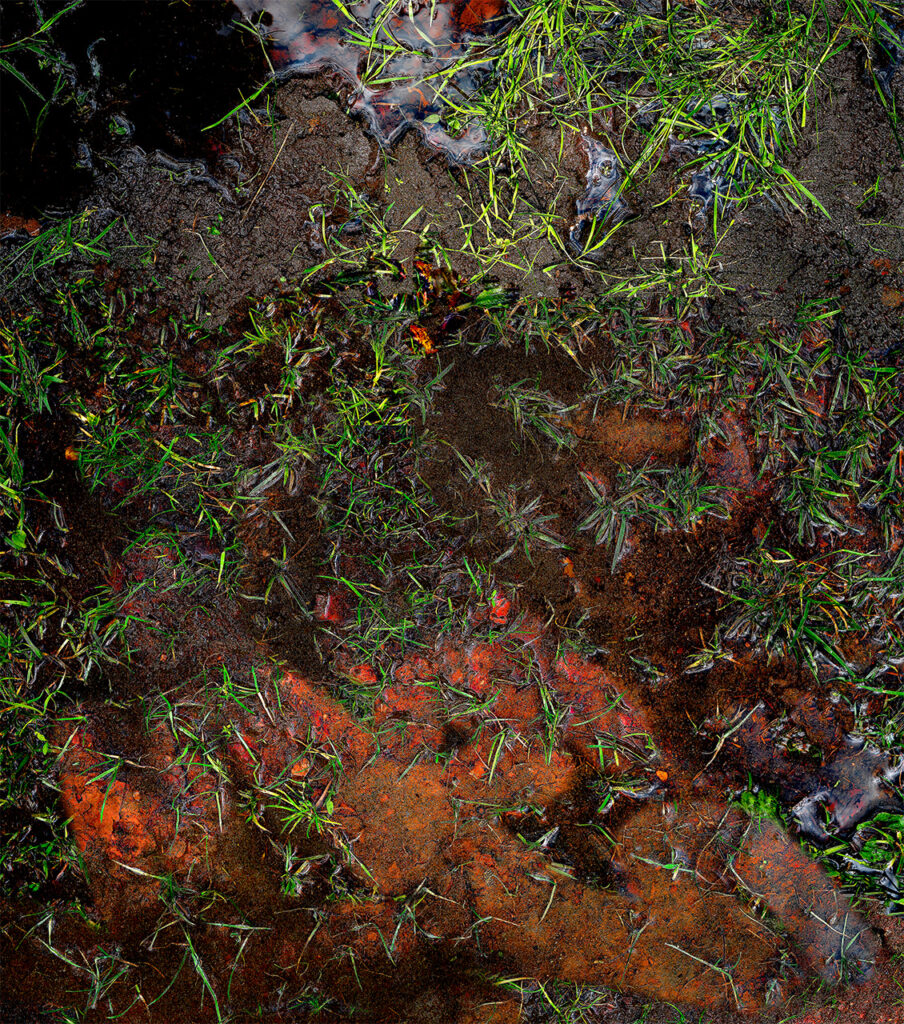
- Gihon River, Johnson, Vermont 7/3/25, 12:45 PM (from Dissonant Ground 2025– series), archival pigment print, 40″ x 50″, 2025.

-
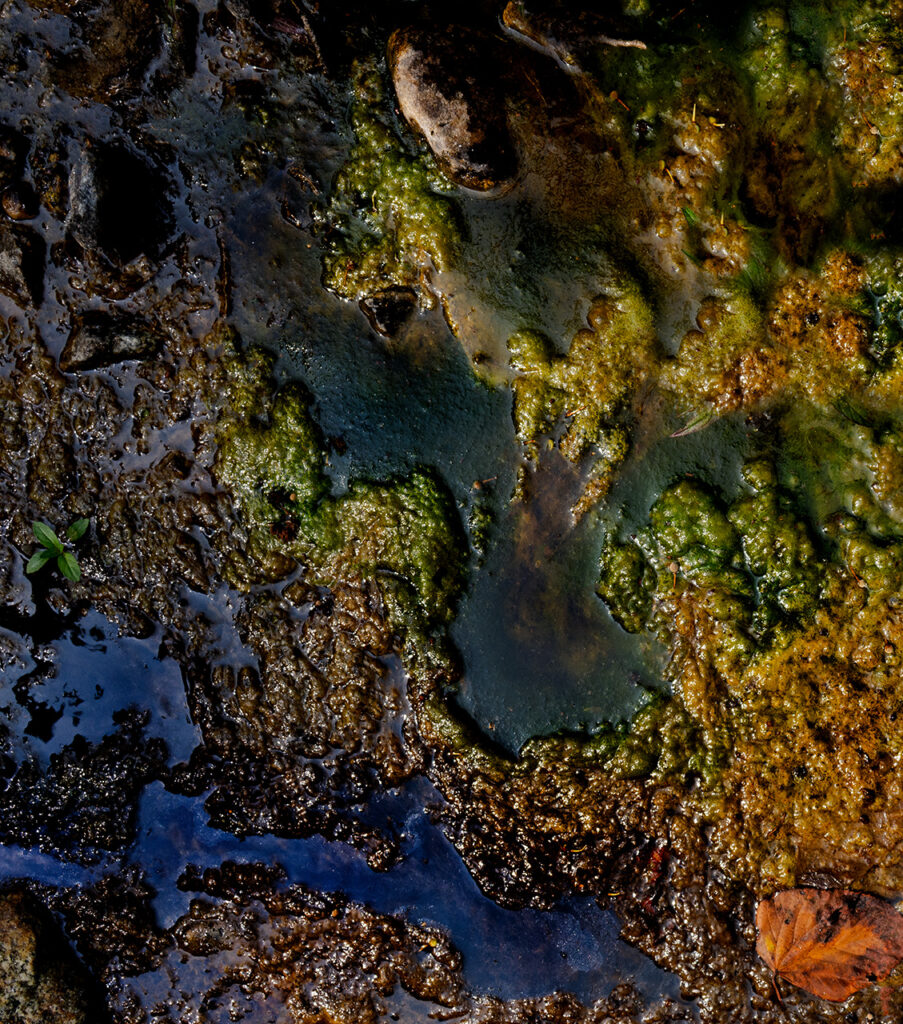
- South Peacham Brook, Peacham, Vermont, After the Flood 8/3/25, 2:31 PM (from Dissonant Ground 2025– series), archival pigment print, 40″ x 50″, 2025.
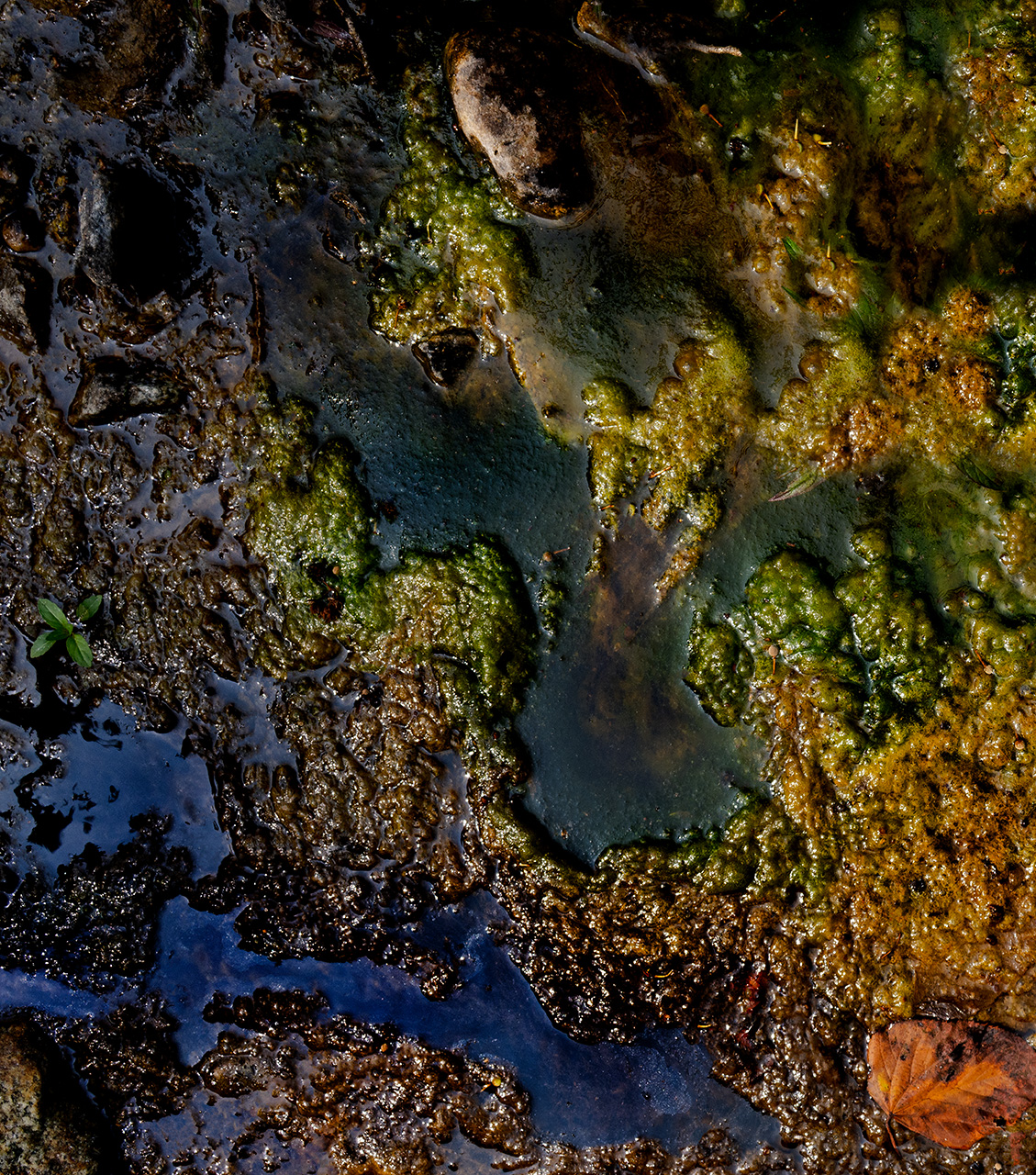
Dissonant Ground 2025
I am an artist based in the New York–New Jersey–Pennsylvania tri-state region. My photographs, installations, micro-stories, and artist books explore the unseen and often contradictory layers of social, cultural, and environmental issues. Recurring themes include climate change, memory, and the passage of time. My current work examines the effects of climate change on fragile riparian zones—ecological edges where land and river meet. Using the camera as an intuitive tool, I document site-specific environments to reveal their hidden significance.
This past summer, I participated in an artist residency at the Vermont Studio Center in Johnson, where I have long documented nearby rivers, especially in the aftermath of floods. Dissonant Ground (2025–) is a recent series from my riparian project, photographed along the Gihon River and South Peacham Brook in northern Vermont, using an aerial perspective. Dissonant Ground explores the tension between what we see and what we understand ecologically, revealing the uneasy relationships among plants, soil, water, floods, droughts, and industrial chemical waste. Although the unusual color shifts in these landscapes can evoke a sublime beauty, the surfaces are often contaminated, as water and debris reshape the shoreline.
Priscilla Stadler Queens, New York, New York
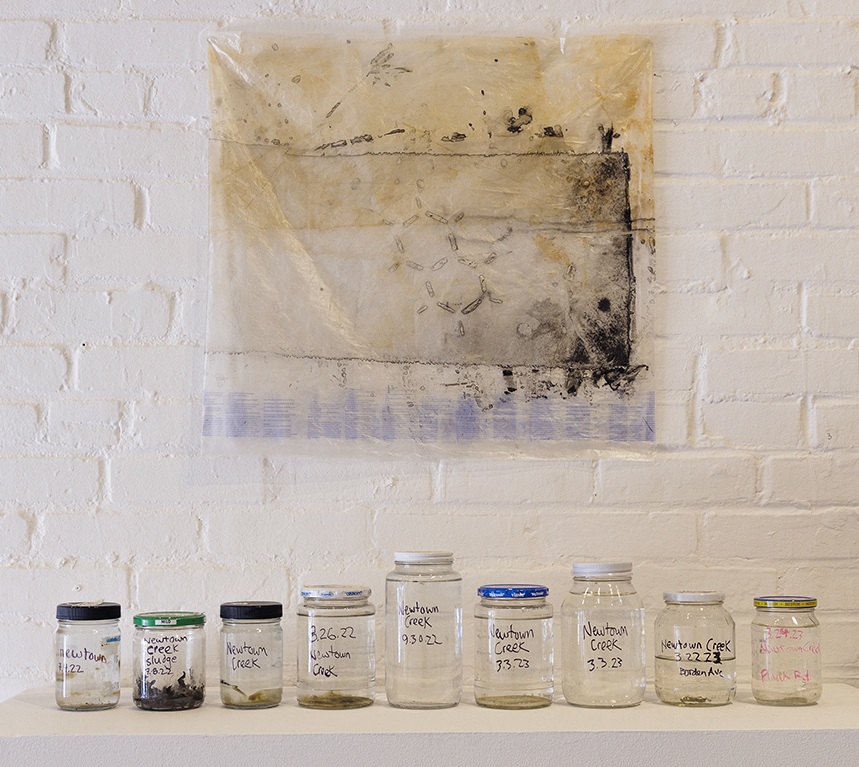
Samples (installation view on pedestal in this photo): dimensions variable, jars with creek water and sediment, 2023. Troubled Waters 14 (on wall): 16” x 22”, ink and pigment on plastic, 2023. At SLUDGE exhibition, Local Project Gallery, Queens, NYC, 2023.
New York City’s contaminated Newtown Creek is a body trying to heal. Since 2022, my SLUDGE project has focused on learning the science and history of the Creek while encouraging public advocacy for its cleanup. The term “body of water” resonates deeply, helping humans understand how spirit and science can permeate each other as bodies of knowledge. My studio and community practice include embroidering lab coats, creating public learning interactions, making ink from Creek soil, and hosting creek-related crafting events. To respond to this injured yet resilient water body, I weave together artmaking, research, pedagogy, and mysticism.
After nearly 200 years of toxic dumping from chemical and petroleum processes, this creek running between Queens and Brooklyn was designated a federal EPA “Superfund” cleanup site—a process requiring decades. Planning for equitable access and healthy ecosystems while addressing climate change and rising sea levels is key to the Creek’s future. An engaged community benefits from participating in these decisions, and art plays an essential role by encouraging residents, workers, and students to learn and potentially advocate for the Creek.
As a non-scientist using pseudo-scientific methods to explore weighty challenges, I take an irreverent, playful approach—gathering unofficial Creek water samples in unsterilized (but washed!) recycled food jars.
Troubled Waters, a SLUDGE subseries, uses creek water, imprints, and inks with chemical symbols alluding to contamination in the creek’s sediment, estimated at 15-25 feet deep. This unofficial record-keeping attempts to comprehend and communicate the desecration of a powerful resource by profit-driven industrial forces that valued it only as a toxic waste receptacle for almost 200 years.
Mikala Aragón Sterling San Francisco, California, and Bakersville, North Carolina
-
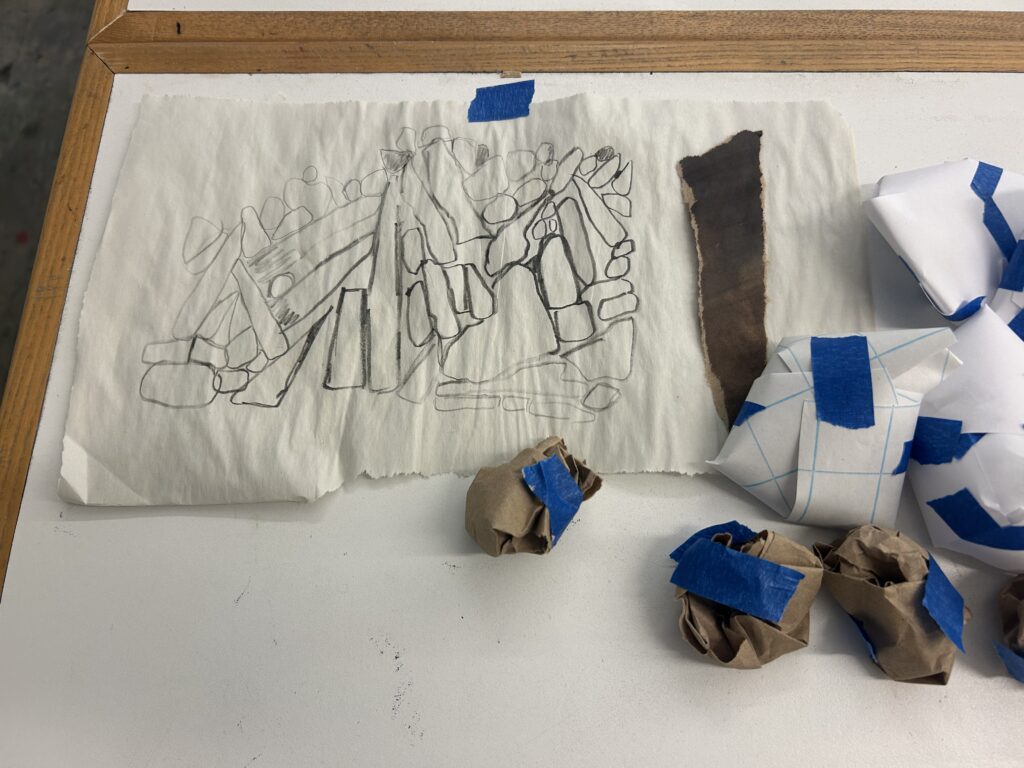
- Stone Project (research phase), charcoal and paper, Penland Winter Residency, 2025.
-
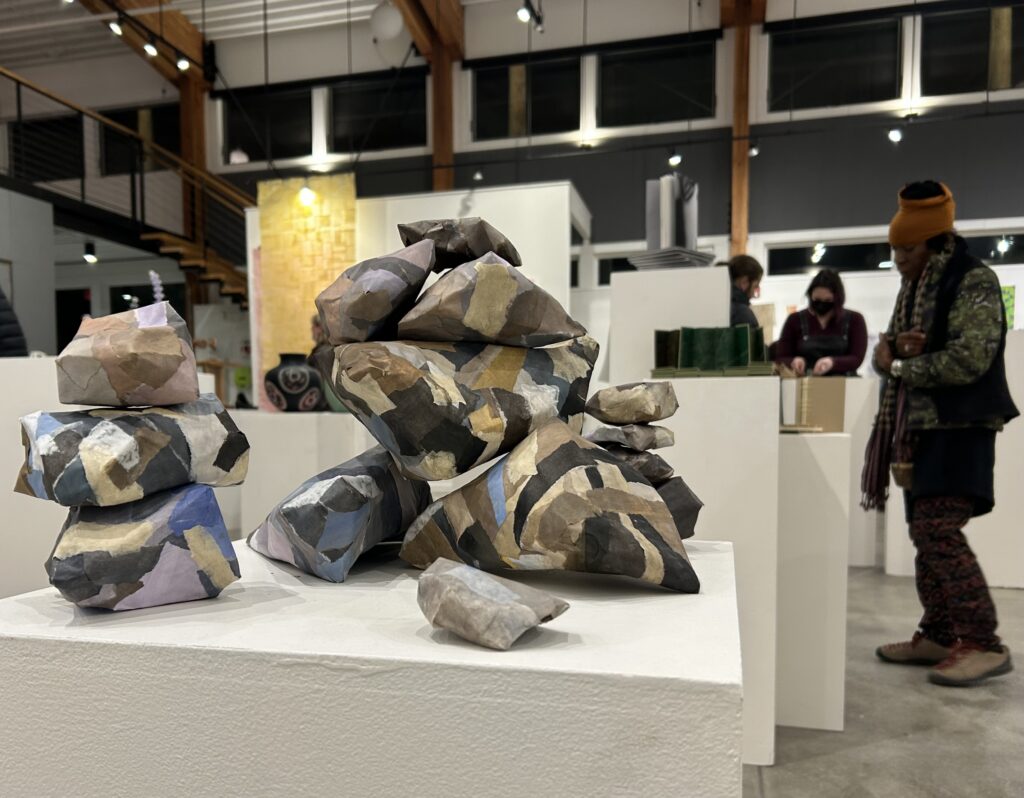
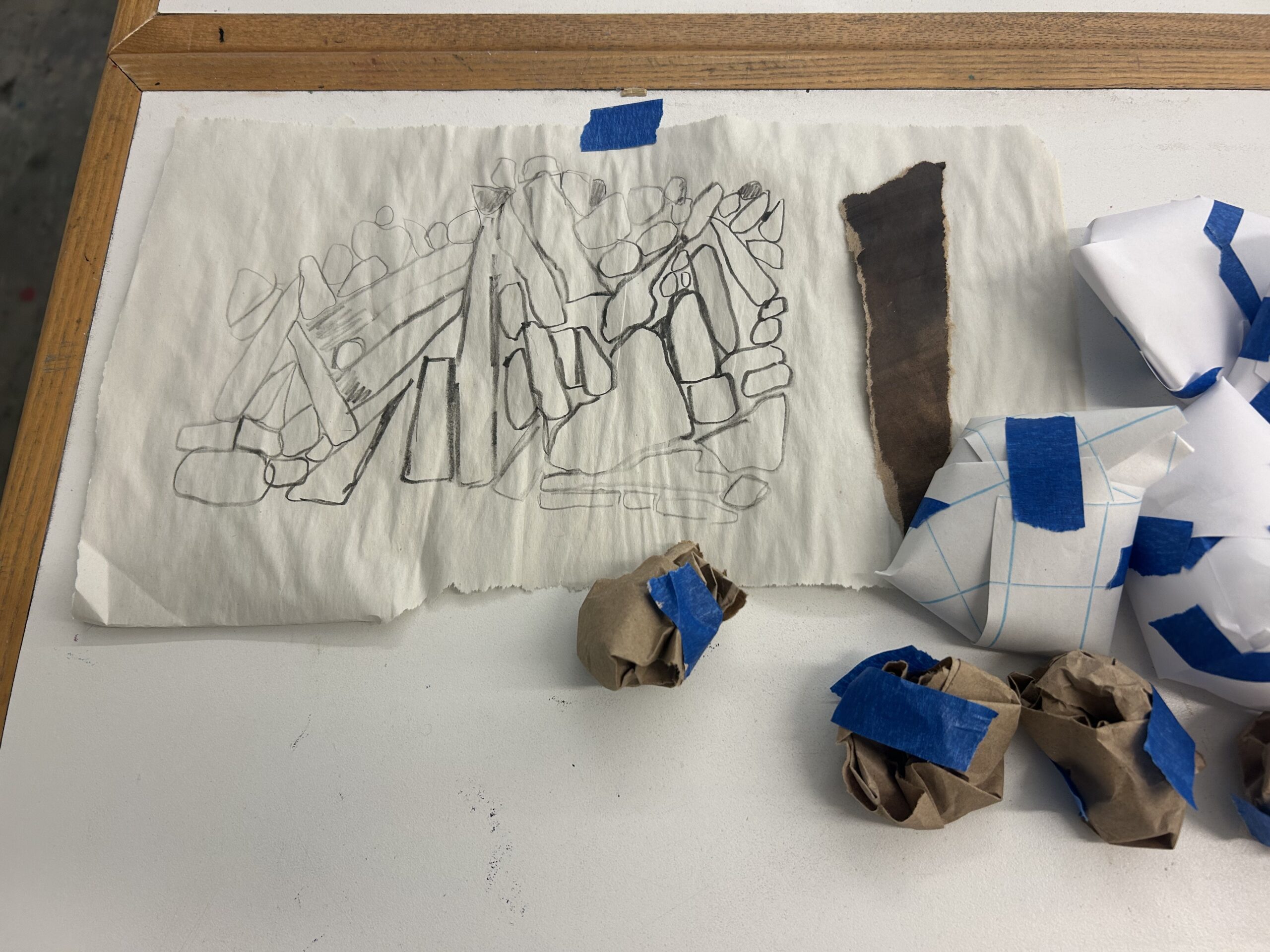
- Stone Project (installation view), gouache and paper mache, Winter Residency Showcase at Penland School of Craft, 2025.
Stone Project
My interdisciplinary art practice is land-based, with themes of stewardship and conservation. I spend time thinking about sustainable building practices that connect users with the natural world. The emphasis of my work revolves around ecology and land use, with larger goals of environmental sustainability. Dry stone masonry is my current practice. This involves building structures from site-sourced rock without mortar to construct walls and staircases. Primarily, this work is done to repair trail systems. My goal is to create long-lasting stone structures without causing distress to the local ecology, allowing visitors to experience the outdoors in a sustainable way. I am continually learning to combine my interests in environmental stewardship and visual arts as a means to develop a sense of place and to have a positive impact on my community.
I participated in a winter residency at Penland School of Craft in North Carolina in January 2025. This transitional time allowed for material studies of my field learnings from the previous trail season. My work from the winter session involved explorations of stone with paper. The idea was to create paper versions of rocks to experiment with builds I had not yet been able to complete in the field, such as improbable stacking and archways. I painted colored washes on a variety of paper types using palettes liberally inspired by stones. I used papier-mache to create structural, stone-like objects. The reassembling of the monochromatic washes created quilt-like patterns on the rocks. It was important that these creations resemble stone but not mimic it in entirety. I was further inspired by drawings in the book Listening to Stone by Dan Snow. I looked specifically to his depictions of rock walls on Inishmore, which are known for their simplicity and intentional lack of tightly packed mass. The geography of the area dictates the use of long, thin, geometric stone. The walls are assembled to maximize height to deflect wind but are porous to retain stability. The uniqueness of these shapes inspired the materiality present in my winter residency studies.
Cindee Travis Klement Houston, Texas
-
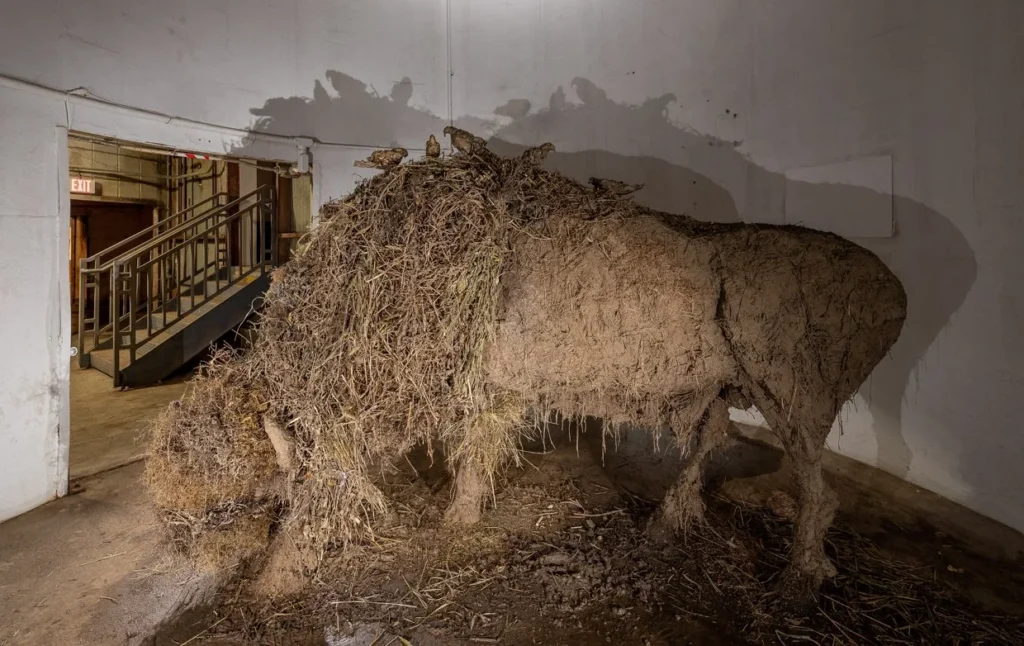
- Endangered Knowledge: The Soul of Humus (installation view), welded steel, lath, Indigenous soil, native dried plants, and bronze, 74” x 36” x 192”, Sculpture Month Houston’s Altamira, 2021.

-
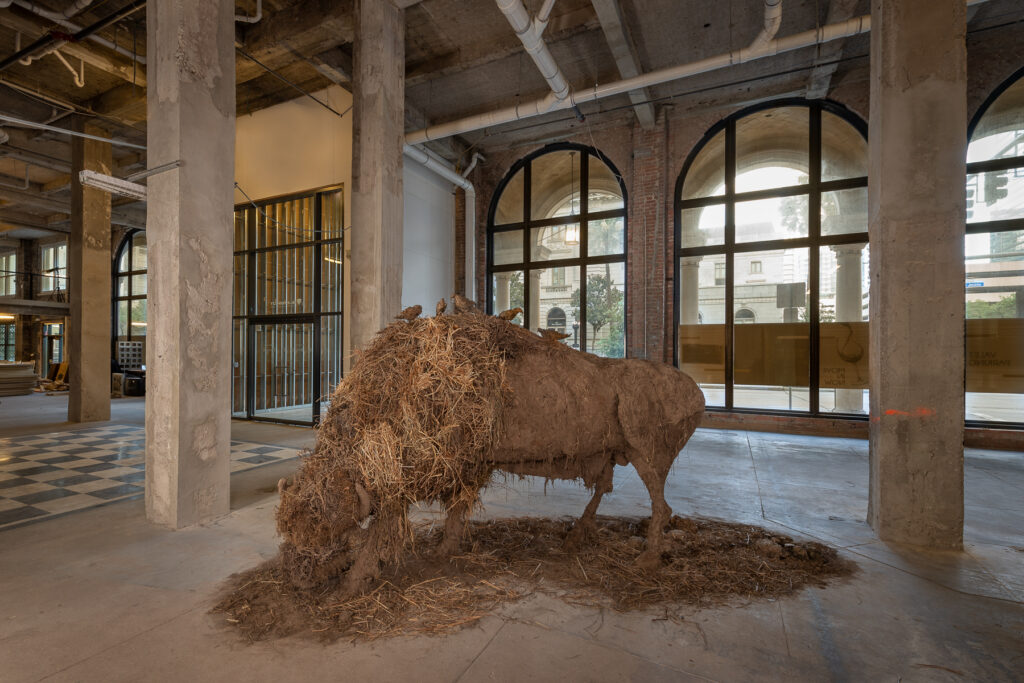
- Installation view at Houston Forever exhibit at The MAG, 2022. Photos by Nash Baker
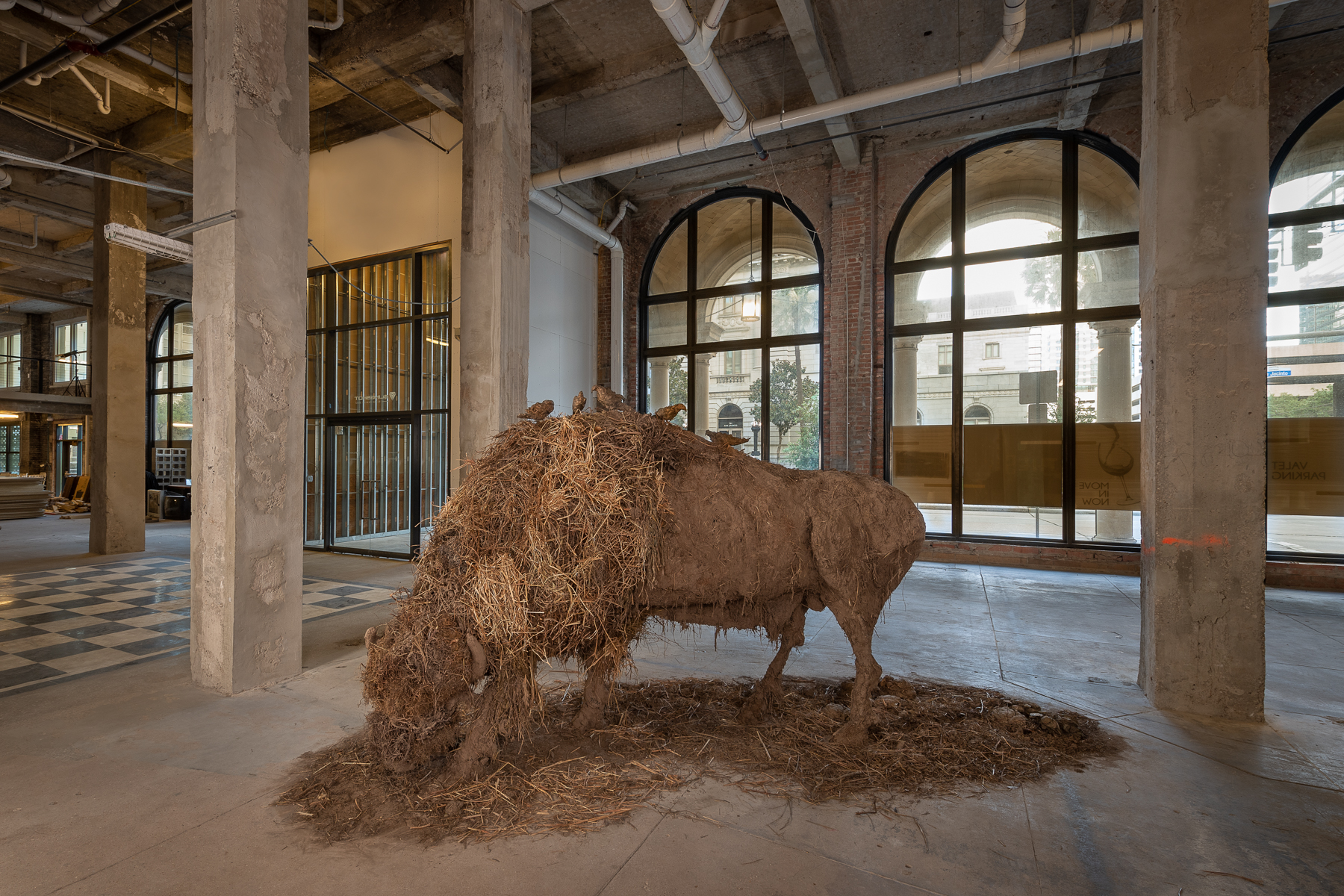
Endangered Knowledge: The Soul of Humus
Four Pasture Rotations: Fumes to Plumes — The bison’s four pasture rotations began in Houston’s Altamira, an art exhibition that explored modern cave paintings and their messages to future civilizations. It continued at the Blue Norther exhibit, linking extreme weather to soil health, and then moved to the former Texaco Building, symbolizing the conflict between ecology and commerce in our civilization.;
Historically, oil was used for lighting and lubrication, but after the Spindletop discovery in 1901, Texaco began marketing petroleum for mass consumption.
The herd’s eating and waste habits, as well as its natural carbon cycling, contrast with society’s mass consumption, which neglects regeneration. While bison return carbon to the soil, humans utilize an abundant amount of energy without repaying our carbon debt, risking future imbalances. Integrating natural recycling of energy consumption can guide regenerative innovation.
The final rotation took the bison to a vacant Forever 21 space. Overconsumption affecting wildlife predates the petroleum industry, rooted in fashion industry practices, as detailed in the Saturday Evening Post article Looks That Kill: The Fashion of Extinction, which chronicles early efforts to save birds from millinery industry threats.
Jen Urso Phoenix, Arizona
-
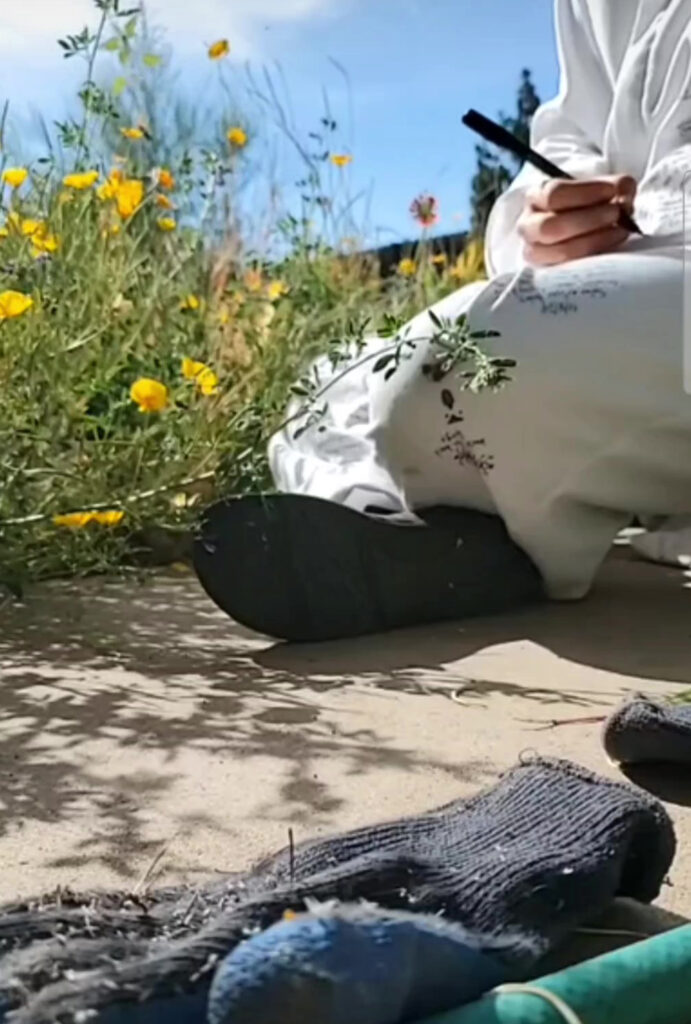
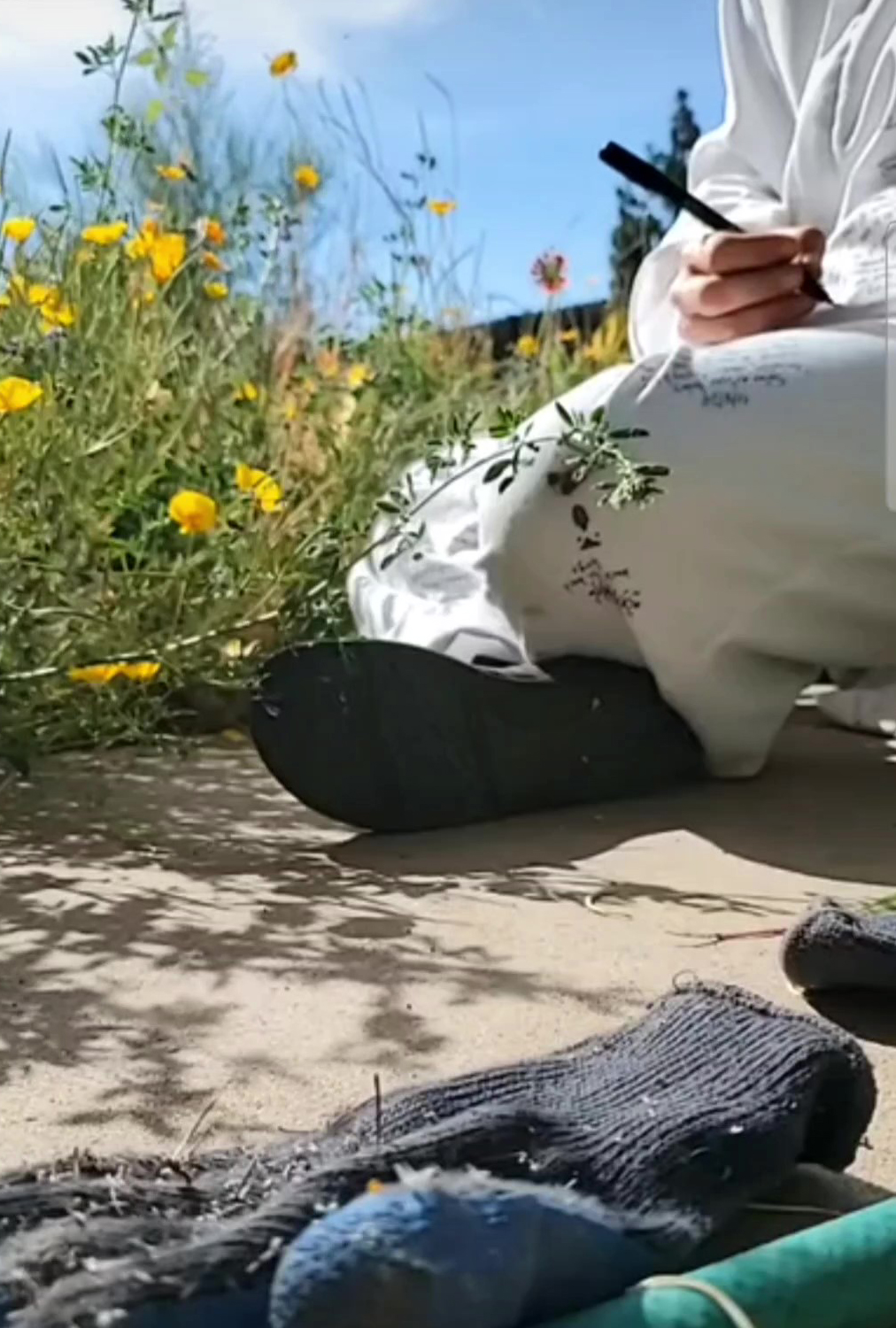
- Leaving Land to Itself: Yard Work (work in progress).
-
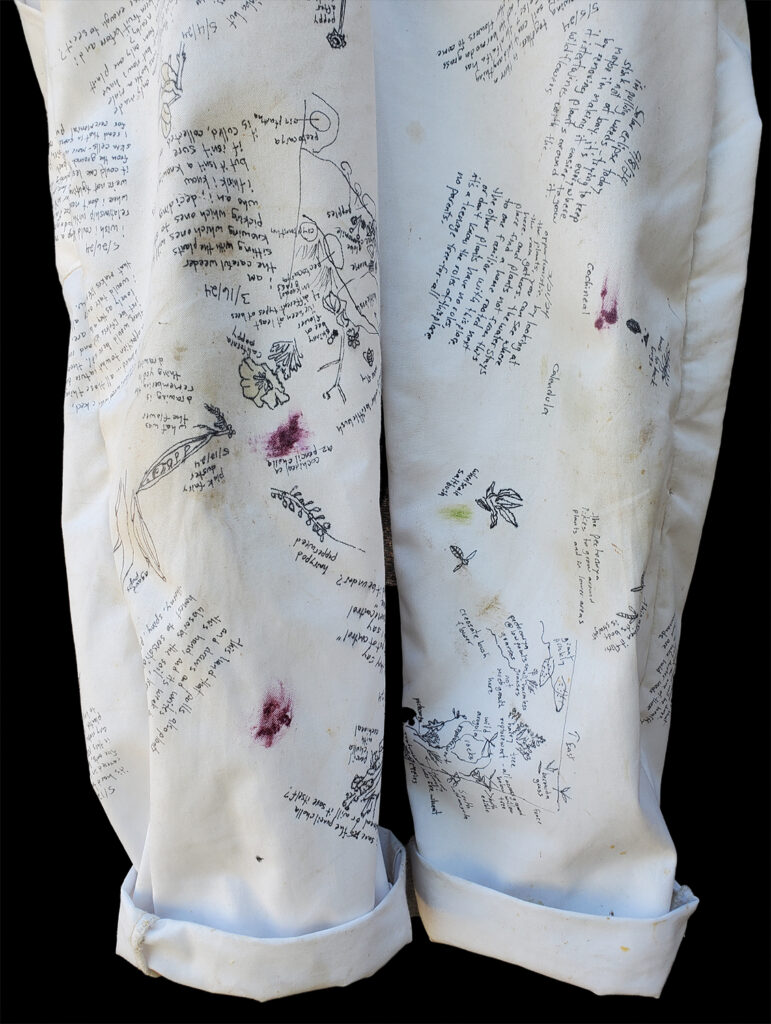
- Leaving Land to Itself: Yard Work, white coveralls, pen dirt, plants, and sweat, 2023.

Leaving Land to Itself: Yard Work
I began Leaving Land to Itself as an open-ended question. The actions I took on the land were responses to smaller questions like, “What would a plant draw?” “Where do plants like to grow?” And, “What would a season of spending time in this space look like on my body?”
Initially, I started Leaving Land to Itself because I wanted to see what would happen if a piece of urban land in Phoenix was minimally managed to the point where it could go about its own business. I wanted to be in the environment to see how it works. By situating myself within my own front yard, I could pay attention and become somewhat integrated, with a better understanding of the living environment that many people often find a nuisance: dust, thorns, tenacious plants, fire ants, Bermuda grass. This project is about resilience, familiarity, the mundane, and deeply considering how we do and make things.
Yard Work is the evidence of my presence in the landscape and includes writing, drawing, sweat, soil, and other stains on the white coveralls I wore for each season.
Shelley K. White Boston, Massachusetts
-
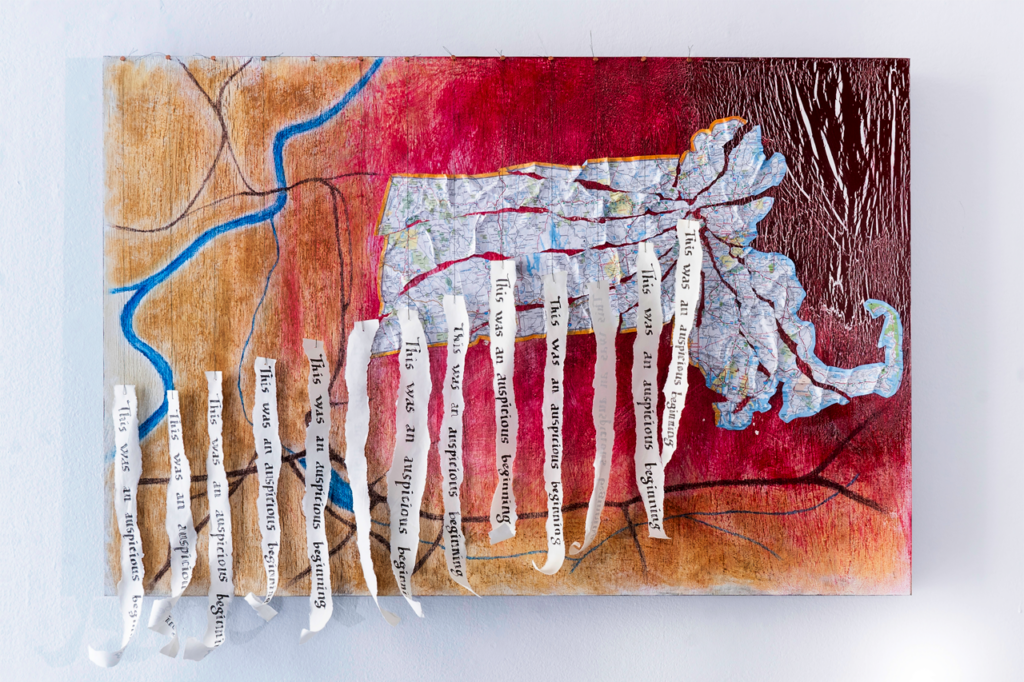
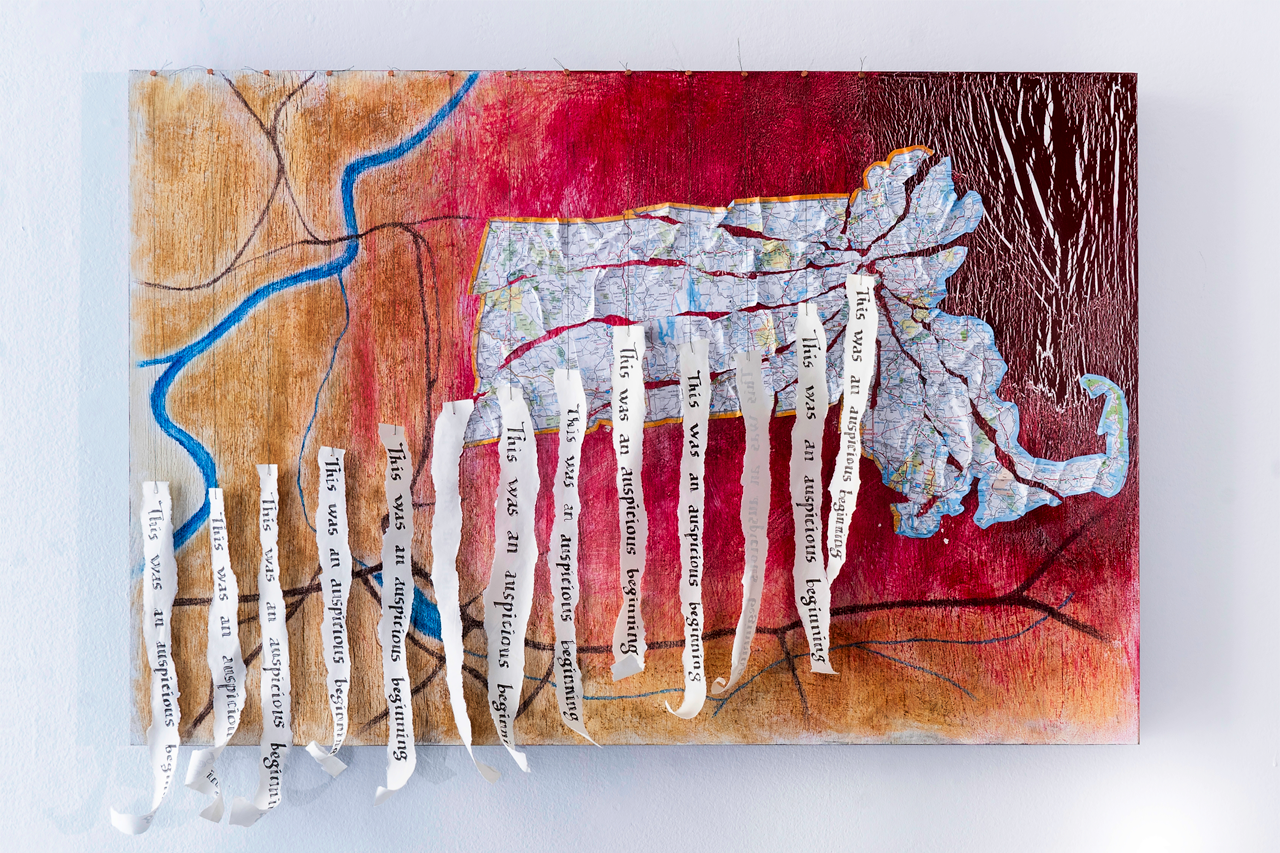
- Concord / Conquer(ed), from the Auspicious Pernicious Beginnings series, crackle paint, chalk pastels, torn maps and paper, ink, oak tree tea dye, and grandmother’s thread, 24″ x 36″, 2024.
-
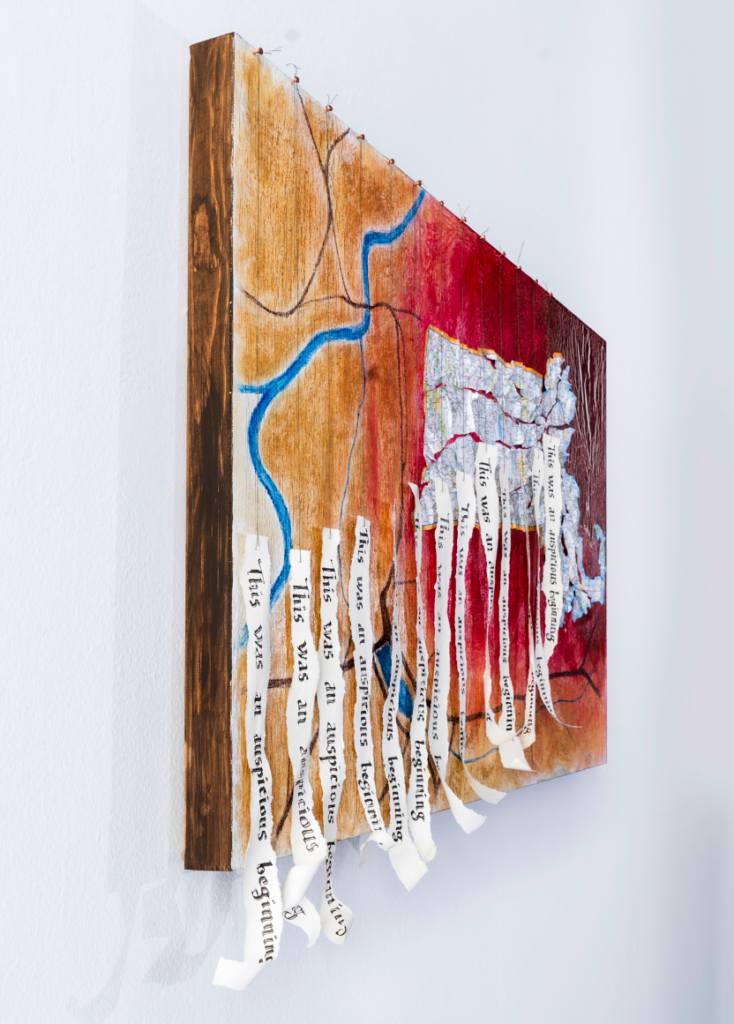
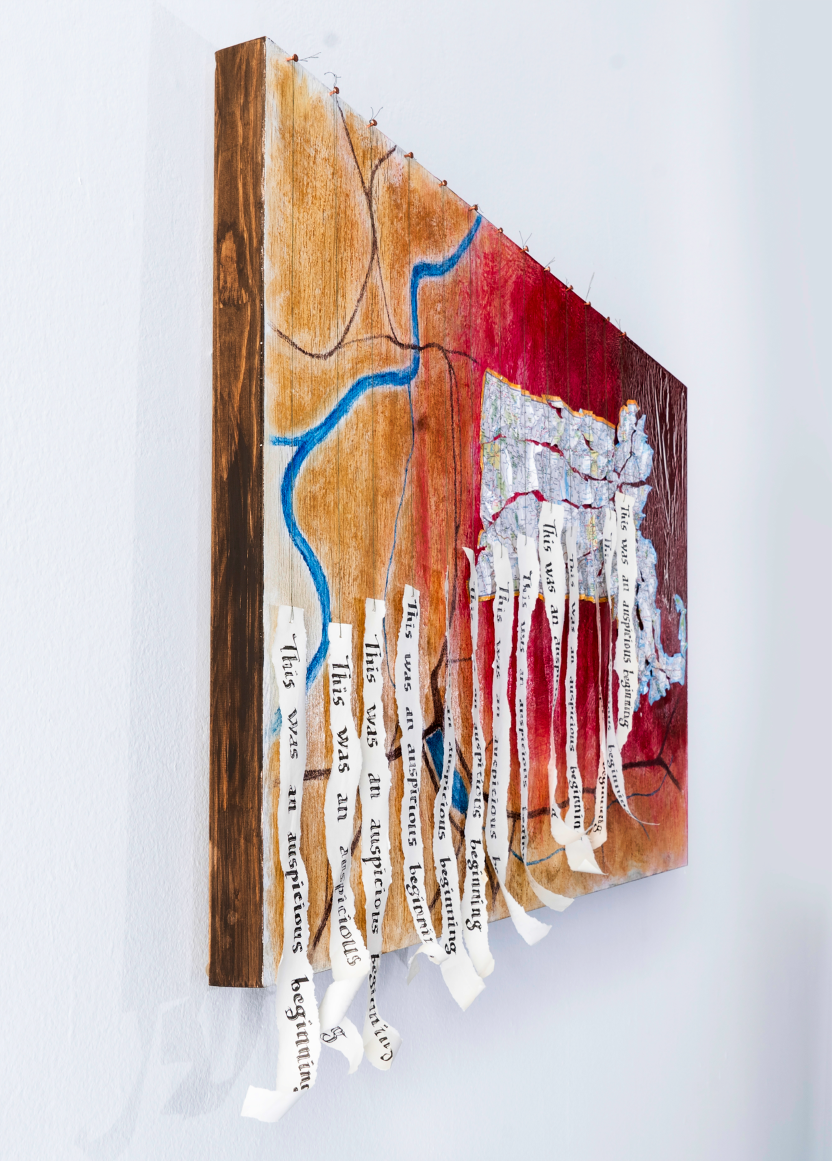
- Side view. Photos by Diana Carbone
Auspicious Pernicious Beginnings
As an interdisciplinary artist working in socially engaged practice, I am drawn to issues that seem most intractable: colonialism, neoliberal globalization, structural racism, border politics, militarism, climate crisis. I am compelled by our popular narratives – how the stories we tell can distance us from responsibility, neatly excusing reproductions of power. At the same time, I am inspired by visual languages that challenge and shift narratives, and by the centrality of art in the history of social movements and social change.
This project, Auspicious Pernicious Beginnings, grapples with New England’s settler colonial histories and mythologies, centering on my maternal family history in Massachusetts. My earliest English ancestor arrived in the U.S. in 1634 and, quickly assuming positions of power, drew boundaries across Massachusetts and the Northeast, overtaking homelands of the Nipmuc and leading battles against other Native American nations as far south as Rhode Island. His biographer and descendant described (over 200 years later) these pursuits as an “auspicious beginning,” evidencing the unproblematized narratives that are handed down intergenerationally. These narratives demonstrate the phenomena of “firsting” and “lasting,” coined by historian Jean O’Brien, where historical records attribute “firsts” to settlers, naturalizing their colonial pursuits, and “lasts” to Native Americans, purporting their total disappearance.
Materially, this work includes mixed media collages and paintings, sculptures, and installation art incorporating natural, familial, and found objects, along with torn historical and contemporary maps. I worked with threads, relics, and treasures handed down by my beloved late grandparents, dialoguing with them through time in the making. I sat with a great old oak associated with these histories, which involuntarily hosted a sign commemorating my ancestor until it was recently removed in an effort toward reconciliation. Its fallen leaves, twigs, and bark became a meditation on how the natural world herself is often forced to tell false histories. I allowed myself to perseverate on the phrase of the “auspicious beginning,” thinking about how intergenerational narratives are repeated to erase and proudly justify bloody histories. Writing this phrase on torn pages from my childhood drawing books, dyed with tea I created from the oak leaves, I aimed to begin a composting process which also unfolded through endless dialogue with my living family members and community. As such, this project is about disrupting false narratives and about holding myself and others accountable for telling, and acting upon, truer histories.
Melanie Zurba Halifax, Nova Scotia, Canada
-
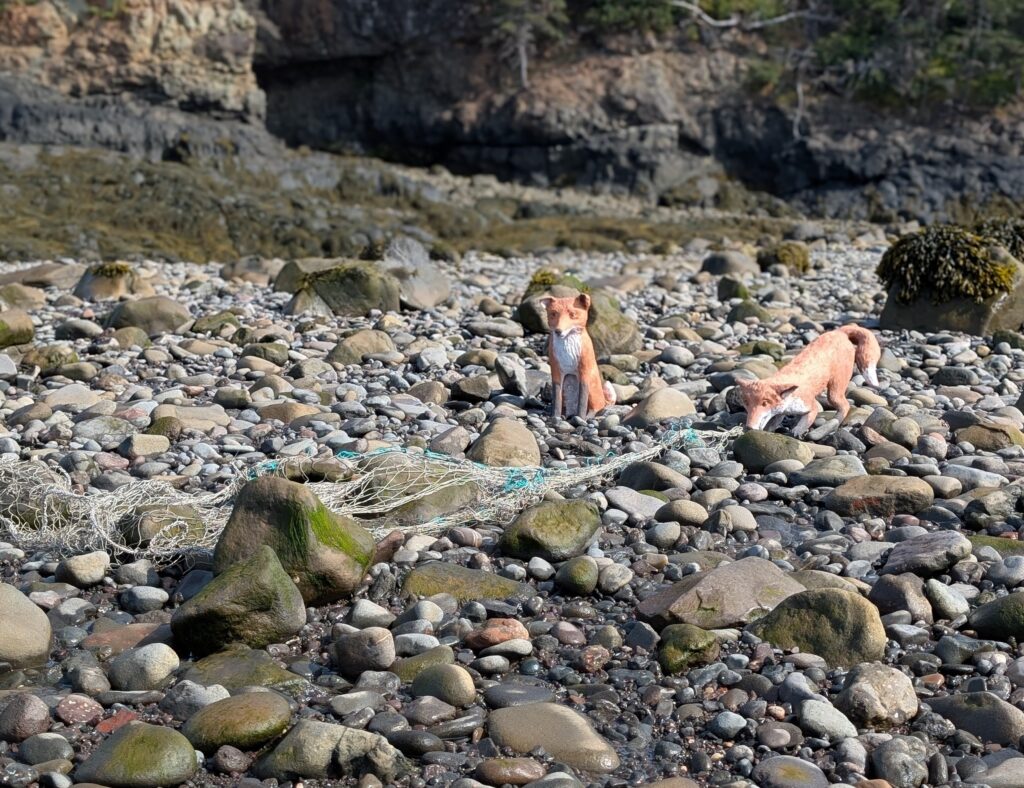
- The Two Foxes Within, Bay of Fundy foraged clay and found ghost fishing gear, 2025.
-
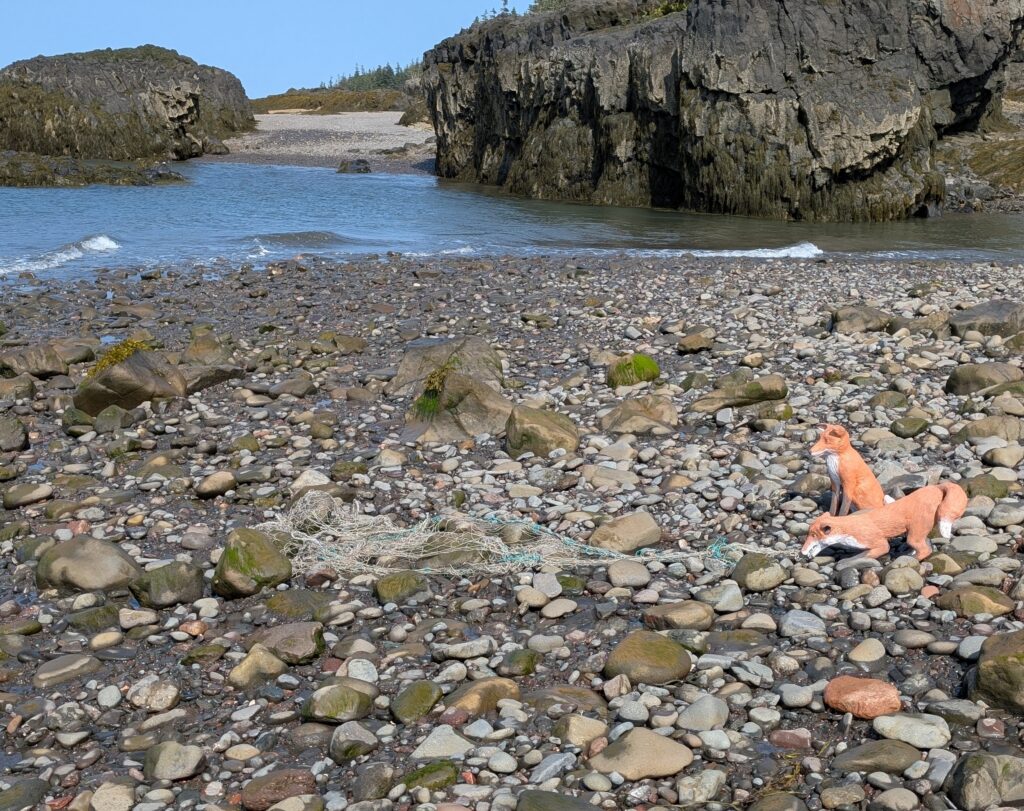
- Landscape view.
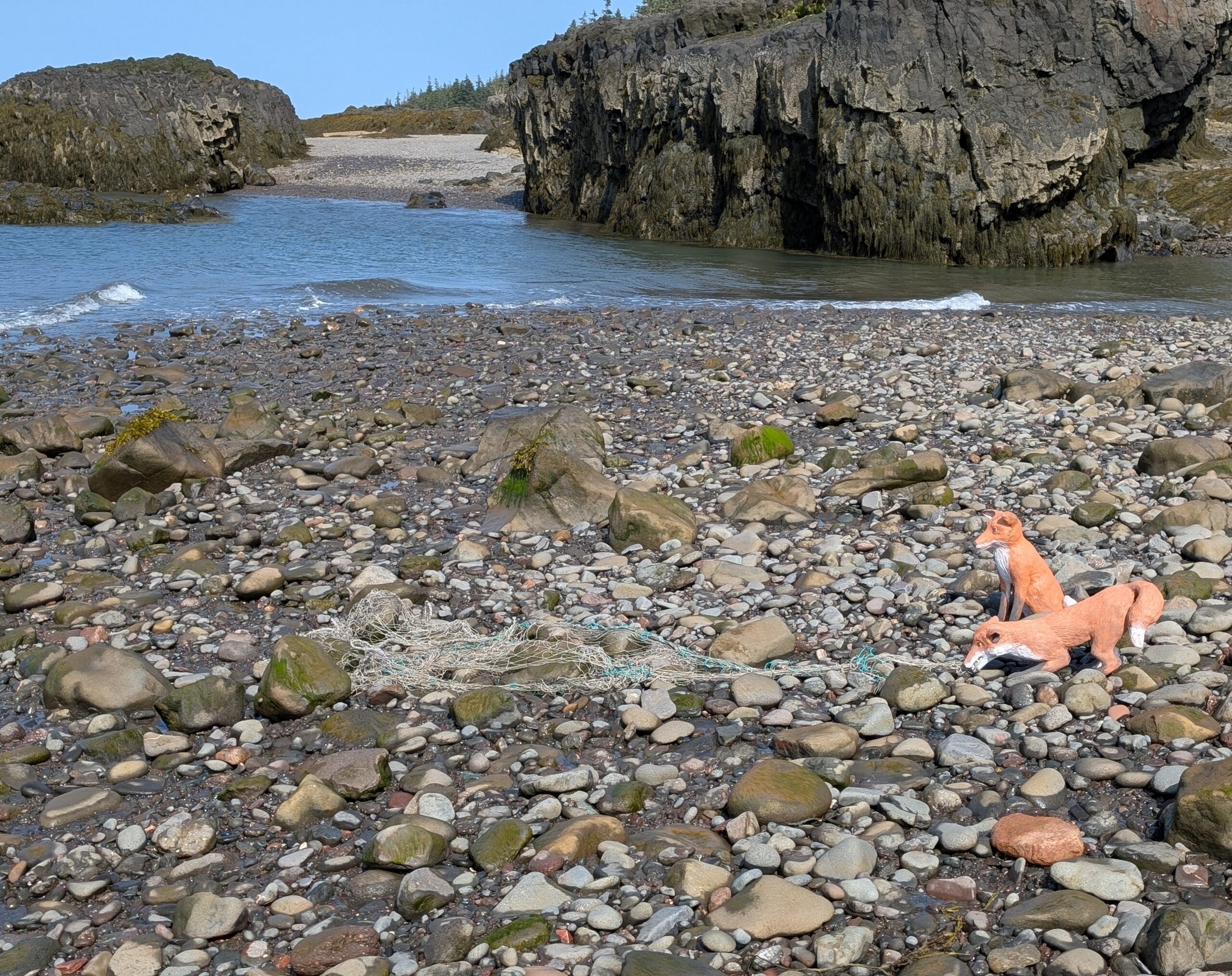
The Two Foxes Within, video.
The Two Foxes Within
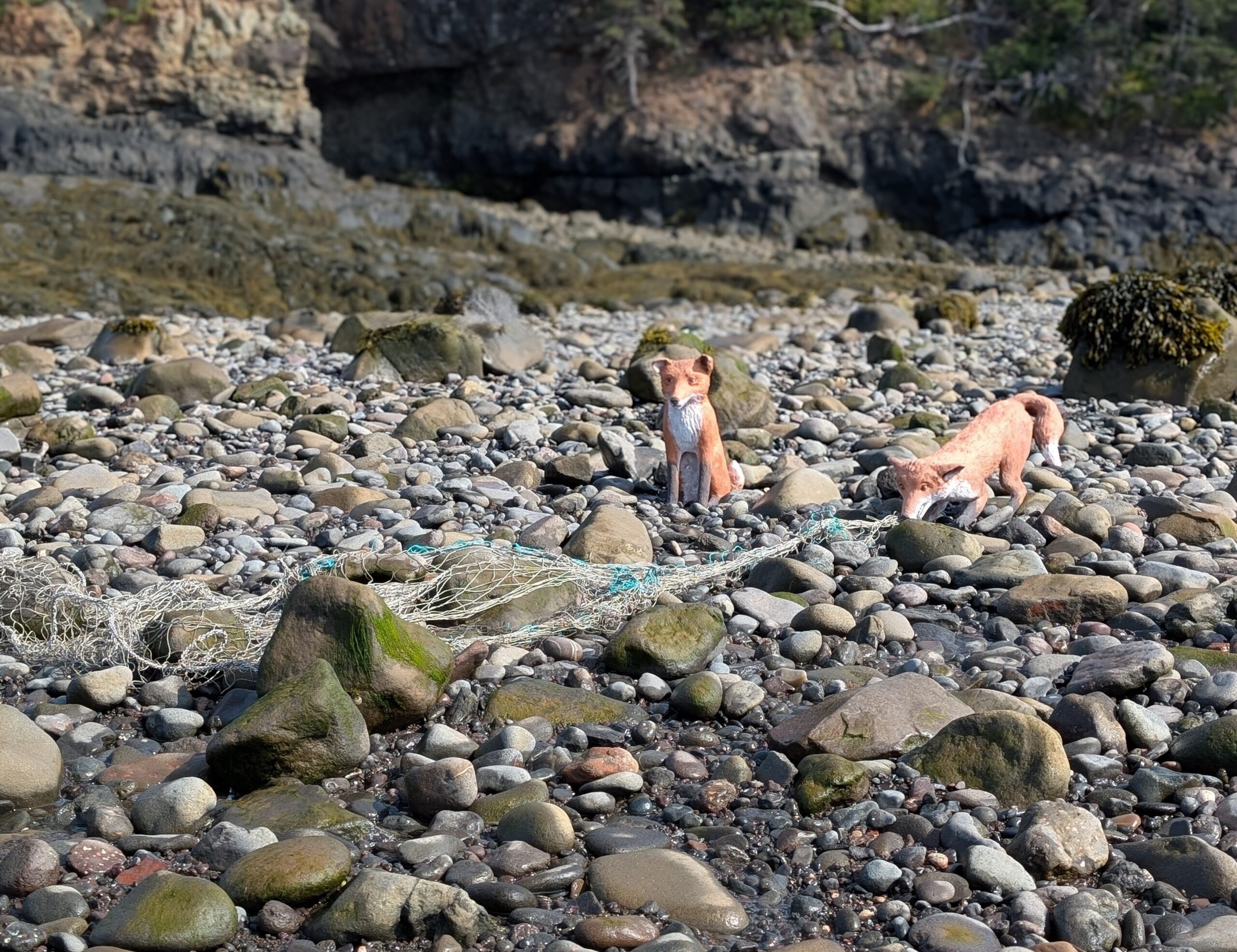
The Two Foxes Within is an installation that relates to the hope, frustration, and apathy felt in the face of the environmental crises. It is site-specific to the Bay of Fundy in Nova Scotia, Canada, which is known for stunning coastlines, fisheries, and the largest tides in the world. Each fox represents a different emotion and/or response. One fox is frustrated and motivated and is trying to pull ghost fishing gear from the beach, and the other fox is sitting and watching, feeling apathy, and not knowing how she should act. This is based on personal reflections and experiences of feeling two versions of myself as a person who has committed my career to understanding and strengthening the links between people, culture, and nature. The foxes are made of clay foraged from the banks of the Bay of Fundy, which was hand processed, meaning stones and seaweed were removed piece by piece. This created opportunities to continuously connect with place through the material and the making process. The textures and smells of the bay also helped to guide the figuration of the two characters. Once fired, the natural tones of the red of the clay came through, giving the color of the fur. The piece was then returned for installation at the Bay of Fundy, where it was photographed and video recorded. In this setting, the reactions of the foxes took on additional meaning. The fox struggling with the net had to deal with large rocks and tangles on the shore, and the other fox looked out at the water seeking connection amidst feelings of disheartenment.
WEAD MAGAZINE ISSUE No. 15, PLACE SETTING
© Copyright 2026 Women Eco Artists Dialog. All rights reserved.