
Upcoming Events
Art+ Activism #24
Birds and the Beads, an Exhibtion
a talk by Meyo Marrufo
On Zoom
Thursday, November 5
4 to 5:30 pm PT
This online Zoom conversation is scheduled to align with the final week of Meyo Marrufo’s ‘Birds and the Beads’ solo exhibition, currently on display at the Mendocino Art Center (October 9th – November 9th).
Whether Meyo is working with digital art, regalia, or weaving, each creation begins with inspiration drawn from the world around her—she says she references ‘the patterns in the land, the rhythm of our dances, the wisdom in our songs.’
As part of WEAD’s online Art+ speaker series, Meyo will be discussing her exhibition, currently on view at the Mendocino Art Center, a show which offers a glimpse into her creative process. Her digital drawings, which she calls fingerdoodles, incorporate basket patterns, traditional dances, and scenes of Pomo life. Each basket pattern carries meaning, reflecting the land, the animals, and the stories of our ancestors. Just as colors shift the tone of a basket’s message, my art weaves together elements of the past and present, preserving and sharing our cultural language.
Beyond her own artwork, she works to uplift Indigenous artists and stories through curation. She has co-curated exhibitions such as After the Burn, which explores fire as a traditional land management tool, and Birds of a Feather, a show that highlights Traditional Ecological Knowledge (TEK) as a living practice.
As a guest curator for the de Young Museum’s Jules Tavernier and the Elem Pomo exhibit, she helped present a more complete narrative of Pomo history, ensuring that their voices were central to the storytelling. Most recently, she co-curated We Are Still Here at the Mendocino Art Center, showcasing the continued resilience and artistry of Pomo people across our homelands.
About Meyo Marrufo
Chintah Mah, my name is Meyo Marrufo, and I am Eastern Pomo from the Clear Lake Basin. I am a tribal member of the Robinson Rancheria Band of Pomo Indians, one of seven federally recognized Lake Pomo tribes. Our homeland surrounds California’s largest natural freshwater lake, once home to more than 30 thriving villages sustained by its abundant resources. Pomo country extends beyond the lake to the Ukiah Valley and the north-central coastline, where over 20 Pomo tribes reside, speaking seven different dialects of our language.
Tribal Knowledge
In addition to my environmental work, I am committed to teaching and sharing our cultural knowledge. When I came of age, I began my journey into Pomo regalia making and traditional food processing—learning these practices from the ground up. As I deepened my understanding, I felt a responsibility to pass this knowledge on, teaching classes on cultural arts, regalia making, and traditional foods across Northern California.
Knowledge is of the Land
Everything I know as a tribal person begins and ends with the land I come from.
I am a weaver—the ones who taught me showed me how to listen to the land. When the leaves bud, it is time to gather peeled sticks. When the streams dry early, I must work quickly. When the snakes come, it is time to stop digging roots and let the plants rest. Our basket designs come from the land—mountain ridges, quail topknots, animal tracks left in the earth.
I am a singer—our songs and dances mirror the movements of our animal relatives. Like a deer, we step with awareness, heads turning to take in the land. Our women move like the flowers of our Mother Earth. Our songs are gifts from the land and offerings to it in return. We sing for protection, for gratitude, for the knowledge to survive.
I am a mother—when my children were born, my family introduced them to our tribe through walking and singing, welcoming them not only to the people but to the land itself. This land will teach them, just as it taught me. Someday, it will be their responsibility to care for it.
Knowledge is of the land.
More info on Meyo’s work can be found here on her website: meyomarrufo.com
Images provided by the artist:
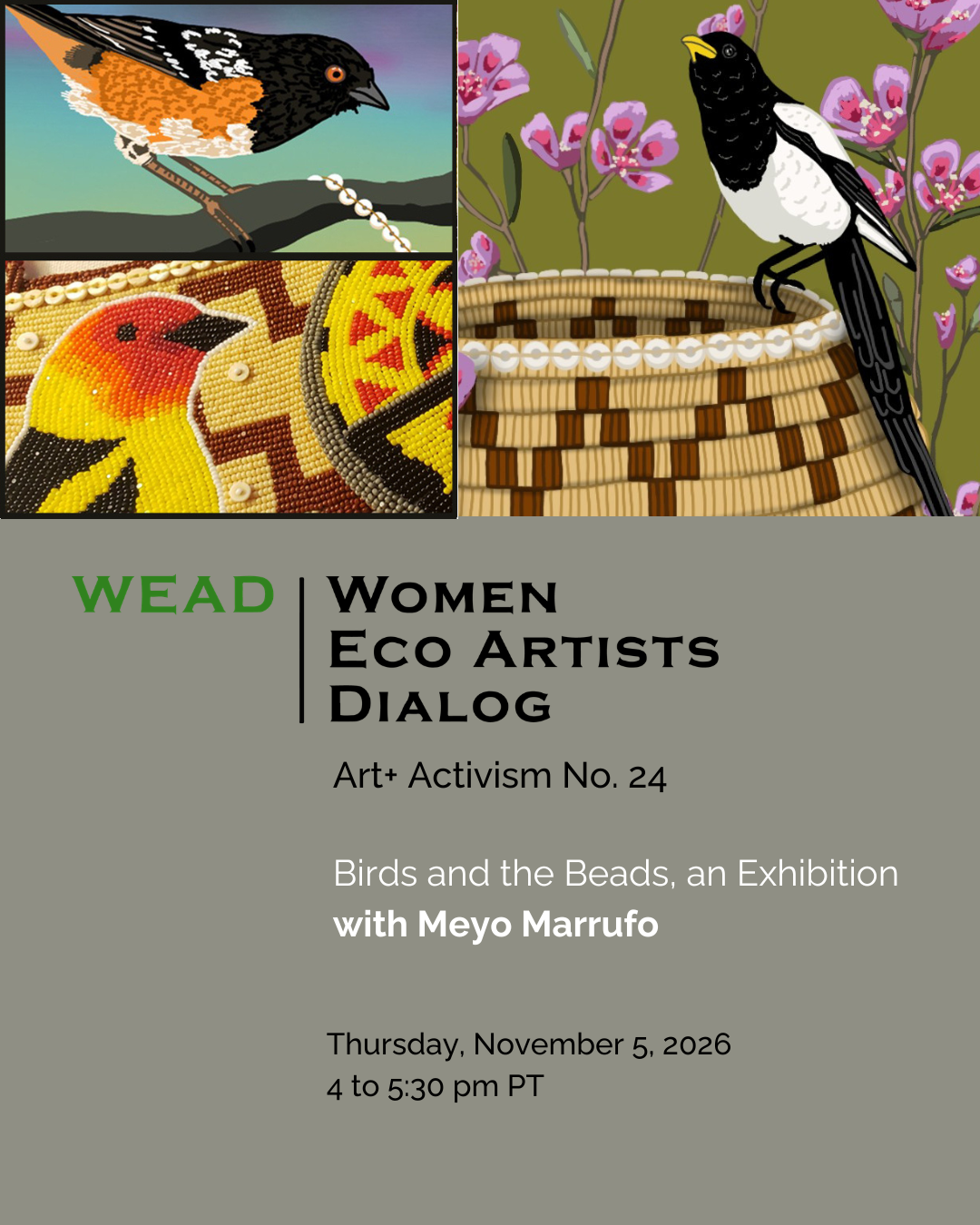
(Left, details) Spotted Towhee: I saw this sunset when I was driving the other day. It looked so beautiful with its orange to blue and the wispy clouds. I pulled over just to look and try to remember it. Tonight, Spotted Towhee watched over his feather basket by the light of the sunset.
(Right, detail) Magpie and Farewell-to-Spring: Today, as I was thinking about life and the paths we take. It brought to mind the zig zag design. The ups and downs of our journeys. What better way to say goodbye to those journeys than with Farewell to Spring flowers with Magpie looking on.
Art+ Activism #24
Birds and the Beads, an Exhibtion
a talk by Meyo Marrufo
On Zoom
Thursday, November 5
4 to 5:30 pm PT
This online Zoom conversation is scheduled to align with the final week of Meyo Marrufo’s ‘Birds and the Beads’ solo exhibition, currently on display at the Mendocino Art Center (October 9th – November 9th).
Whether Meyo is working with digital art, regalia, or weaving, each creation begins with inspiration drawn from the world around her—she says she references ‘the patterns in the land, the rhythm of our dances, the wisdom in our songs.’
As part of WEAD’s online Art+ speaker series, Meyo will be discussing her exhibition, currently on view at the Mendocino Art Center, a show which offers a glimpse into her creative process. Her digital drawings, which she calls fingerdoodles, incorporate basket patterns, traditional dances, and scenes of Pomo life. Each basket pattern carries meaning, reflecting the land, the animals, and the stories of our ancestors. Just as colors shift the tone of a basket’s message, my art weaves together elements of the past and present, preserving and sharing our cultural language.
Beyond her own artwork, she works to uplift Indigenous artists and stories through curation. She has co-curated exhibitions such as After the Burn, which explores fire as a traditional land management tool, and Birds of a Feather, a show that highlights Traditional Ecological Knowledge (TEK) as a living practice.
As a guest curator for the de Young Museum’s Jules Tavernier and the Elem Pomo exhibit, she helped present a more complete narrative of Pomo history, ensuring that their voices were central to the storytelling. Most recently, she co-curated We Are Still Here at the Mendocino Art Center, showcasing the continued resilience and artistry of Pomo people across our homelands.
About Meyo Marrufo
Chintah Mah, my name is Meyo Marrufo, and I am Eastern Pomo from the Clear Lake Basin. I am a tribal member of the Robinson Rancheria Band of Pomo Indians, one of seven federally recognized Lake Pomo tribes. Our homeland surrounds California’s largest natural freshwater lake, once home to more than 30 thriving villages sustained by its abundant resources. Pomo country extends beyond the lake to the Ukiah Valley and the north-central coastline, where over 20 Pomo tribes reside, speaking seven different dialects of our language.
Continuing Tribal Knowledge
In addition to my environmental work, I am committed to teaching and sharing our cultural knowledge. When I came of age, I began my journey into Pomo regalia making and traditional food processing—learning these practices from the ground up. As I deepened my understanding, I felt a responsibility to pass this knowledge on, teaching classes on cultural arts, regalia making, and traditional foods across Northern California.
Knowledge is of the Land
Everything I know as a tribal person begins and ends with the land I come from.
I am a weaver—the ones who taught me showed me how to listen to the land. When the leaves bud, it is time to gather peeled sticks. When the streams dry early, I must work quickly. When the snakes come, it is time to stop digging roots and let the plants rest. Our basket designs come from the land—mountain ridges, quail topknots, animal tracks left in the earth.
I am a singer—our songs and dances mirror the movements of our animal relatives. Like a deer, we step with awareness, heads turning to take in the land. Our women move like the flowers of our Mother Earth. Our songs are gifts from the land and offerings to it in return. We sing for protection, for gratitude, for the knowledge to survive.
I am a mother—when my children were born, my family introduced them to our tribe through walking and singing, welcoming them not only to the people but to the land itself. This land will teach them, just as it taught me. Someday, it will be their responsibility to care for it.
Knowledge is of the land.
More info on Meyo’s work can be found here on her website: meyomarrufo.com
Images provided by the artist:
(Left, details) Spotted Towhee: I saw this sunset when I was driving the other day. It looked so beautiful with its orange to blue and the wispy clouds. I pulled over just to look and try to remember it. Tonight, Spotted Towhee watched over his feather basket by the light of the sunset.
(Right, detail) Magpie and Farewell-to-Spring: Today, as I was thinking about life and the paths we take. It brought to mind the zig zag design. The ups and downs of our journeys. What better way to say goodbye to those journeys than with Farewell to Spring flowers with Magpie looking on.