
WEAD focuses on women’s unique perspective
in ecological and social justice art.
WEAD ECO Artists Directory
Browse international women-identified eco artists in the WEAD directory.

UPCOMING EVENTS
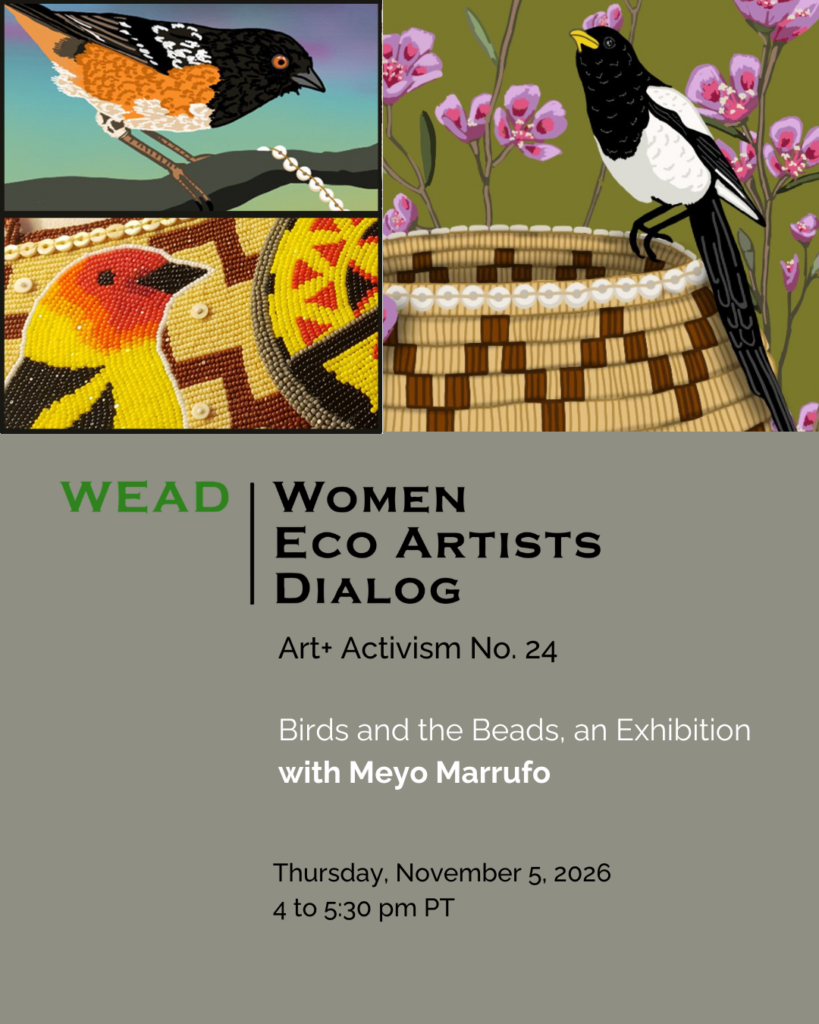
Art+ Activism #24 with Meyo Marrufo presenting on "Birds and the Beads, An Exhibition," Thursday, November 5, at 4 pm on Zoom
This online Zoom conversation is scheduled to align with the final week of Meyo Marrufo’s ‘Birds and the Beads’ solo exhibition, currently on display at the Mendocino Art Center (October 9th – November 9th).
Whether Meyo is working with digital art, regalia, or weaving, each creation begins with inspiration drawn from the world around her—she says she references ‘the patterns in the land, the rhythm of our dances, the wisdom in our songs.’
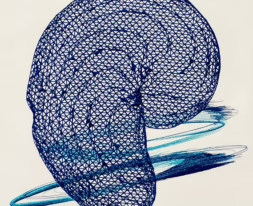
As part of WEAD’s online Art+ speaker series, Meyo will be discussing her exhibition, currently on view at the Mendocino Art Center, a show which offers a glimpse into her creative process. Her digital drawings, which she calls fingerdoodles, incorporate basket patterns, traditional dances, and scenes of Pomo life. Each basket pattern carries meaning, reflecting the land, the animals, and the stories of our ancestors. Just as colors shift the tone of a basket’s message, my art weaves together elements of the past and present, preserving and sharing our cultural language.
Beyond her own artwork, she works to uplift Indigenous artists and stories through curation. She has co-curated exhibitions such as After the Burn, which explores fire as a traditional land management tool, and Birds of a Feather, a show that highlights Traditional Ecological Knowledge (TEK) as a living practice.
As a guest curator for the de Young Museum’s Jules Tavernier and the Elem Pomo exhibit, she helped present a more complete narrative of Pomo history, ensuring that their voices were central to the storytelling. Most recently, she co-curated We Are Still Here at the Mendocino Art Center, showcasing the continued resilience and artistry of Pomo people across our homelands.
EXHIBITION CALL
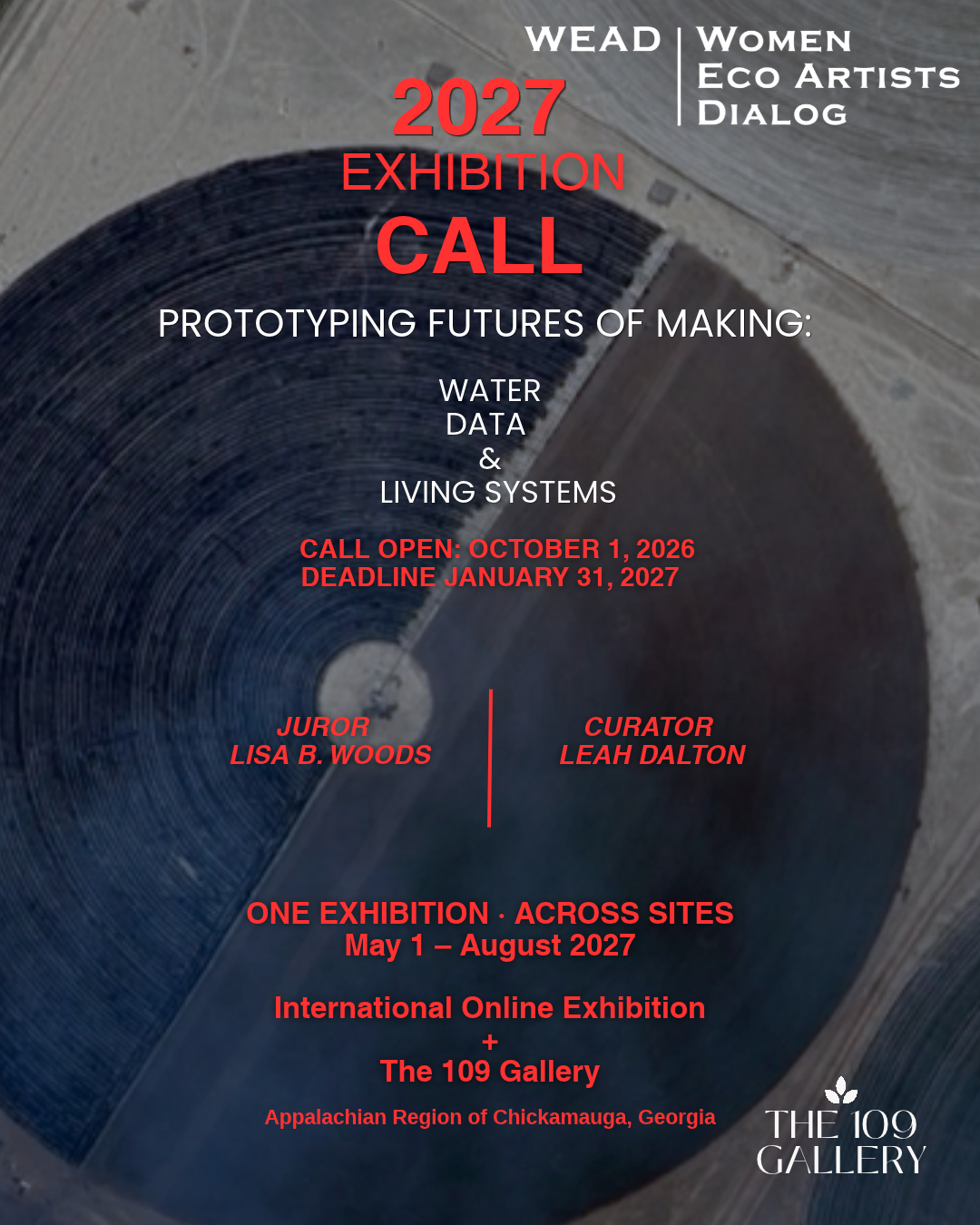
WEAD’s 2027 Member Exhibition of Ecoart and Social Justice Art: Prototyping Futures of Making: Water, Data, and Living Systems
Online and at The 109 Gallery
Deadline for submissions: January 31, 2027
Exhibition dates: May 1, 2027 to August 31, 2027
Jurors: Lisa B. Woods and Leah Dalton
What does it mean to build within systems that are already alive? What forms of intelligence move through water, soil, biological networks, and data? How are we already prototyping the futures we inhabit? Read the full exhibition call.
WEAD Magazine

Remediation, Mallery Quetawki (Zuni Pueblo), acrylic on canvas, right half of 16″ x 20″ diptych, 2020
ISSUE No. 15: Place Setting
WEAD is excited to introduce WEAD Magazine #15: PLace Setting.
Andrée Singer Thompson is the issue’s featured artist. Among the central essays are two about soil, one by Salma Arastu and one co-authored by Rhonda Janke and Deanna Pindell. Four central essays were written by artists working within artist-in-residence programs in alternative community settings, including Laura Donkers, Stephanie Garon, Carol Newborg, and Mallery Quetawki. The departmental essays include reflections by Bee (Beverly) Naidus and Ruth Wallen, a review of Minoosh Zomorodinia‘s Spirit Gleaning at 500 Capp Street by Sharon Siskin, and a profile of Robin Wall Kimmerer by Alexandra Alter.
WEAD member artists with featured portfolios are Kimberly Callas, Amy Feger, Beth Fein, Maru García, Tanja Geis, Alisa Gorshenina, Laura Green, Stacy Levy, Patricia Miranda, Abby Spangel Perry, Joanne Ross, Priscilla Stadler, Mikala Aragón Sterling, Cindee Travis Klement, Jen Urso, Shelley White, and Melanie Zurba.
Susan Leibovitz Steinman is this issue’s executive editor. WEAD staff member, Kasha Frese, directed the magazine’s production and editorial. Special thanks to our volunteers: Production Assistant Mikala Aragón Sterling, and Copyeditors Emily Anne Kappenman and Lanny DeVuono.
Edited to be accessible to readers from all walks of life, WEAD Magazine serves as an archive of the field, as a resource for academics, and as an inspiration to artists and scientists. We encourage you to consider it as a source for your classrooms or your research into ecoarts.
Recent Exhibition
WEAD’s Annual Member Exhibition

Bodies and Borders: Ecologies of Consent
Online and at The 109 Gallery
October 1, 2025 to January 31, 2026
Bodies and Borders: Ecologies of Consent investigates the intersection of bodies, ecology, and agency through the lens of permeability and protection, and explores how consent is navigated within biological, political, and ecological systems.
This dual exhibition appeared online at WEAD’s KMX Gallery and in person at Leah Dalton’s The 109 Gallery in Chickamauga, Georgia. Juried by Beverly Naidus and Leah Dalton, the exhibit featured 58 works from 44 artists, including 15 videos.
RECENT PRESENTATION
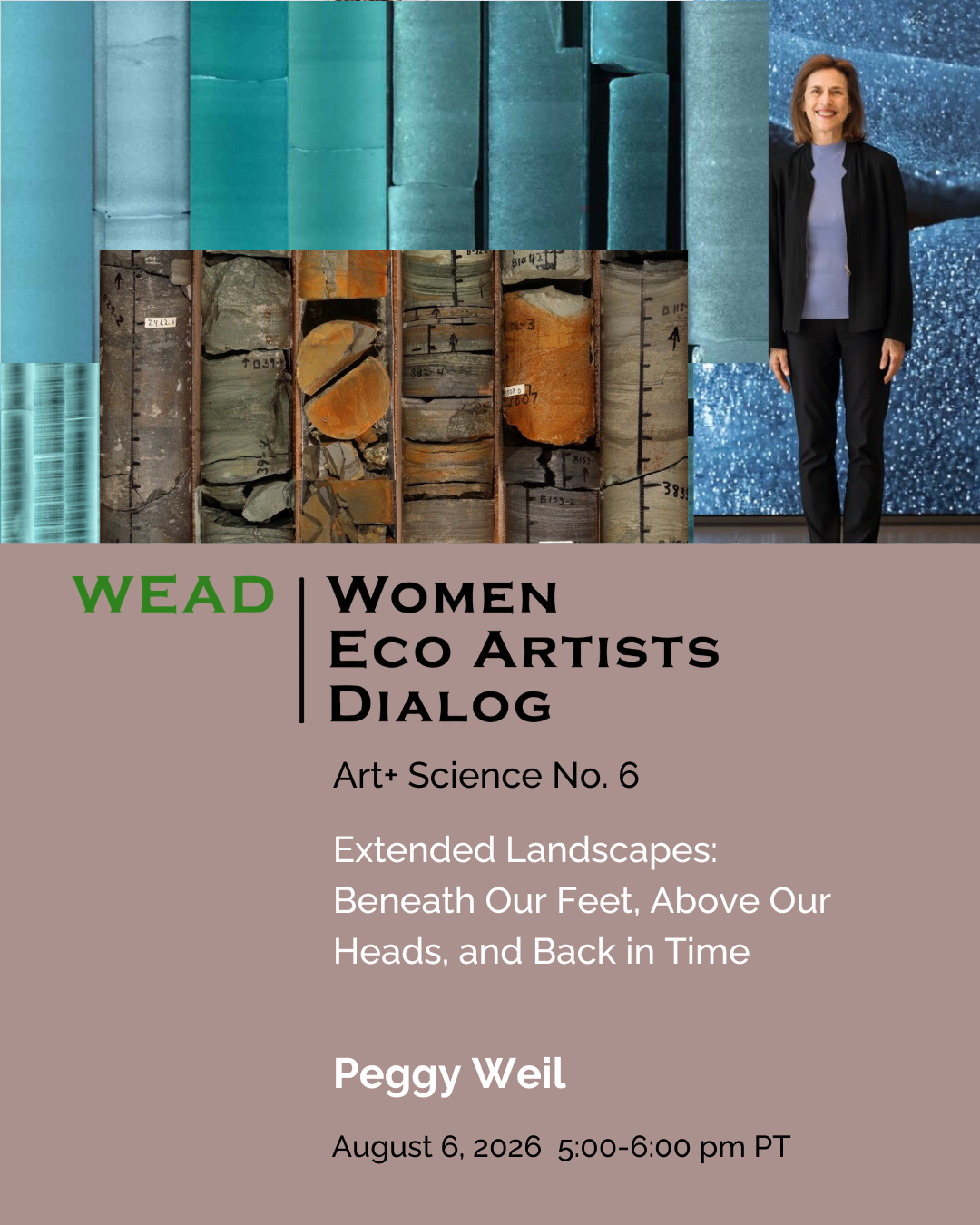
Art+ Science #6: Extended Landscapes: Beneath Our Feet, Above Our Heads, & Back in Time with Peggy Weil — LIVE ONLY, no recording
Thursday, August 6, 5:00 to 6:00 pm PT
on Zoom
This event was LIVE ONLY! No recording is available
Artist Peggy Weil spoke on Zoom about her MoMA exhibition, Core Memory, and her series Expanded Landscapes, works that visualize the layers of the Earth that exist “beneath our feet, above our heads, and back in time.” This event was live only. No recording is available.
An innovator in digital portraiture, Weil’s practice ranges from large-scale public installations to videos and interactive art. Since 2011, the artist has focused on what she calls “Extended Landscapes.” Weil’s current exhibition at the Museum of Modern Art (MoMA), Core Memory, brings together two of the artist’s “underscapes”: 88 Cores, a video descent through the Greenland ice sheet, and 18 Cores, which unearths images of rock cores from beneath California’s Salton Sea.
About Peggy Weil
Peggy Weil is a multi-disciplinary artist and designer based in Los Angeles. Her work explores physical, digital, cultural, and socio-political landscapes through work spanning video installation, large-scale public art, and pioneering digital interactive media. Her long-form video installation 88 Cores has shown across the US, from The Climate Museum in NYC (2018) to currently at MoMA’s Core Memory (2026). Her public installations include UnderLA for CURRENT:LA Public Art Biennial 2016 and HeadsUP! 2012 in Times Square.
Since 2011, her ongoing Extended Landscapes series has produced landscape portraits focused on the unseen processes of climate change. In 2007, collaborating with Nonny de la Peña, she co-created foundational immersive journalism and VR projects centered on human rights, including Gone Gitmo, a virtual installation of Guantánamo Prison exhibited internationally. In 1998, Weil created MrMind, an early netart chatbot that asked visitors, “Can you convince me that you are human?” Sixteen years of global conversations from MrMind became the libretto for The Blurring Test: Songs of MrMind, performed in New York in 2020 and 2023.
A Harvard and MIT graduate, she was a member of the Architecture Machine Group (precursor to the MIT Media Lab), grounding her practice in early human-computer interaction and AI discourse. She is co-author of Inventing Eliza: How the First Chatbot Shaped the Future of AI (MIT Press, June 2026), and has taught at CCA, UCLA, and USC.
See Peggy’s work online at:
Learn about her MoMA show, Core Memory, here.
Photos by permission of the artist.
EXHIBITION CALL
WEAD’s 2027 Member Exhibition of Ecoart and Social Justice Art: Prototyping Futures of Making: Water, Data, and Living Systems
Online and at The 109 Gallery
Deadline for submissions: January 31, 2027
Exhibition dates: May 1, 2027 to August 31, 2027
Jurors: Lisa B. Woods and Leah Dalton
What does it mean to build within systems that are already alive? What forms of intelligence move through water, soil, biological networks, and data? How are we already prototyping the futures we inhabit? Read the full exhibition call.
WEAD Magazine
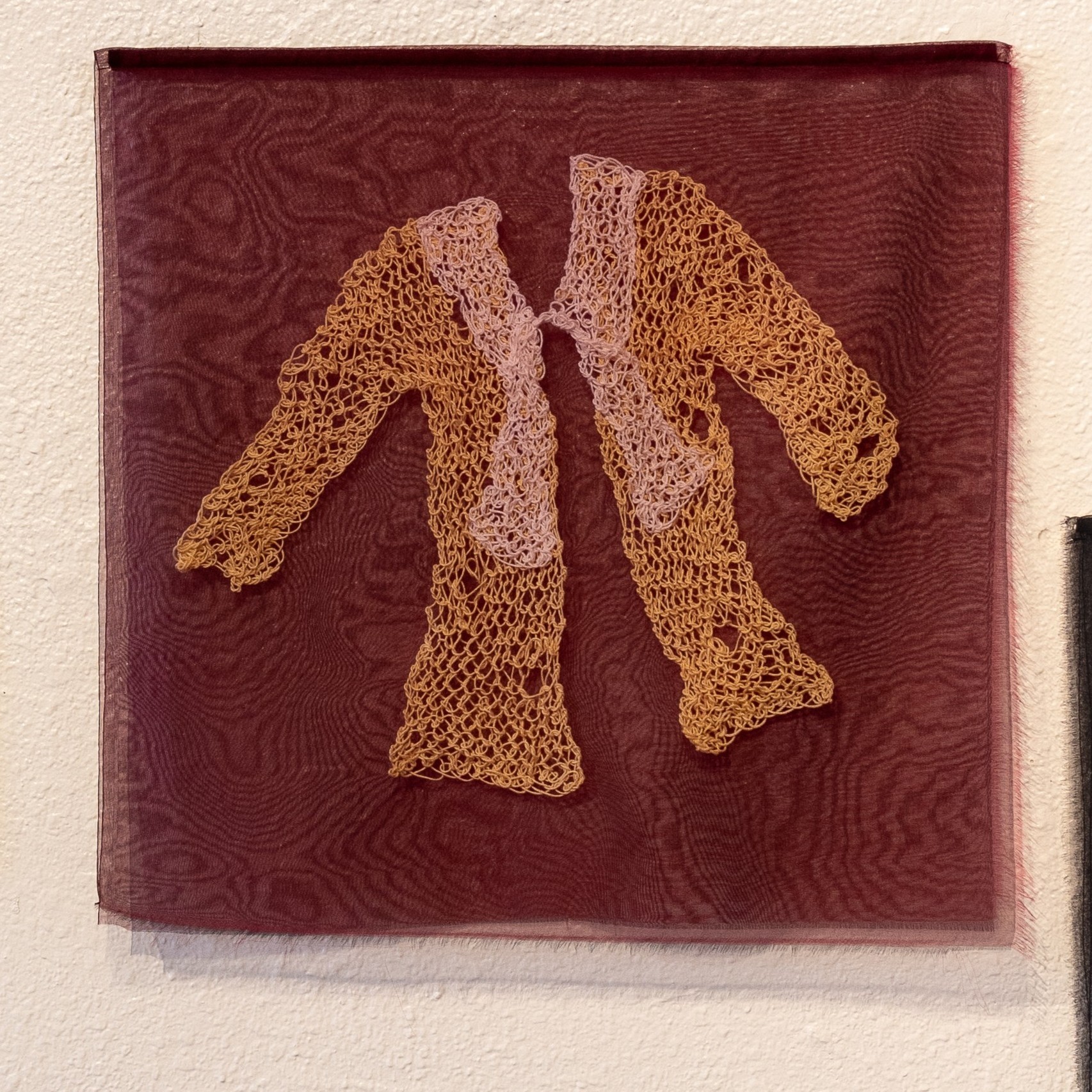
ISSUE No. 15: Place Setting
WEAD is excited to introduce WEAD Magazine #15: PLace Setting.
Andrée Singer Thompson is the issue’s featured artist. Among the central essays are two about soil, one by Salma Arastu and one co-authored by Rhonda Janke and Deanna Pindell. Four central essays were written by artists working within artist-in-residence programs in alternative community settings, including Laura Donkers, Stephanie Garon, Carol Newborg, and Mallery Quetawki. The departmental essays include reflections by Bee (Beverly) Naidus and Ruth Wallen, a review of Minoosh Zomorodinia‘s Spirit Gleaning at 500 Capp Street by Sharon Siskin, and a profile of Robin Wall Kimmerer by Alexandra Alter.
WEAD member artists with featured portfolios are Kimberly Callas, Amy Feger, Beth Fein, Maru García, Tanja Geis, Alisa Gorshenina, Laura Green, Stacy Levy, Patricia Miranda, Abby Spangel Perry, Joanne Ross, Priscilla Stadler, Mikala Aragón Sterling, Cindee Travis Klement, Jen Urso, Shelley White, and Melanie Zurba.
Susan Leibovitz Steinman is this issue’s executive editor. WEAD staff member, Kasha Frese, directed the magazine’s production and editorial. Special thanks to our volunteers: Production Assistant Mikala Aragón Sterling, and Copyeditors Emily Anne Kappenman and Lanny DeVuono.
Edited to be accessible to readers from all walks of life, WEAD Magazine serves as an archive of the field, as a resource for academics, and as an inspiration to artists and scientists. We encourage you to consider it as a source for your classrooms or your research into ecoarts.
Recent Exhibition
WEAD’s Annual Member Exhibition
Bodies and Borders: Ecologies of Consent
Online and at The 109 Gallery
October 1, 2025 to January 31, 2026
Bodies and Borders: Ecologies of Consent investigates the intersection of bodies, ecology, and agency through the lens of permeability and protection, and explores how consent is navigated within biological, political, and ecological systems.
This dual exhibition appeared online at WEAD’s KMX Gallery and in person at Leah Dalton’s The 109 Gallery in Chickamauga, Georgia. Juried by Beverly Naidus and Leah Dalton, the exhibit featured 58 works from 44 artists, including 15 videos.
RECENT RECORDINGS
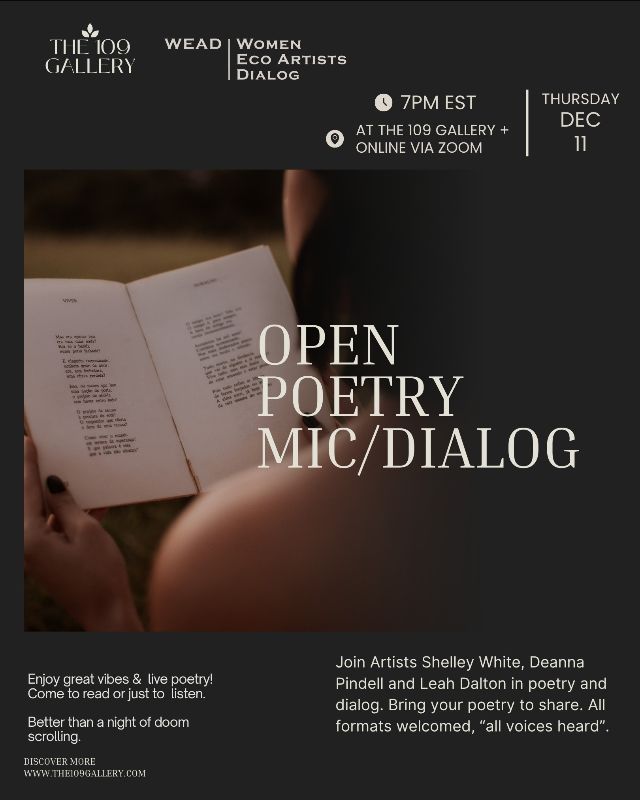
Open Poetry Mic/Dialog, part of WEAD's 2025 exhibition Borders & Bodies: Ecologies of Consent
Open Poetry Mic/Dialog with Shelley White, Deanna Pindell, Leah Dalton, Petra Kuppers, and Ruth Wallen, as part of Borders & Bodies: Ecologies of Consent, the 2025-26 show of WEAD members’ ecoart and social justice art Recorded live, December 11, 2025, on Zoom and live at The 109 Gallery in Chickamauga, Georgia.
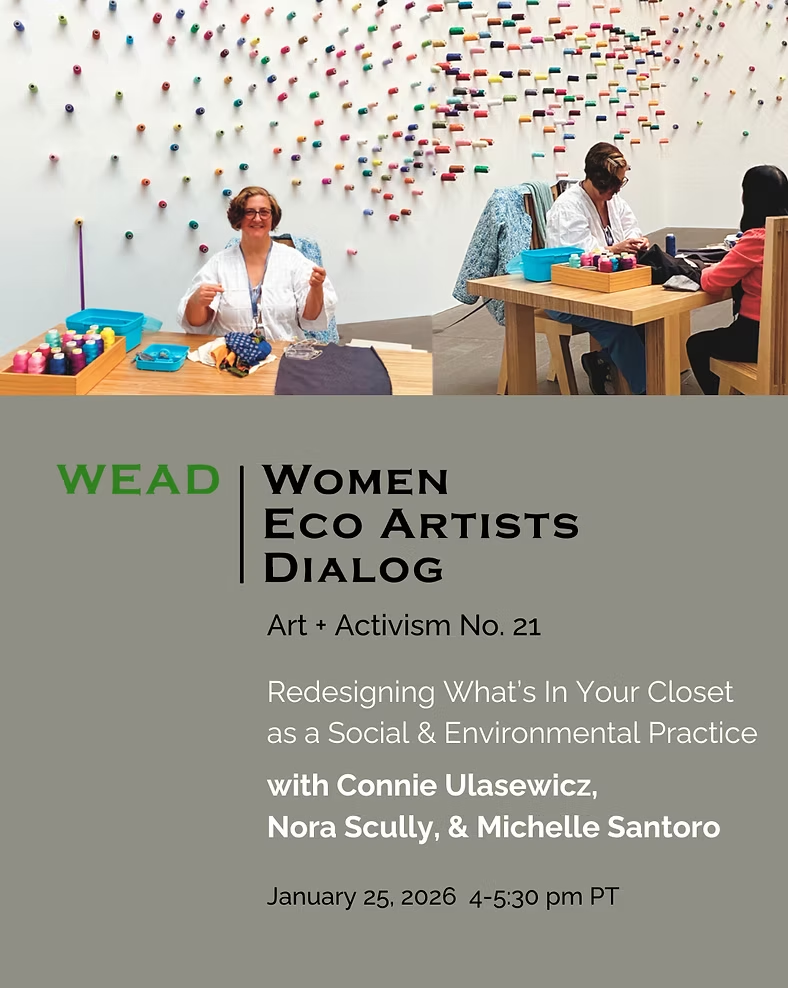
Art+ Activism #21: "Redesigning What’s In Your Closet as a Social & Environmental Practice" with Connie Ulasewicz, Nora Scully, and Michelle Santoro
Why keep or pitch your clothing? Let’s explore why and how you can extend the life of your favorite pieces through repair and redesign.
Your closet holds more than just clothes. It contains gallons of water, pounds of fertilizer, and a significant carbon footprint. If we are responsible for our planet and its people’s well-being, we must adopt practices that cause less harm, starting now. The three of us are each committed to helping you understand the real impact of clothing production, purchasing, wearing, washing, and discarding, as well as the environmental damage caused by misuse. Connie will uncover the waste, pollution, and policies shaping our apparel choices. Nora and Michelle will share practical ways to repair, redesign, and keep your clothes in use. Together, we’ll reveal the true value of what we wear.
As members of STRAC, the California Strategic Textile Recovery Advisory Council, Connie and Nora are sponsors of SB707, California’s Responsible Textile Recovery Act of 2024. This law, the first of its kind in the country, will hold producers accountable for the environmental impact of their clothing. We believe that each of us is responsible for our clothing choices. That mending and creative repair give us the chance to tell a story about our values through color, shape, and texture. As Connie wrote in her co-authored book SUSTAINABLE FASHION, we would then be “pairing our passion for style with a passion for positive change.”