
Location: Berkeley, California
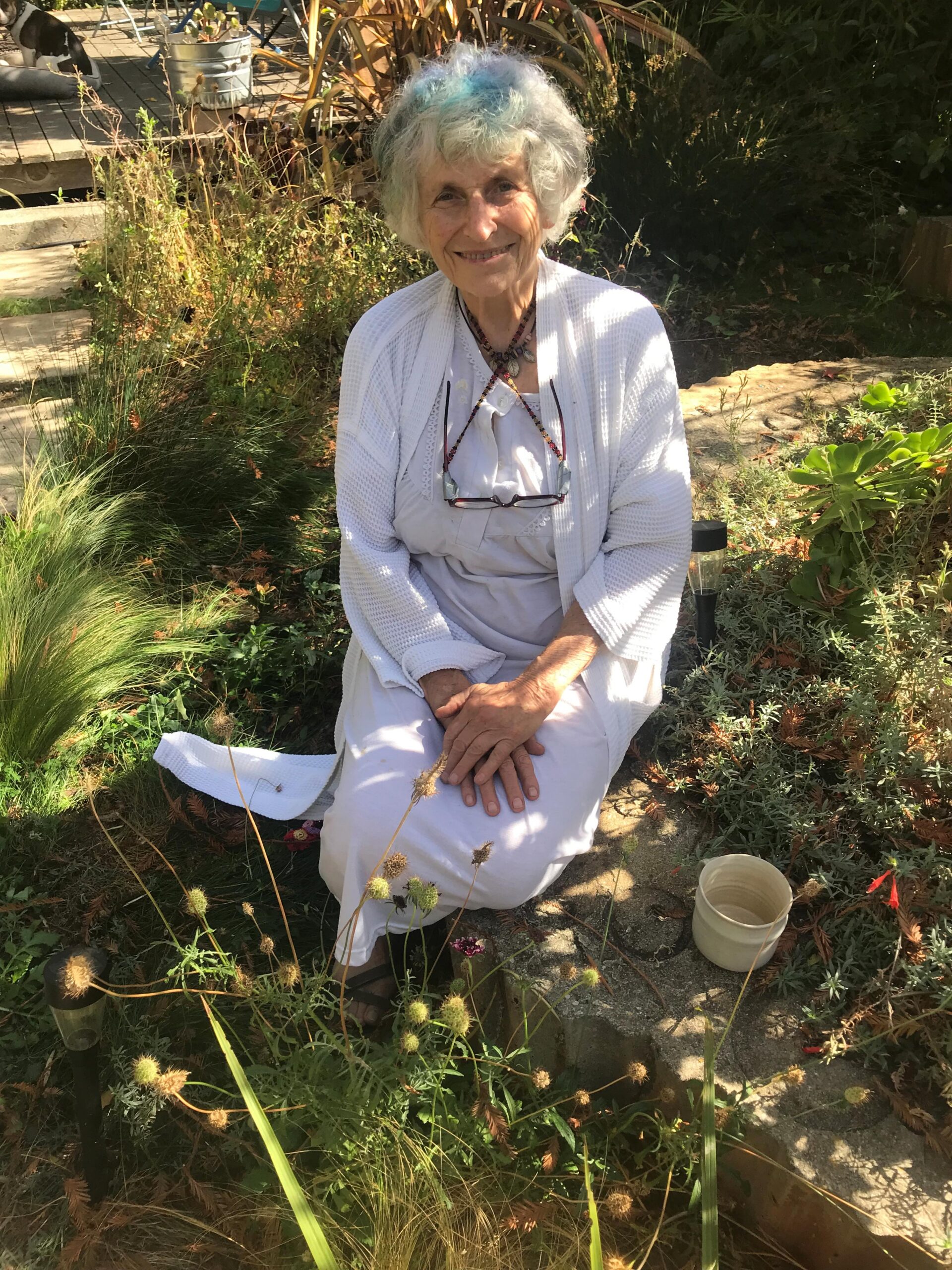
Andrée Singer Thompson, circa 2023. Photo: Susan Leibovitz Steinman
Andrée Singer Thompson is a dear friend of WEAD, a founding WEAD board member, and a gutsy “pied piper.” Her work is based on deep research with pragmatic goals. Her artworks teach, and her teaching gives students the essential tools for healing broken nature and downtrodden communities. Nearing 90 years old, she continues to model courage, tenacity, creative chutzpah, and kindness.
Andrée lives in a multicolor Victorian house in West Berkeley, California. Giving directions, she says, “I’m a short person living on Short Street.” What may seem silly isn’t; no one forgets that street. It’s indicative of a vibrant sense of humor, a critical survival tool, and an effective teaching strategy. She loves a full house. Her door is open to community, students, activists, artists, both new and known for decades, and strangers sent by other believers. She’ll offer to feed you, maybe fresh greens from her organic garden or eggs from her chickens. Frustrated and angry over dark, divisive politics, she uses art to teach survival skills for bad times, emphasizing collaboration with nature and each other. She lives what she teaches: empathy, tolerance, inclusivity, sharing, the importance of all arts, and love. Her words become a catchy tune you can’t get out of your head. And that is why she is a pied piper. Her words stick and encourage action.
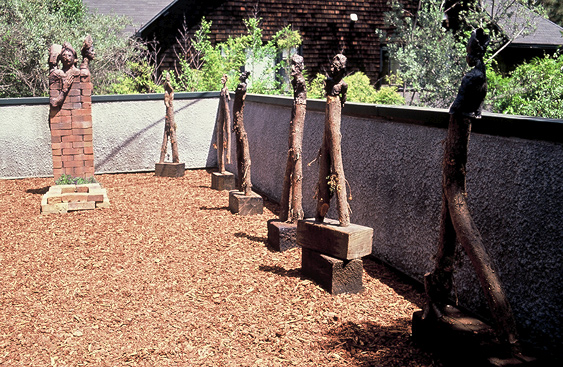
Survivors (installation view),19 figures of ceramics, brick, and wood, Judah Magnes Museum, Berkeley, California, 1992.
This is Andrée’s story, told by Andrée; partly excerpted from the Bay Area Women Artists Legacy Project series.1
Andrée by Andrée
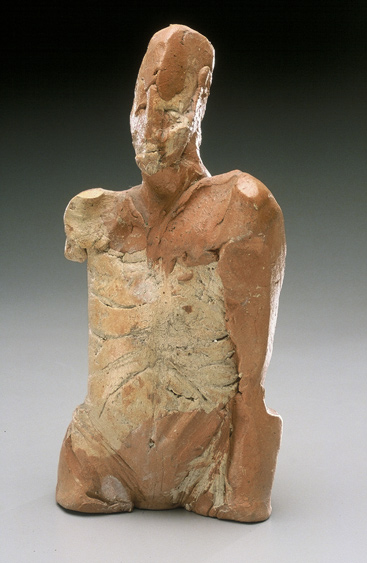
Survivor (one in a series), fired stoneware, 1992.
I. Art as a Healing Force
My belief in art as a healing force, a constant in my teaching practice, has its roots in a dysfunctional childhood. As a child, I always loved to draw. I discovered consolation from home trauma in my visual and written creations. In school, I was lucky to find positive mentors. My high school art teacher suggested I go to art school — a prospect unacceptable to my family. On a scholarship to Western Reserve University, I enrolled in Cleveland Institute of Art courses.2,3 There, discovering clay, I was encouraged by Toshiko Takaezu to pursue an art career.4 I kept a psychological partner by majoring in both art and psychology. After graduating, I hitchhiked around Europe and North Africa for three years. I had seen work by Peter Voulkos and, upon return, moved to California to study with him.5 Although I was still hooked on the psychological safety of functional ware, this helped me to move into more sculptural forms. Needless to say, Pete was a strong mentor, as was Toshiko.
In the early 70s, I had my first one-person show featuring unique functional clay with sculptural components. It was followed by two major shows of landscapes and endangered species at San Francisco galleries. Increasingly, my work and research were about environmental and social justice issues.
In 1975, in reaction to and healing from several family deaths, I began to experiment with using wet clay as a medium, a metaphor for passing time and paying attention to now. The performers I covered in slip (liquid clay) were collaborators.
In 1976, I went to San Francisco State University (SFSU) to study with Jock Reynolds, director of the graduate program in the Center for Experimental and Interdisciplinary Art.6 There, I began a 26-year collaboration under the name “EVA” with Valerie Otani and Elizabeth Stanek, creating large outdoor environmental installations.7 We shared an interest in wet clay as a metaphor for transformation. Environmental and social justice issues were frequent themes. An engaging book about EVA was written by Maria Porges.8,9 Unfortunately, Valerie Otani passed away before the book was published.
II. Drying Clay as Metaphor
-
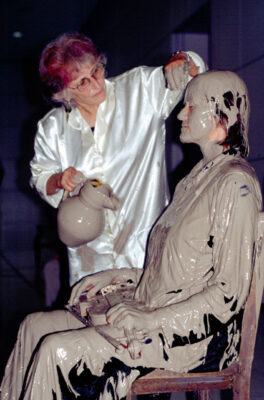
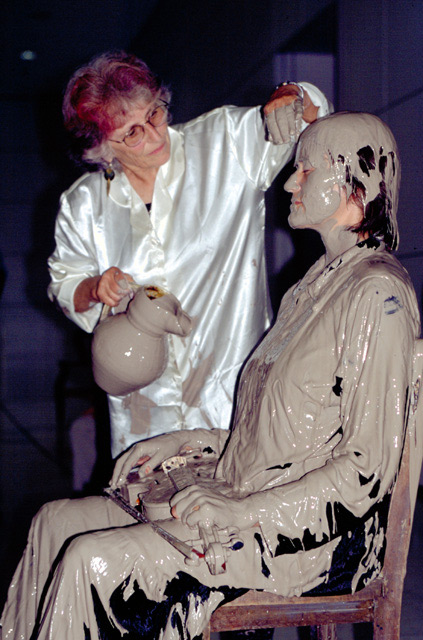
- Skins Modulations: Marty Simonds (performance view), wet to dry cracked clay.
-
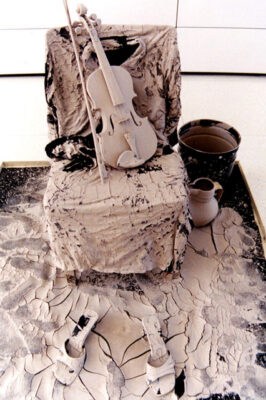
- Installation view, Pacific Rim Sculptors Group Show, 2003.
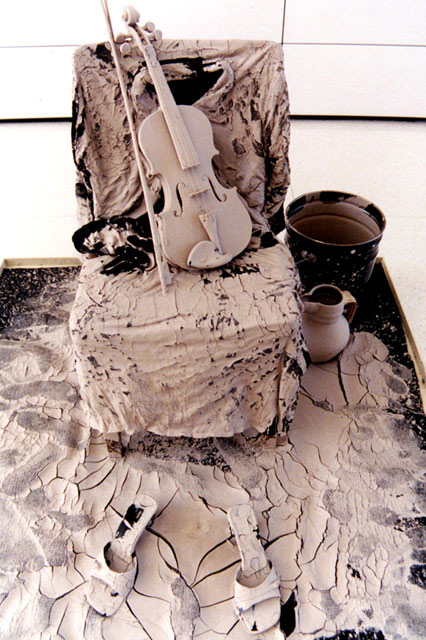
I have always loved clay best in its wet state. In the 80s, I continued experimenting with unfired liquid slip. The transitions that occur in the process of wet slip becoming dry, cracked earth serve as a provocative metaphor for our impermanence, a connection to the earth, and our own ongoing physical transformations. These transitions also reflected personal transformation, as I was once again dealing with family deaths.
In the graduate show at Southern Exposure Gallery in ‘79, I did my first wet clay performance as part of a series, SKINS.10 I covered a friend with a liquid clay slip. He sat still as the clay dried during the evening, and eventually disrobed, leaving the drying clay-covered clothes as a sculptural remnant. Further SKINS performances involved a friend, professional violinist Marty Simonds, with her violin. Marty reflected that both our mediums, live music and wet clay, are transitory in nature.11
At SFSU, Elizabeth, Valerie, and I continued our EVA collaboration, making environmental installations using mixed media. We chose outdoor locations to reach audiences beyond galleries and museums, exploring issues specific to each public site. In the 80s, we did eight large installations, including Clay in Change, 1984, and Blue Perspectives, 1987. In 1988, we created Passages, a site-specific piece at San Francisco’s Intersection for the Arts that was reviewed by Maria Porges.12 The location had been a mortuary, and the piece was a metaphor for transformation between life and death.
Working collaboratively with Elizabeth and Valerie was an important part of my life. As we worked, a fourth entity emerged with the most developed creative ideas, which did not belong to any of us individually. By giving up a piece of ourselves, we could create a better whole. Our collaborative ideas also influenced my personal work.
III. Resilient Survival
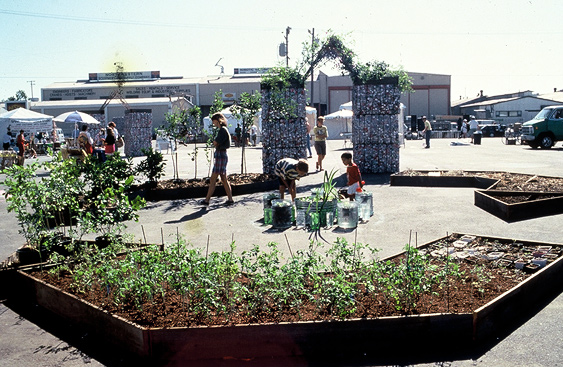
Back 2 The Garden (garden view), Susan Leibovitz Steinman and Andrée Singer Thompson, recycled metal and living plants, Re Cycle Festival, Berkeley Recycling Center, Berkeley, California, 1993. Garden planted in containers shaped in recycling symbols, from fresh compost, to plants with full fruit, to plant material that had been beaten and tossed back into the compost. Photos: Susan Leibovitz Steinman
-
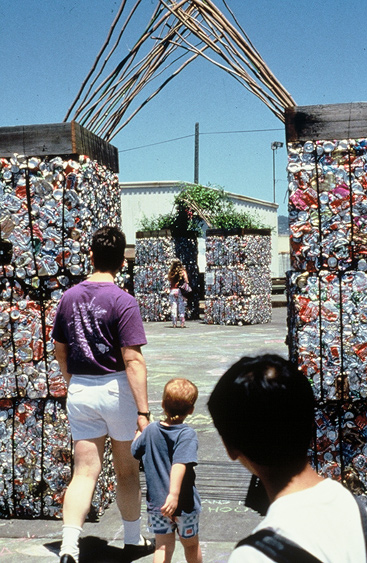
- Back 2 The Garden, entry archway.
-
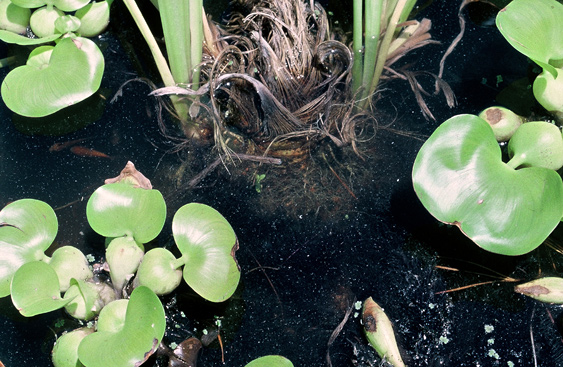
- Close-up view of central garden’s water-cleansing hyacinths.
Resilient survival remains a constant theme in my sculpture and environmental projects, and even in some performance and wet clay installations. One of my more important shows in the 1990s was Survivors at the Judah Magnes Museum, which was a direct expression of and reference to my childhood experience of witnessing the demise of most of my father’s family in the Holocaust from 1937 through 1945.13 Figures in the show were made of clay heads attached to wooden bodies, on bases made of symbolic railroad ties. Trauma often results in the separation of mind and body. The healing process entails uniting the soul, ergo the uniting of clay and wood. One figure, a four-sided chimney with figure heads, reflected in a pool of water, symbolic of life.
During the 90s, I continued doing EVA eco collaborations with Elizabeth and Valerire, including a large installation in Nevada, Olive Tree Requiem at the Oakland Museum, and Cannery Row Catch in Monterey, California.14
Other collaborations during this time included Tathata, a piece with bassist Shinji Eshima, and environmental works with Mary White, Christina Bertea, and Susan Leibovitz Steinman, which usually included outreach education for the students.15 Much of this work was also part of WEAD.
-
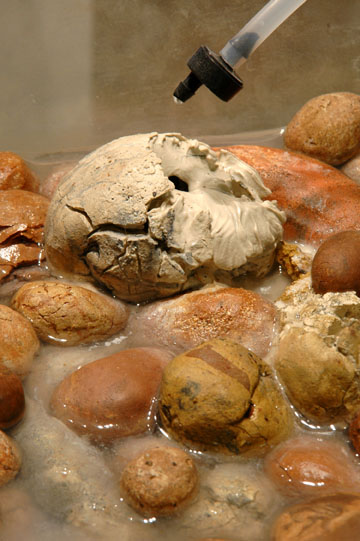
- Fragile Ecologies (close up view), Valerie Otani, Elizabeth Stanek, Andree S. Thompson, unfired clay,
-
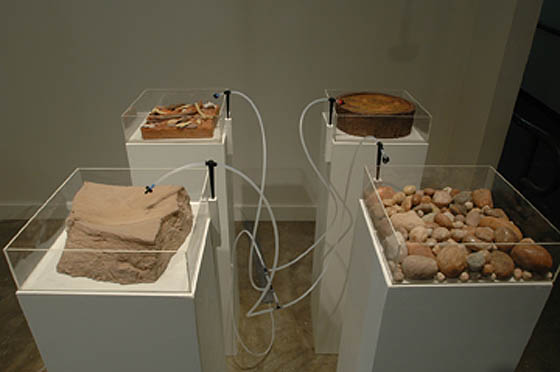
- Installation view, National Council on Education for the Ceramic Arts Conference, Portland, Oregon, 2006.
Another noted EVA show was Fragile Ecologies for the National Council on Education for the Ceramic Arts conference in Portland, Oregon.16 Elements referenced the environment and were made of unfired clay on separate stands. As visitors approached, water came on through a feeding tube above the clay pieces, causing erosion and disintegration. By the end of the month-long show, many had disintegrated. One woman who saw a section of burnished raw clay rocks asked where we got such beautiful rocks. I explained that we made them from unfired, polished clay. As she approached, the water came on, and she exclaimed, “How sad that something so beautiful and time-consuming is going to disappear!” I softly said, “Bingo!”
My educational work, especially with children at risk, is an ongoing force, and in the 90s, I lectured about art as a healing process. The most important issue of our time is the environment, and I continued to make noise with hopes of awakening younger generations to the importance of acting and using our creative talents to give voice to these issues.
IV. Public Engagements
-
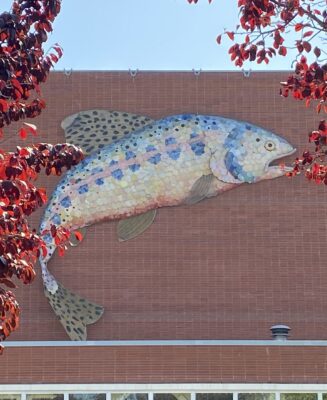
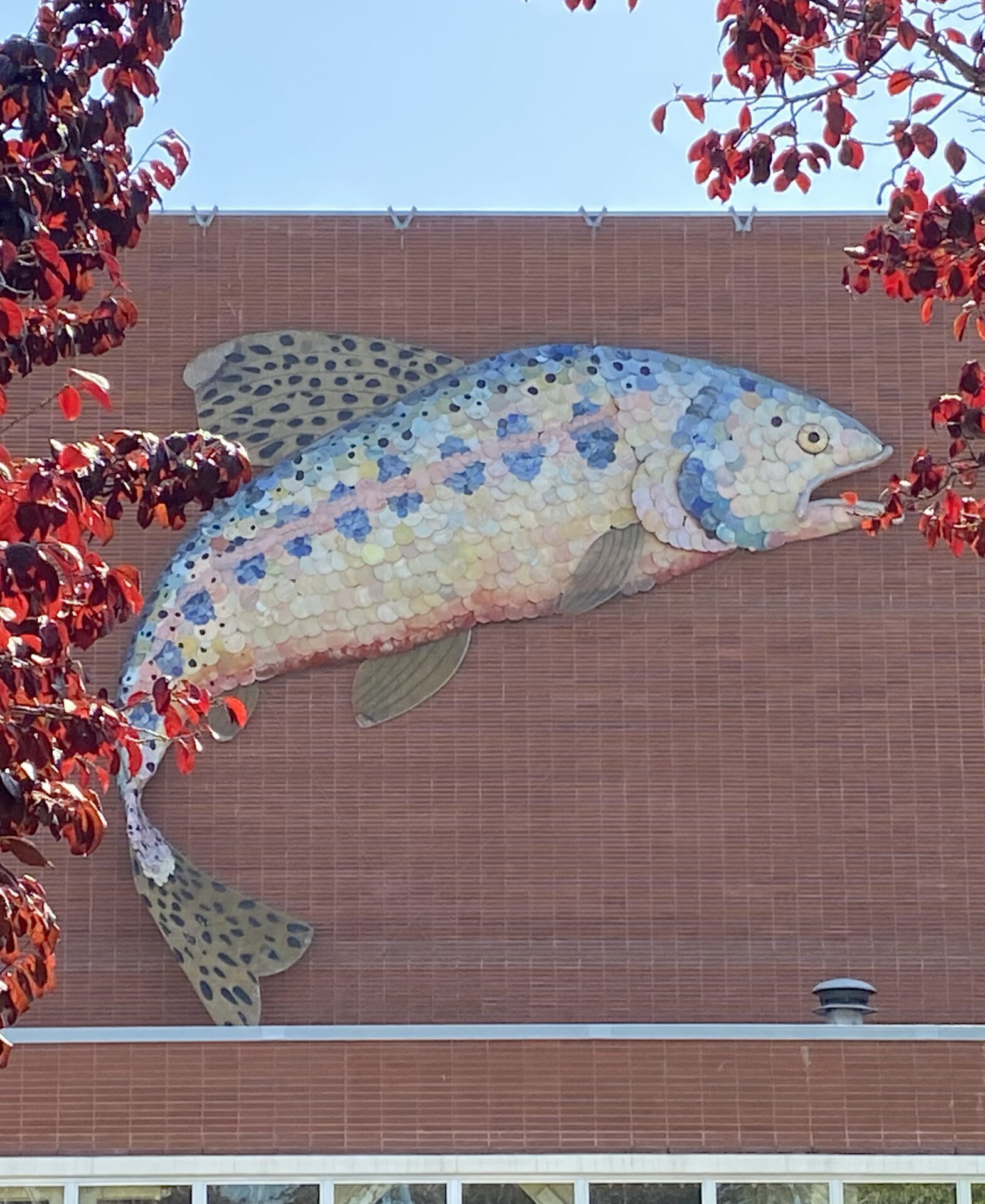
- Making Waves: A Ripple Effect, Guillermo the Golden Trout,, 50 foot, 800 pound recycled metal sculpture. Photo: Kasha Frese, 2025
-
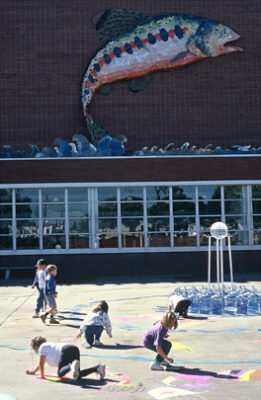
- View from courtyard, Richmond Art Center, Richmond, California, 1997. Below, children draw endangered species in chalk.
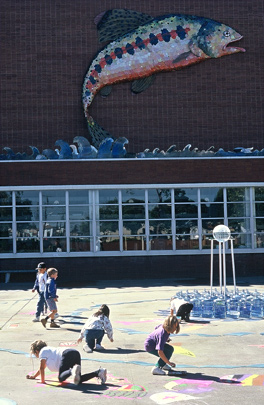
In the early 80s, I began teaching and serving as art coordinator for the Artist in Schools program and the Richmond Art Center (RAC) in Richmond, California.17 RAC Director Jeff Nathanson invited me to create a multi-part eco installation there in 1997.18 The major component was Guillermo, a 50-foot golden trout made of recycled metal, installed on a highly visible outside wall. The golden trout has cycled in and out of endangered species status. The installation embodies my ongoing concern with environmental degradation, healing, and survival, with a focus on the scarcity of drinkable water.
Guillermo was the centerpiece of a larger installation in the center’s courtyard and hallway gallery. In the courtyard, a clear world globe dripped drinkable water. Students from the children’s art classes were invited to do bright chalk drawings of endangered creatures in between the ground waves, which radiated outward from the centerpiece onto the roof, where metal waves surrounded the space.
One indoor gallery was dedicated to my work with children in the Richmond elementary schools and at the Richmond Art Center — “stained glass” paper images of endangered species on sunlit gallery windows. Guillermo remains on the wall of the Richmond Auditorium as a permanent installation and will celebrate its 30th anniversary next year.
-
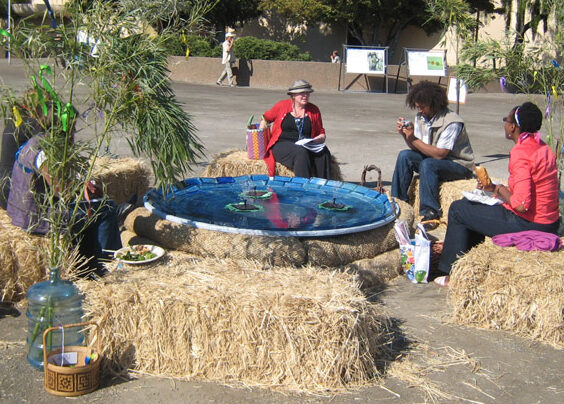
- Water, A Gathering Place, Andrée Singer Thompson, Mary B. White, Christina Bertea, discarded satellite dish, recycled glass bricks, straw wattles, ribbons.
-
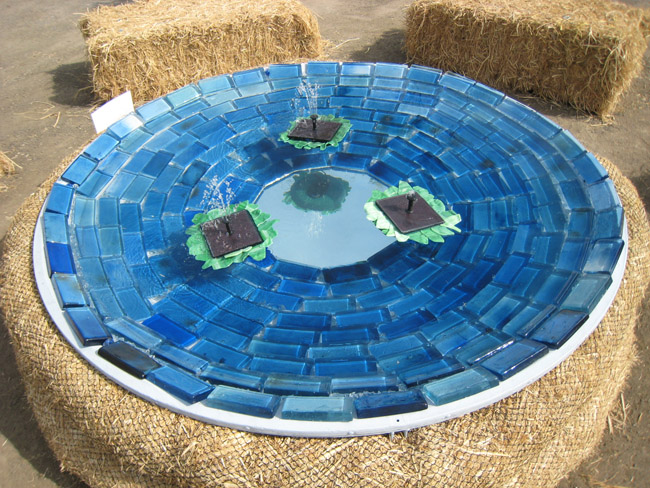
- Installed at Bioneers Conference, Marin Civic Center, San Rafael, Califorrnia, 2008.
In the early 2000s, my work was included in major shows, such as WEAD member exhibitions, a Marin County Falkirk Garden exhibition on art as activism, and annual Bioneers Conference exhibitions.19, 20 I collaborated with Susan Leibovitz Steinman to create several publicly-sited ecoart installations working with civic groups, recycling centers, at-risk high school students, and elementary school classes. These projects had strong participatory and educational components.
V. Education as Ecoart
Since the 1980s, I have filled sketchbooks with drawings of endangered species and information about why they became endangered. I continue to add to my collection of endangered species, as more are lost every year. I most identify with ravens as messengers. They are intelligent, beautiful, crafty, loyal, playful, and funny. They are often in attendance, as watchers in my exhibits.
Much of my personal, collaborative, and installation work is about resilient survival and my belief that we all have an innate desire to heal, both as individuals and communities.
Ecoart Matters Class
-
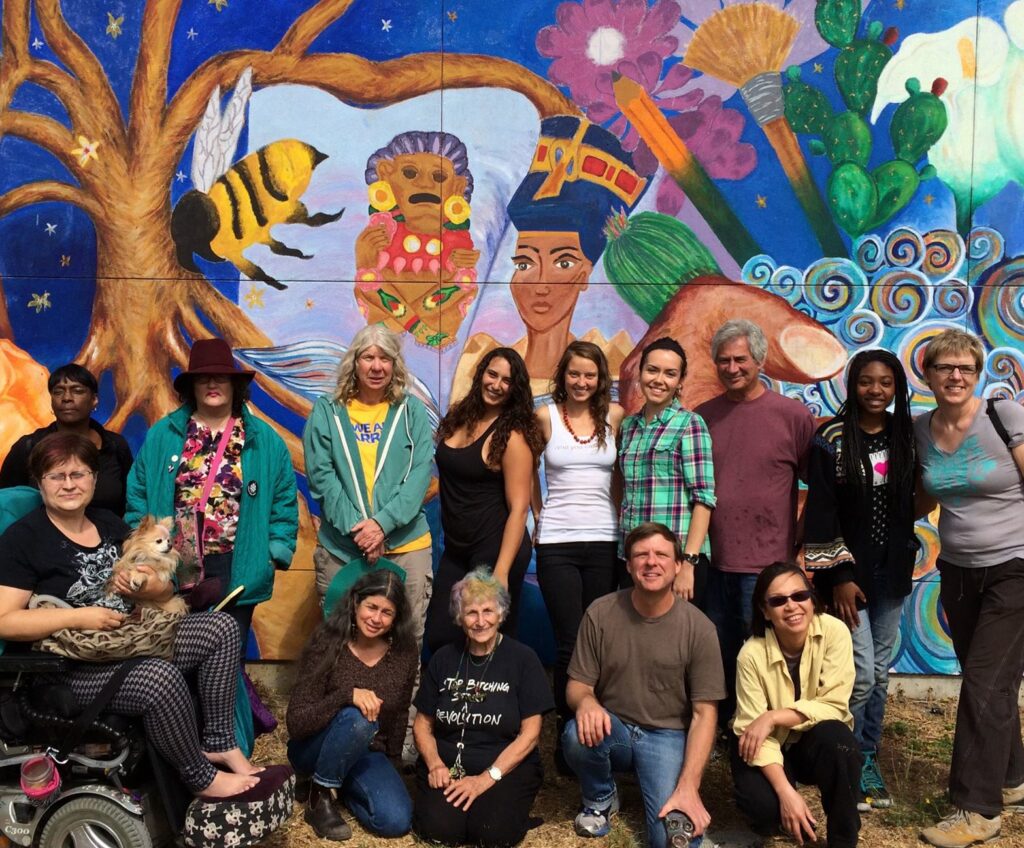
- Students from Fall 2015 EcoArt Matters class with teachers Andrée Singer Thompson and Sharon Siskin.
-
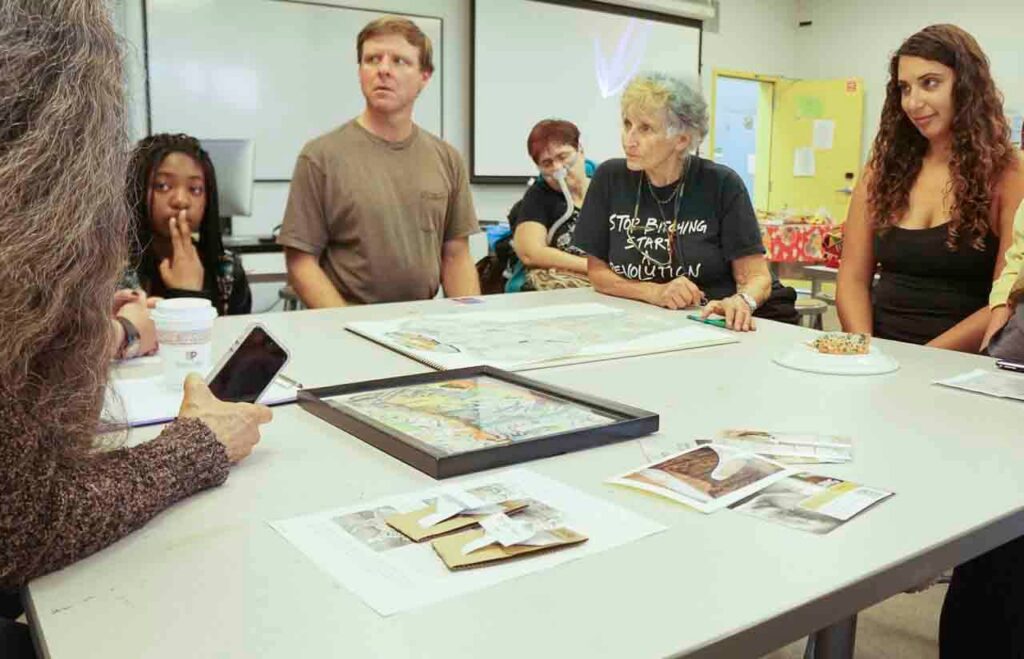
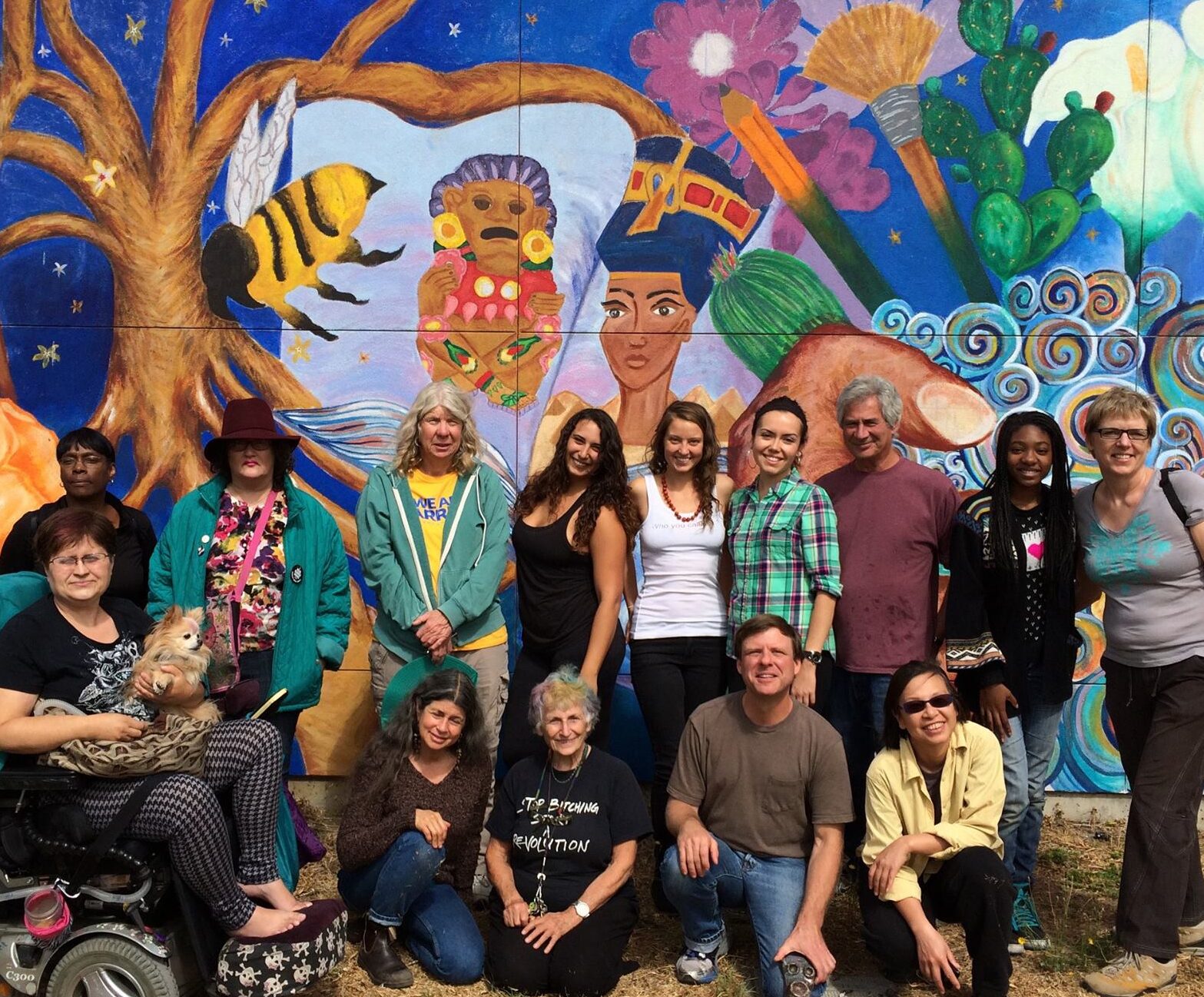
- Andrée with students in EcoArt Matters classroom, Fall 2015.
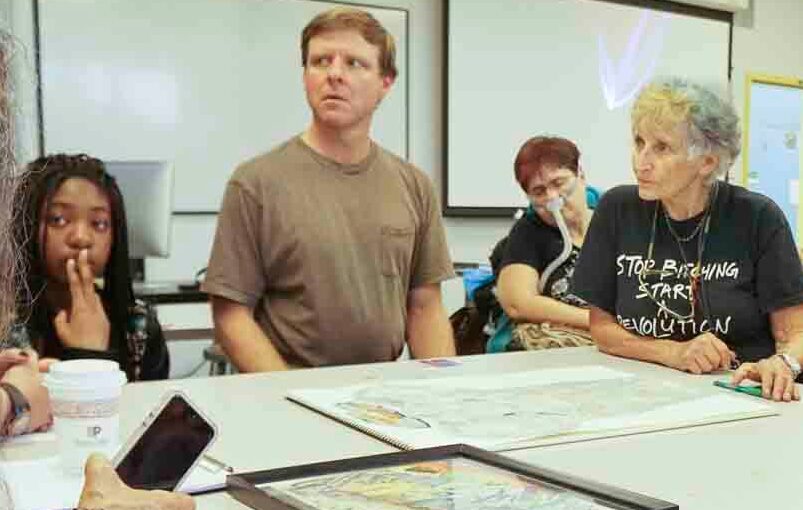
Several outdoor projects, like the Slough (1980) at Point Isabel, made me aware of environmental concerns, a pivotal experience for me. I had researched endangered species for years, and I increasingly became invested in following environmental data. I found it alarming that there was so little public knowledge of how dark the prognosis was.
This awareness led me to design the EcoArt Matters class, which I founded in 2005 at Laney College in Oakland, California.21 Its mission was to introduce college-level students to environmental and social justice issues. The curriculum was designed to encourage students to employ and discover creative solutions. Such a class did not exist in the Bay Area.
The class met once a week for a full day. It included guest speakers, activist artists, and community leaders who worked with environmental resources. Topics included the usefulness of bats (we built bat houses), mosquito abatement, clean water resources, community garden organizing, and more.
For the first project each semester, students were asked to take a solo walk, bringing full attention to how things feel, look, etc. Then, they made a piece about that experience. I invited artists and community organizers to talk to the students, including Berkeley’s Poet Laureate Rafael Jesús González, Inés Ixierda and Victoria Montaño from Sogorea Te Land Trust, Haleh Zandi, founder and director of Planting Justice, and many others. 22, 23, 24 We also took field trips each semester. Some favorites were Recology, Creative Growth, and San Quentin Arts Program.25, 26, 27 Every spring semester, Bioneers provided our students with a scholarship to attend their annual conference, which was always an inspiring time.
Sharing a fresh, healthy lunch was a key part of strengthening the class as a community. Everyone brought something organic for the potluck. As part of their coursework, students told the class where the ingredients in their dish were originally sourced (not the grocery store).
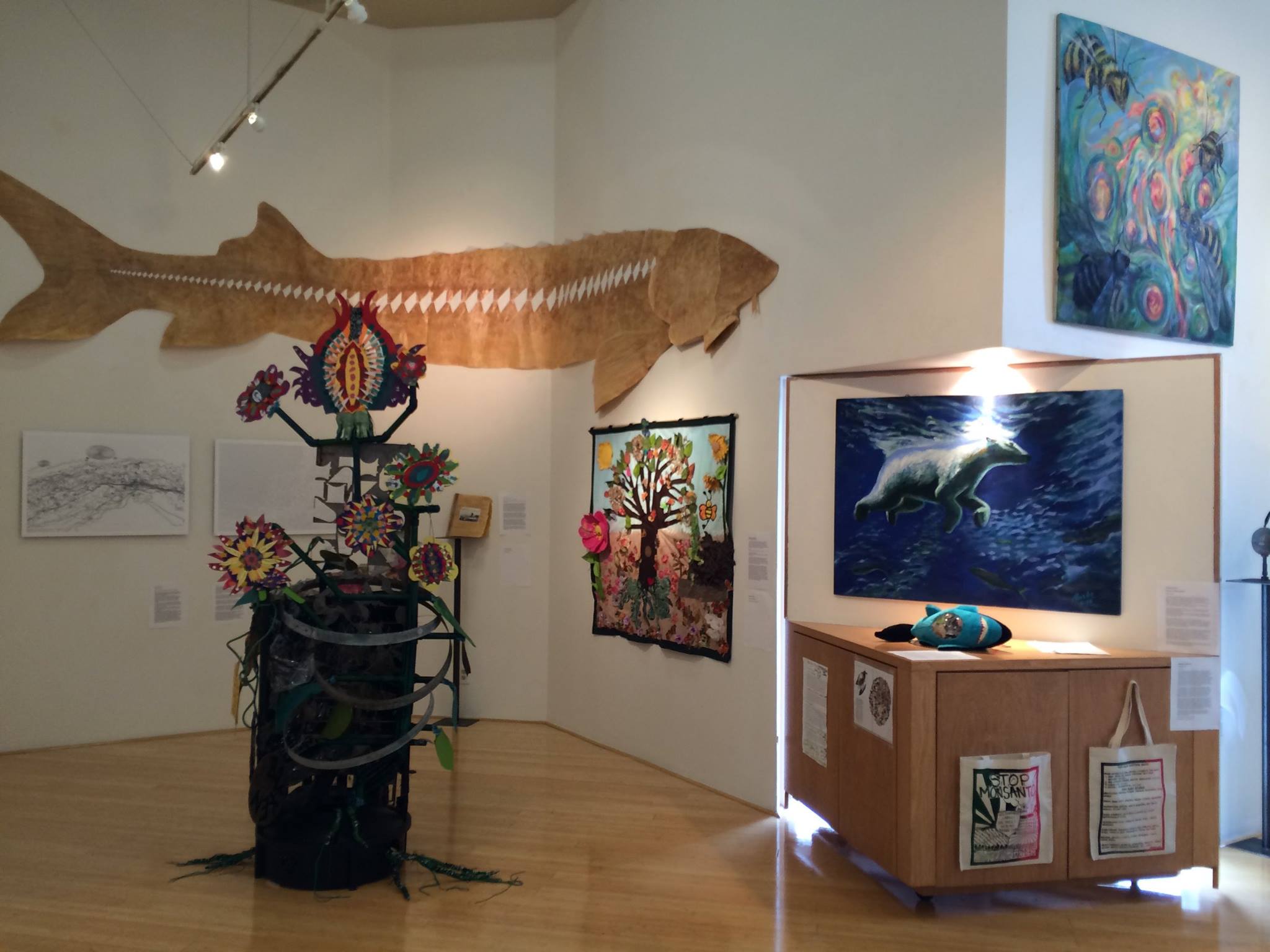
Students’ work in the EcoArt Matters 10th Anniversary Exhibition, June Steingart Gallery, 2015.
Each semester, students researched subjects relevant to themselves and created art to inform and educate their classmates and other viewers. They might choose food, endangered species, water, or any other eco-related topic. It was important that they learn how to think through a project, the proposal, and the dynamics of a group show. These pieces were shown at a final exhibit/performance, which was open to the public. Along with artwork, each student prepared a research paper explaining the topic and how viewers could impact change.
The first year, the students’ show was in the Oakland Museum. We also exhibited at the Steingart Gallery on the Laney campus, the Laney library, the Oakland Zoo’s education center, the Addison Street Windows Gallery in Berkeley, Vickie Jo Sowell’s studio gallery, and Big Daddy’s Complete Rejuvenating Community Garden.28, 29, 30, 31
In 2011, Sharon Siskin came to co-teach with me. Her focus was on community engagement and social justice. It was important for her to be a part of the course. You can’t separate environmentalism from social justice. The course was so popular that many students wanted to take it over and over again. So, we developed four sections or modules. The fourth was the community-engaged section. Students would volunteer for Save the Bay, the Oakland Zoo, etc.32
In 2021, I retired and started coming as a guest lecturer to introduce the core concepts and history of eco-arts. At that point, Raheleh Minoosh Zomorodinia came to teach with Sharon. With her teaching skills in new media, the students learned to create stop-motion animation and short films, which were showcased in the final exhibition.
Postscript
Andrée retired from teaching and the WEAD Board a few years ago. She continued to participate in discussions in the Ecoart Matters classes under its new teachers, Sharon Siskin and Raheleh Minoosh Zomorodinia. A sign of our times, the college administration discontinued the class in fall 2025. Today, not one to be idle, Andrée remains influential in her community, rallying and mentoring wherever she can.
- “Books,” Bay Area Women Artists’ Legacy Project, accessed April 6, 2026, https://bawalp.org/books.
- “About Us,” Cleveland Institute of Art, accessed April 13, 2026, https://www.cia.edu/about-us/.
- “History,” Case Western Reserve University, accessed April 13, 2026, https://case.edu/about/history/.
- “About Toshiko,” Toshiko Takaezu Foundation, accessed April 13, 2026, https://www.toshikotakaezufoundation.org/about-toshiko.
- “Peter Voulkos,” Smithsonian, accessed April 13, 2026, https://americanart.si.edu/artist/peter-voulkos-5183.
- “Curating a Legacy”, The New Journal, accessed April 13, 2026, https://thenewjournalatyale.com/2018/02/curating-a-legacy/.
- “Valerie Otani,” Public Art Archive, accessed October 12, 2025, https://publicartarchive.org/artist/Valerie%20Otani.
- “About,” Maria Porges, accessed April 13, 2026, https://mariaporges.com/about-2.
- Maria Porges, EVA: A Collaboration (Andrée Singer Thompson, Berkeley, California, 2019),
- “History,” Southern Exposure, accessed April 13, 2026, https://soex.org/about/history.
- “Martha Simonds,” San Francisco Opera, accessed April 13, 2026, https://www.sfopera.com/about/bios/orchestra/martha-simonds/.
- “About,” Intersection for the Arts, accessed April 13, 2026, https://theintersection.org/about-intersection/.
- “Judah L. Magnes Museum,” Magnes, accessed April 13, 2026, https://magnes.berkeley.edu/research-at-magnes/judah-l-magnes-museum/.
- “About,” Oakland Museum of California, accessed April 13, 2026, https://museumca.org/about-us/.
- “Shinji Eshima,” San Francisco Ballet, accessed April 13, 2026, https://www.sfballet.org/orchestra/shinji-eshima/
- “About,” National Council on Education for the Ceramic Arts, accessed April 13, 2026, https://nceca.net/about-us-1.
- “About,” Richmond Art Center, accessed April 13, 2026, https://richmondartcenter.org/about/.
- “Press Release: Jeff Nathanson Named Interim Executive Director of Richmond Art Center,” Richmond Art Center, accessed October 12, 2025, https://richmondartcenter.org/press-releases/press-release-jeff-nathanson-named-interim-executive-director-of-richmond-art-center/.
- “Falkirk Demonstration Gardens,” City of San Rafael, accessed April 13, 2026, https://www.cityofsanrafael.org/falkirk-demonstration-gardens/.
- “Our Purpose,” Bioneers, accessed October 12, 2025, https://bioneers.org/about/purpose/.
- “Laney College,” Peralta Community College District, accessed October 12, 2025, https://www.peralta.edu/about/laney-college.
- “Rafael Jesus Gonzalez,” Engaging the Senses Foundation, accessed April 13, 2026, https://engagingthesensesfoundation.com/poet/rafael-jesus-gonzalez/#:~:text=Rafael%20Jes%C3%BAs%20Gonz%C3%A1lez%2C%20Prof.,%26%20Latin%2DAmerican%20Studies%20in1969.
- “About,” The Sogorea Te Land Trust, accessed April 13, 2026, https://sogoreate-landtrust.org/about/.
- “About,” Planting Justice, accessed April 13, 2026, https://plantingjustice.org/pages/about-us.
- “About Us,” Recology, accessed October 12, 2025, https://www.recology.com/about-us/.
- “About,” Creative Growth, accessed September 4, 2025, https://creativegrowth.org/about.
- “About Us,” Recology, accessed October 12, 2025, https://www.recology.com/about-us/.
- “About,” Creative Growth, accessed September 4, 2025, https://creativegrowth.org/about.
- “Sanctuaries, Prisons, and Healing,” Women Eco Artists Dialog, accessed April 13, 2026, https://weadartists.org/sanctuaries-prisons-and-healing/
- “Cube Space Gallery,” (formerly Addison Street Windows Gallery), City of Berkeley Civic Arts Program, accessed October 12, 2025, https://berkeleyca.gov/community-recreation/civic-arts/public-art/cube-space-gallery
- “About,” Vickie Jo Sowell, accessed October 12, 2025, https://vickiejosowell.com/about
- “Big Daddy’s Complete Rejuvenating Community Garden,” Vickie Jo Sowell, accessed October 12, 2025, https://vickiejosowell.com/garden
- “Who We Are,” Save The Bay, accessed October 14, 2025, https://savesfbay.org/who-we-are/.
© Copyright 2026 Women Eco Artists Dialog. All rights reserved.