
Location: Healdsburg, California
FIRST, A PERSONAL CALL TO COLLECTIVE ACTION
Historically, WEAD has worked to support the broadest umbrella of earth and social justice feminist artists. It’s integral to our philosophy that good can emerge from different soils. While ecologically this approach remains smart, it has proven politically complex in the current world crisis. WEAD never assumes our members have identical viewpoints. Diversity makes us strong. We need to unite specifically to safeguard diversity. Today in the U.S., ecological, cultural, and constitutional protections are being destroyed. Innocent people are being killed, decent people are being deported, and unwarranted wars are spreading globally. Embracing our differences, we can and must work together to preserve all life and to dislodge those bent on doing harm.
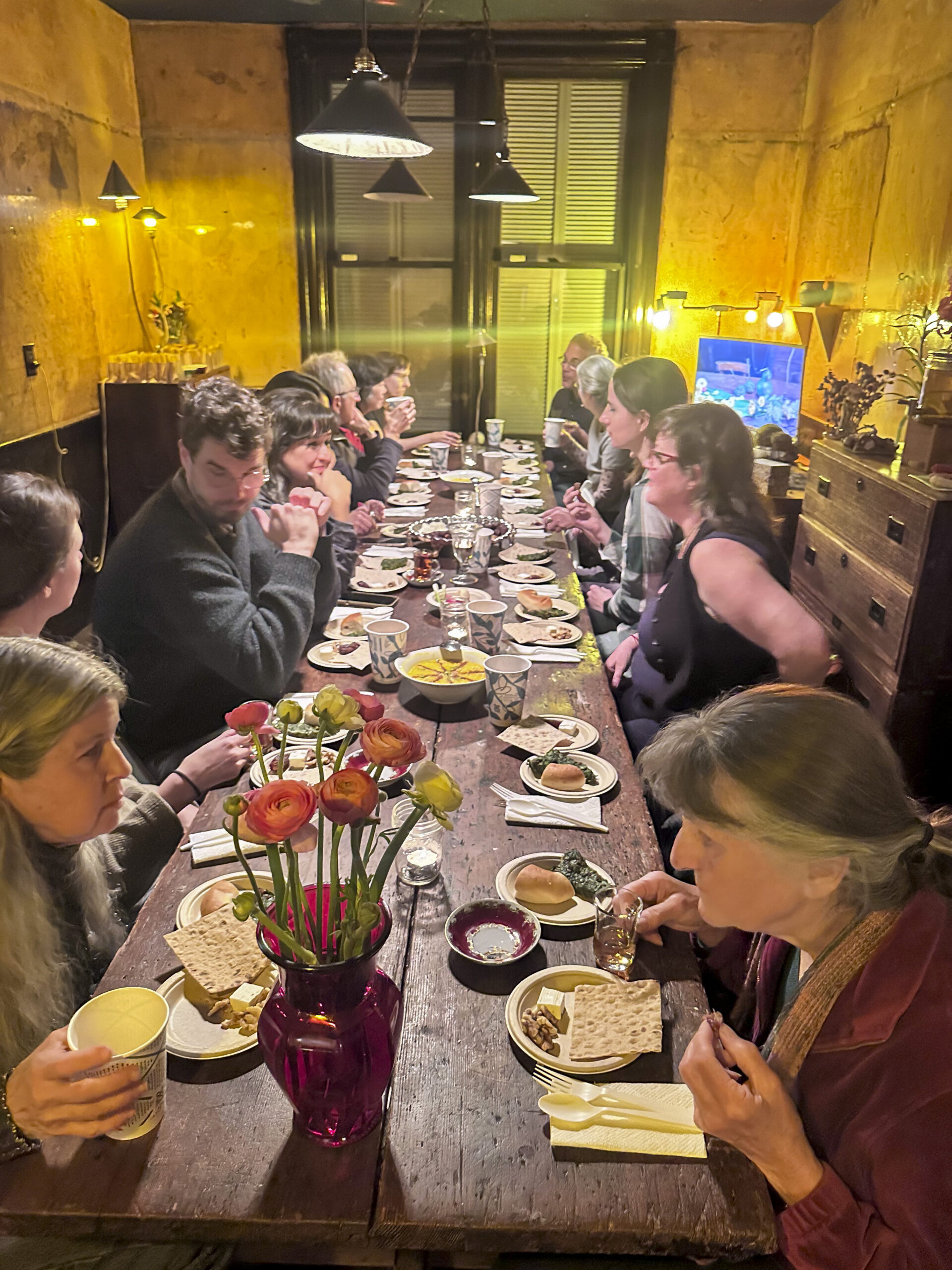
Bahar Celebration, Minoosh Zomorodinia, 2025, The David Ireland House, San Francisco.
ISSUE 15: PLACE SETTING
PLACE SETTING is our poetic analogy for community-based, site-specific art. Each essay explores working in a specific community, as a guest or local artist, collaborating with that community to represent its history and culture, goals, and needs.
Featured Artist: Andrée Singer Thompson
In this issue, we honor the deeply respected California artist Andrée Singer Thompson. In San Francisco’s East Bay communities, we call her our ecoart pied piper. She has logged more than half a century of teaching time with all ages and grades, from elementary to college classes. We call her a pied piper because students follow her heartfelt paths to healing environmental and social justice wounds. She epitomizes the power of teaching for the survival of future natural resources and generations. She is a local treasure and a global model of how to inspire students of all ages.
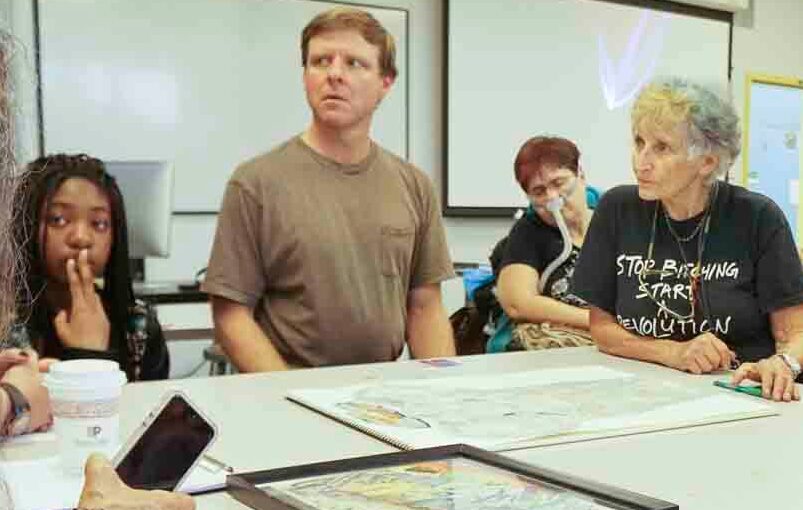
Andrée Thompson with students in the EcoArt Matters classroom at Laney College, Oakland, California, Fall 2015.
The Central Essays
Ecoartist Residencies
Four essays share the commonality of being written by artists working within artist-in-residence programs in alternative community settings. They exemplify the high value of such programs to communities and artists.
Mallery Quetawki (member of the Pueblo of Zuni Tribe, New Mexico) is artist-in-residence for the College of Pharmacy, Community Environmental Health Program, at the University of New Mexico. She writes The Indigenous Ways of Knowing and Art as Scientific Translation for Native American Communities Affected by Abandoned Uranium Mines.
Across the U.S., in its most northeastern corner, Downeast Maine, Stephanie Garon (Maryland) writes about another abandoned mine’s negative effects on the ecology and cultural lives of the Passamaquoddy Tribe’s land. Mining here has impacted the water supply for five townships and two reservations.
Climate change and colonization in New Zealand have endangered environmental relationships and cultural values of the Maori people. Laura Donkers, as a non-Indigenous New Zealander, examines the idea of Home in the Hokianga Community (Northland, Aotearoa/New Zealand) through a public drawing project she led as an artist-in-residence there.
A veteran of community art programs in alternative settings, Carol Newborg (California) writes how that history led her to San Quentin Prison in 2010, where she was hired as the new arts program director. She found San Quentin to have its own sense of community. Her work had two core components: facilitating access to art and bringing that art to the public. The program continues to be a huge success and a model for other art-in-prisons programs.
The Soil is Alive
Two essays in this issue investigate a sense of place via the microbial activity in soil.
Rhonda Janke (Kansas) and Deanna Pindell (Washington) write about separate and collaborative projects that derive from burying cloth in soil, as artworks and as scientific experimentation.
Salma Arastu‘s essay, Soil and Soul, traces her personal history. Arastu was born in India, has moved several times, and now lives in Berkeley, California. Her current artwork is based on her studies of the attributes of soil, and she writes about how it has influenced her contemporary calligraphic paintings. Her mission is to unite humanity and spirituality, soil and soul, with soil as her teacher.
Department Essays
Dr. Robin Wall Kimmerer: An Appreciation
A New York Times piece by Alexandra Alter, November 29, 2024
I first read this essay in the New York Times (NYT), published on the occasion of the release of Dr. Robin Wall Kimmerer’s latest book, The Serviceberry: Abundance and Reciprocity in the Natural World (2025). Her books have almost cult status among ecologists and are hugely popular with the broader public. They are the kind passed from peer to peer, friend to friend, and among family members. Her previous book, Braiding Sweetgrass, spent five years on the NYT bestseller list. WEAD thanks the NYT for generously allowing us to republish this article.
Becoming Ecoart Elders
Bee (Beverly) Naidus and Ruth Wallen
Two longtime, highly respected WEAD Seed Artists and friends, Bee (Beverly) Naidus and Ruth Wallen, are now elders in the ecoart field. With more than 40 years of ecoart projects, installations, teaching, and writing, they take the time to sit down together to reflect on what aging means personally and how it affects continuing projects and future plans.
Spirit Gleaning Review: Minoosh Zomorodinia’s Experimental Installation at 500 Capp Street
Sharon Siskin
In 2024, Minoosh Zomorrodinia was awarded the prestigious artist residency at 500 Capp Street, the former house and studio of the iconic conceptual artist and sculptor David Ireland (1930-2009). Zomorrodinia’s work paid homage to Ireland’s legacy of investigating and inviting participation from the local community. Sharon Siskin reports on the multiple presentations and community collaborations Zomorrodinia offered at 500 Capp Street.
Next Issue
Proposals for essays are accepted on a rolling basis. The magazine publishes approximately once a year, with a very loose deadline for publishing. Authors of accepted essays receive an honorarium of $100 and our profound thanks.
Artist Portfolios
Submissions to the Arist Portfolios section of WEAD Magazine are limited to WEAD members. Submit 5+/- excellent images with a few paragraphs about them and your work. Approximately 10 artists are included in each issue. There is no remuneration. Inquire via info@weadartists.org.
Poetry, A Fresh Opportunity
Beginning with the next issue, WEAD Magazine will include poetry. Please submit your poems dealing with ecology, social justice, nature, women’s experiences, and life motifs. Write info@weadartists.org if you have further questions.
Recommended Reading
We depend on our large community of readers to alert us to the books most worth reading. And if you personally have written one, send us the information. We thrive on recommendations. Send via to info@weadartists.org.
Closing
I founded WEAD Magazine in 2009. An undergraduate journalism major, I’d always wanted to produce a magazine, and WEAD was a golden opportunity. Wrapping up Issue # 15 in 2026, I am past 80 years old. No matter the problems, I’ve had the fortune of a good life. While I can, I want to mentor a new editor or editorial team, wherever you are in this world. Due to the wonders of Zoom and similar programs, the editorial team doesn’t have to be in one place.
If you’ve ever wanted to produce a magazine that champions the values of eco and social justice art, this is your own golden opportunity. Email me at steinmanstudio@gmail.com and be sure to copy info@weadartists.org. I’ll tell you the pros, and honestly, the cons of this volunteer position. In the balance, the work has been amazingly rewarding. It has deepened my own ecoart and social justice education, and introduced me—and our readers—to artists working all over the world, doing incredible, meaningful work. Let’s keep it going.
Thank you,
Susan Leibovitz Steinman
WEAD MAGAZINE #15: PLACE SETTING
Masthead
Issue 15 Press kit: bit.ly/15_presskit
Creator: Susan Leibovitz Steinman
Executive editor and editor-in-chief: Susan Leibovitz Steinman
Production and editorial director: Kasha Frese
Production assistant: Mikala Aragón Sterling
Copyeditors: Emily Anne Kappenman and Lanny DeVuono
Contributors: Alexandra Alter, Salma Arastu, Laura Donkers, Stephanie Garon, Rhonda Janke, Bee (Beverly) Naidus, Carol Newborg, Deanna Pindell, Mallery Quetawki, Sharon Siskin, Ruth Wallen
ABOUT WEAD MAGAZINE
WEAD Magazine was created by Women EcoArtists Dialog (WEAD) founder Susan Leibovitz Steinman in 2009. The online magazine is content-driven and publishes on an intermittent annual schedule. It features essays and artwork from international social justice and ecoartists, curators, and historians. Edited to be accessible to readers from all walks of life, it is an archive of the field, a resource for academics, and an inspiration to artists and scientists. Each issue includes a featured artist and six articles by ecoartists or social justice artists who share the philosophical underpinnings, methodology, evolutions, and outcomes of their practices. Issues also include reviews of art shows, artists in conversation, and featured artist portfolios.
Susan Leibovitz Steinman is editor-in-chief. Donna Brookman, Praba Pilar, and Connie Tell have guest edited. Kasha Frese is director of production and editorial. The magazine has featured the groundbreaking artists: Helène Aylon, Claudia Bernardi, Betsy Damon, Agnes Denes, Reiko Goto, Mildred Howard, Suzanne Lacy, Amy Lipton, Mali Wu, Larissa Marangoni, Amalia Mesa-Bains, and Reva Stone.
Past contributors are Mary Jo Aagerstoun, Krystle Ahmadyar, Stefani Allegretti, Jane Ingram Allen, Navjot Altaf, Jacki Apple, Rina Banerjee, Liza Behrendt, Claudia Bernardi, Suzaan Boettger, Wendy Brawer, Jackie Brookner, Teresa Camozzi, Beth Carruthers, Elina Chauvet, Joyce Cutler-Shaw, Erica Cirino, Tim Collins, Betsy Damon, Jane Chin Davidson, Anne Douglas, Edie Dillon, Chris Drury, Joann Easton, Lauren Elder, Evgenia Emets, Ria Vanden Eynde, Verona Fonte, Chris Fremantle, Suzon Fuks, Sheila Ghidini, Leslie Goldberg, Isabella La Rocca González, Reiko Goto, Jean Grant, Michele Guieu, Lynne Hull, Basia Irland, Joyce Janvier, Jourdan Imani Keith, Atefeh Khas, David Kupfer, Robin Lasser, Eve Andree Laramee, Loraine Leeson, James Lerager, Chiyomi Taneike Longo, Stacy Levy, Laura Lynch, Tina Mariane Krogh Madsen, Mahmoud Maktabi, JL Malbrook, Mali Wu, Larissa Marangoni, Angela Marsh, Dominique Mazeaud, Anke Mellin, Barbara Morris, Zea Morvitz, Andrew Munn, Beverly Naidus, Carol Newborg, Nazanin Noroozi, Caro Novella, Mary A. O’Brien, Lissette Olivares, Daniela Peña Corvillon, Praba Pilar, Cecile Pineda, Kamala Platt, Aviva Rahmani, Tabita Rezaire, Denny Riley, Boryana Rossa, Randy Rosenberg, Ann T. Rosenthal, Robin Rosenthal, A.E. Ryan, Shelley Sacks, Hiroko Shimizu, Margaret Shiu, Danielle Siembieda, Sharon Siskin, Maya & Rachel Siskin-Lavine, Jennifer Smith, Sharon Spain, Elizabeth Stanek, Megan Steinman, Susan Leibovitz Steinman, Lorna Stevens, Paz Tornero, Josefa Vaughan, Cecilia Vicuña, Amber Vilas, Ruth Wallen, Shu-Ju Wang, Patricia Watts, Linda Weintraub, Christine and Margaret Wertheim, Mary Bayard White, Veronica Wiman, Insa Winkler, Robyn Woolston, Nanette Yannuzzi Macias, Yi-Chun Lo, ZAC collective, Shai Zakai, and Minoosh Zomorodinia.
WEAD Magazine readership spans the globe, and the majority of its readers are based in the United States, European Union, United Kingdom, Canada and the Indian Subcontinent. To read any issue of WEAD Magazine, visit weadartists.org/previous-issues/.
About Women EcoArtists Dialog
Founded in 1996 by Susan Leibovitz Steinman, Jo Hansen, and Estelle Akamine, Women EcoArtists Dialog (WEAD) focuses on women’s unique perspectives and collaborates internationally to further the field and understanding of ecological and social justice art. Our purpose is to provide information on the ecoart and social justice art fields to artists, curators, writers, art and public art administrators, educators in art and ecology, cross-disciplinary professionals, and the public, and to further the fields of, and the understanding of, environmental and social justice art. WEAD’s online member directory includes more than 600 artists working with themes of ecology and social justice. WEAD produces an annual member exhibition, the annual WEAD Magazine, a monthly Art+ speaker series, quarterly workshops, and two artist-in-residence programs. WEAD also publishes a monthly newsletter featuring leaders in the field, member and community exhibitions, and calls for art. WEAD’s current board includes Co-Chairs Mary Bayard White and Deanna Pindell, Treasurer Bob Stern, Secretary Rhonda Janke, and Directors Christina Bertea, Leah Dalton, Deb Durant, Lauren Elder, Avery Huetter, Sharon Siskin, and Board Ambassador Callan Porter-Romero. For more information, visit weadartists.org.
© Copyright 2026 Women Eco Artists Dialog. All rights reserved.