
Location: California
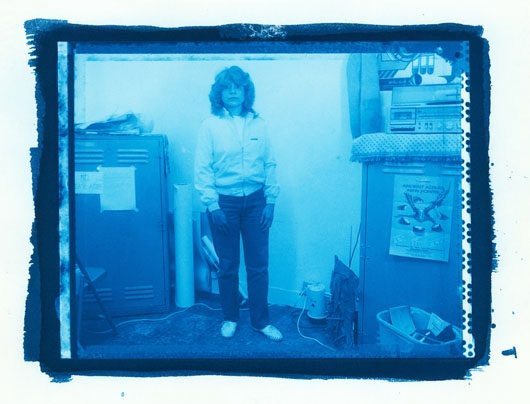
SELF-PORTRAIT COLLABORATION, Robert Solywoda and Inmate, Cyanotype, 1987.
I. CREATING A PRISON STUDIO
IN 1984, I ENTERED THE WORLD OF A WOMAN’S prison—as an art teacher. The first class I taught was drawing, and that first night, 23 women inmates showed up and sat at card tables set up in a hallway of California Rehabilitation Center, in Norco, east of Los Angeles. I wanted to start with drawing a room, since I thought that creating an imaginary personal space might be inviting. To set up the single-point perspective, I asked everyone to start from the upper left corner of the page. I looked around and counted—two women started at the upper left. Shortly after that, I found out how common learning disabilities are among inmates. Later, I realized that was only one of many reasons that women inmates have had trouble fitting into school and the rest of society; about 80% of women inmates also have a history as victims of physical and/or sexual abuse. They are mostly very low income, and a large majority have two or more children and are single. Over 60 percent of women inmates are in for drug or other non-violent property crimes.
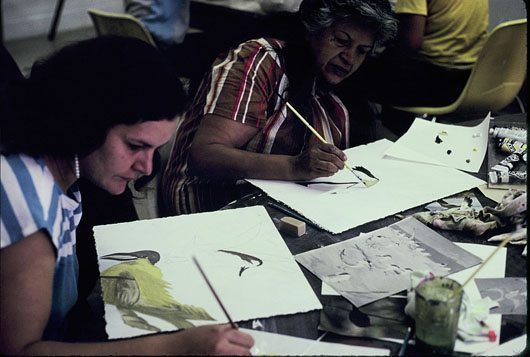
BIRD MURAL, Tom Skelly and CRC inmates, 1987
I learned a lot from that first class, and learned more as I went on to three years of a California Arts Council Artists-in-Social-Institutions grant, with support from Arts-in-Corrections, a program of the California Department of Corrections and Rehabilitation (CDCR) from 1980 to 2010. In 1980, each of the six prisons in the state hired an artist/facilitator, who worked to supervise art, music, theater, and other classes. Until 2003, each new prison was built with a studio and practice rooms, and each had an artist/facilitator.
California Rehabilitation Center (CRC) was an extremely incongruous prison site. It opened in 1929 as a luxury resort hotel, and it featured a marble dance floor in the ballroom, carvings, tile murals, hand-painted ceilings, and an Olympic-sized swimming pool and mineral baths, and was supposedly patronized by Al Capone and other famous criminals. The depression ended its life as a hotel, and it later became a Navy hospital. It was passed to the state as the site for CRC in 1963. Since that time, California has gone on to build all of its new prisons, now numbering 33, rather than adapt other buildings.
Due to its history as a rehabilitation center, the CRC administration was supportive of the new Arts-in-Corrections (AIC) program, which started in 1980. I was given a small storage shed, and helped clear the old furniture, books, and raccoons out of it so that I could have two tables, a kiln, and shelves, and offer classes for up to 12 inmates at a time. The program was successful, and the following year, I was given a much larger space, the old Navy morgue, which became the studio for many years to follow.
II. EARLY PROJECTS—INDIVIDUAL AND COLLABORATIVE
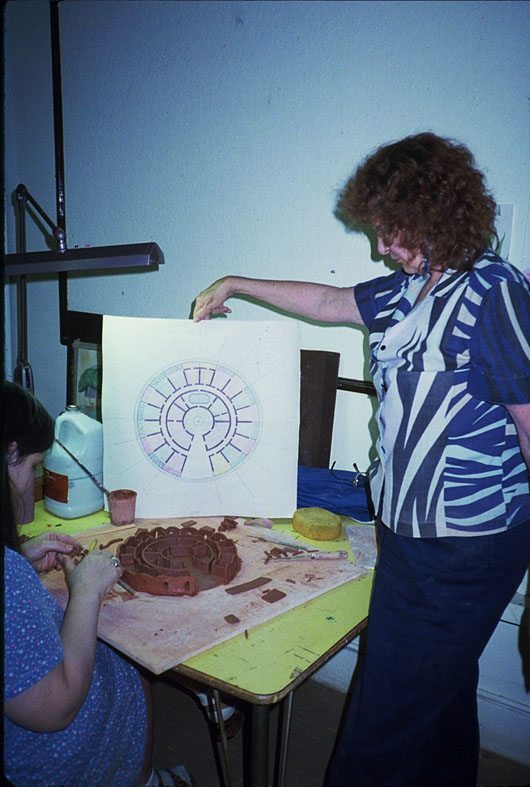
CERAMIC ARCHITECTURE, Nader Khalili Project, CRC, 1989.
THROUGHOUT THE RESIDENCY, I WAS ABLE TO INVITE guest artists for short-term
workshops. Developing self-esteem and self-awareness is fundamental to personal
growth, which is an ultimate goal of any arts program with disadvantaged
individuals, so many of the projects focused on self-portraiture, both literal and
figurative. Although the use of cameras is heavily restricted in California prisons now, there were many exciting AIC photo projects in the 80s and 90s. In 1987, a New York photographer, with a grant from Polaroid, Robert Solywoda, came for a series of workshops. The women used the viewfinder of the 4×5 camera and
envisioned how they would pose and what they wanted to include in the frame
for their self-portrait. They later worked with the negatives to create their own
cyanotypes in the sun. The inmates kept their prints and the B&W polaroids, and Solywoda later created five editions of the 11 images. They were originally exhibited at Self-Help Graphics in East Los Angeles, and collected by the AIC central office and Polaroid Corporation.
On that first night of teaching drawing inside, I learned that it was important to
always teach by demonstration, rather than by verbal description alone. And my
original instinct that creating an imaginary personal space was a good project
proved true. My grant was focused on ceramics, and we worked on making
miniatures of rooms, buildings, and scenes, such as a beach scene from one woman’s
native Mexico or a small kitchen or bedroom from home, using slab construction.
Some wonderful miniature interior pieces came through a project taught by
an assistant to Nader Khalili, an innovative architect who supported Arts-in-
Corrections. His assistant, Debra Denker, taught the women how to create vaulted
domes from miniature ceramic bricks they cut out of terra cotta. The walls of their buildings were slabs, and the rooms and buildings they made varied from small houses to a multi-chambered round building created by a former madam.
Many of the women gave their artwork to their children. It served as a very
important link to family, and one that was happily free from prison references. Maintaining ties to family and community are some of the most important factors in
successfully staying out of prison upon release.
Other successful projects used mixed media for assemblage boxes with self-portraiture as a theme. Work by Betty Saar and others was presented as examples.
Again, the small, private enclosed space formed a safe ‘world’ for the inmates,
whose lack of privacy is extreme. Those pieces led to an exhibit at Cal Poly Pomona in 1989, Altars, Icons and Altered Images. Arts-in-Corrections supported work going to the outside as community service, so that some programs created murals which went to facilities such as hospitals, DMVs, schools, and other public venues. The artist/facilitators had mural crews, which they were able to train in drawing, painting, and mural skills. Exhibitions also helped create a positive bridge between the public and the inmates, 90 percent of whom are paroled and return to our communities.
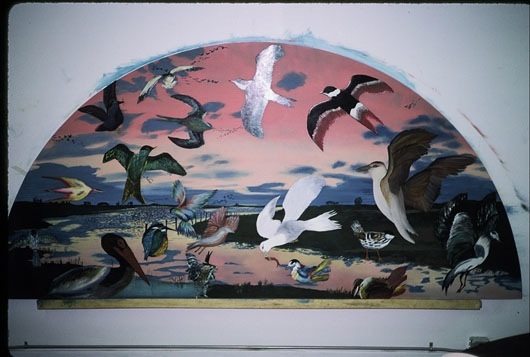
BIRD MURAL, Tom Skelly and CRC inmates, 1987.
A mural created for an alcove above a CRC doorway worked well as a group project.
It was led by Tom Skelly, the artist/facilitator from the nearby California Institution for Men (CIM). He and the women chose the theme; he painted the background while the women painted the birds from pictures and learned to use a simple palette, with guidance as needed.
One of the richest experiences I found inside was the studio atmosphere of quiet
talk, openness, storytelling, and humor shared by a group of women working
together on their art projects. It is a rare and wonderful function of arts programs inside, where the normal racial and other divisions that separate people and define prison are ignored in the common experience of learning and creating. While my individual practice as an artist involved creating more abstract sanctuary installations during the 80s and 90s, I realized later that the studio I created at CRC was a true sanctuary.
III. QUILTING– SOLACE AND OUTREACH
MARGOT STRAND JENSEN, A NATIONALLY EXHIBITING TEXTILE artist, worked as a full-time artist/facilitator at Northern California Women’s Facility (NCWF), Stockton, from 1990-95. Her professional background gave her a range of techniques she was able to apply to the seemingly foreign and unfamiliar prison studio she encountered when first hired by Arts-in-Corrections, and she was only given two days of a normal weeklong orientation. As Margot said, she “was the biggest fish you’d ever seen on the yard.” Her new studio wasn’t set up for textiles, and her budget didn’t come through for 6 months, so Margot had no fabric, thread, or sewing machines. She was surprised when she started to see the inmates in colorful muumuus and flipflops, but she soon realized that the AIC studio was near the area where the old muumuus and other used fabric supplies were tossed, and she was able to pad the tables with old blankets and use old muumuus for their first quilts. Margot taught her students that the use of old cloth was part of the tradition of American quilting, which used old cuffs and other discarded pieces. The first project for her students was hand-stamping patterns on fabric with found objects, since piecing quilt patterns required more time and experience, and was challenging with the higher levels of dyslexia among the inmates. They used flyswatters, feathers, painted leaves, and old utensils to create their first pieces with fabric paint Margot had bought. The groups of women learned by making small quilts, which they treasured as projects to work on back in their cells, and which they used to decorate their spaces and give to their families.
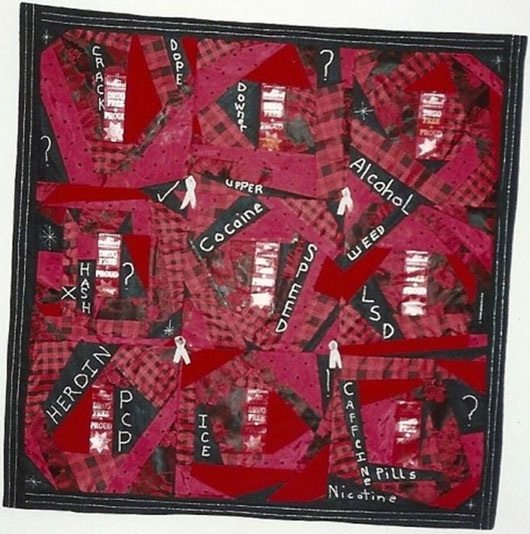
MISERY, Collaboration between Margot Strand Jensen and NCWF inmates, textiles, 1994.
The stitching for the quilt work was solace to them in their cells, and one of her
students in her 40s said, “This is the first thing I’ve finished in my life.” The process of learning a new art form and succeeding at it is part of the success of AIC; the increase in self-esteem can help inmates realize they have value and potential to learn other ways to behave and support themselves upon their release.
After she was assigned two inmate-clerks and was able to buy sewing machines, she
proposed that they create narrative quilts as a way to give back to the community.
Then they worked in groups on these larger pieces that were intended to go to
social service agencies, libraries, city halls, clinics, and other community venues. The women chose themes that they thought they could help teach others on the outside, and worked in small groups creating the quilts. Two quilts pictured below included red ribbons, which Margot was able to get from Sacramento when they were left over from a school drug education program. These quilts focused on an anti-drug theme.
The quilts were displayed in a national exhibit, New Directions- Quilts for the 21st Century, at the Lesher Gallery of the Bedford Center in Walnut Creek in 1994. Margot and her students ultimately created about 30 quilts and had them framed and ready to donate to the community, but Margot became very ill from repeated unannounced pesticide spraying in the studio and education area, and was never able to return to work. A few of the quilts were at one time in Sacramento offices, and the location of the others is unknown.
IV. PRINTMAKING AND BOOK-MAKING
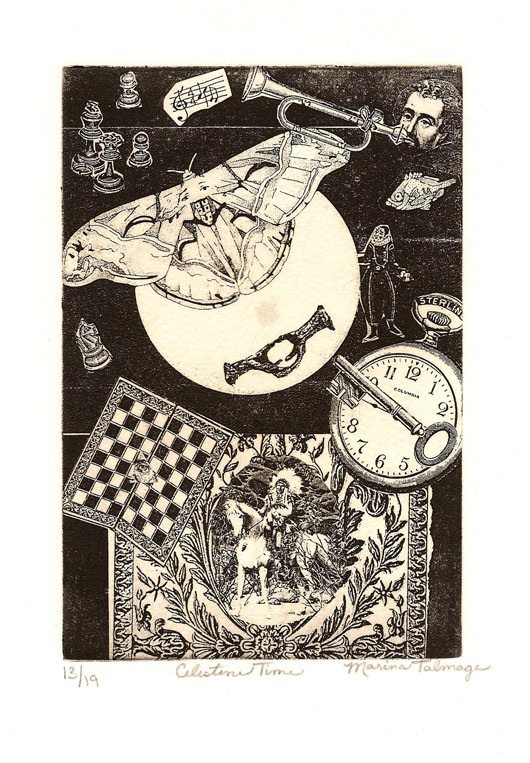
CELESTINE TIME, Marina Talmage, intaglio print, 1996.
THE STUDIO AT CALIFORNIA INSTITUTION FOR WOMEN (CIW) had a press, brought in by the original artist/facilitator, Kim Kaufman. Many books and portfolios were
produced there with teachers Beth Thielen, Jonde Northcutt, Nick Capaci, and others. Fortunately, an edition of many of these are part of UCLA’s Prison Arts Archiving Project. Some of the smaller artworks from throughout the state prison studios and much documentation about the program have been archived permanently for study and to serve as a model for other programs.1
Jonde Northcutt and Nick Capaci co-led a number of workshops, teaching intaglio and collograph printmaking, among other techniques. They brought in photographic and other collage elements; the women also drew and contributed their own imagery and wrote poetry for some of the editions, and many wonderful works were produced.
Beth Thielen is a multi-media artist who created many technically accomplished
and beautiful pieces with women at CRC and CIW and men in many facilities,
focusing on hand-made books. One fine example is the Tower Book, which involved
printmaking, writing, and book-making in a collaboration between the women of
CRC and the men of San Quentin. The Tower Book can be displayed open or closed,
and can also be mounted on a tall freestanding base.
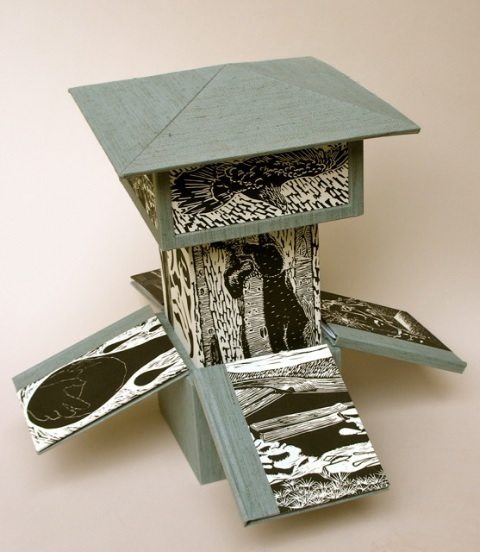
TOWER BOOK, Beth Thielen, Women of CRC and Men of San Quentin, Mixed Media, 2007.
—Beth Thielen
V. ARTS-IN-CORRECTIONS: PAST SUCCESS AND FUTURE HOPE
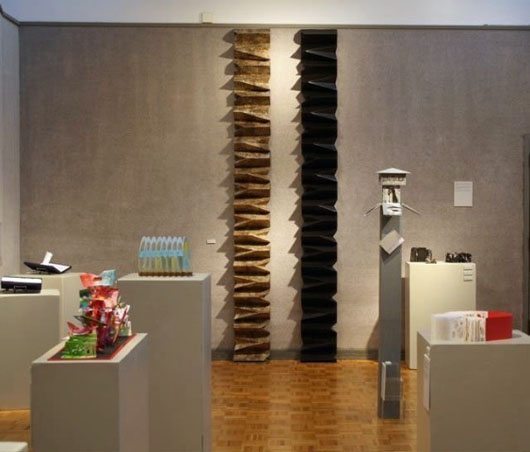
TOWER BOOK displayed, St. Mary’s College Gallery, Book Arts Exhibit, 2010.
WHEN I LOOK AT ARTWORK FROM A VARIETY of prison programs nationally, I am
frequently impressed by different elements—the honesty or the emotion or the
highly skilled style of traditional or indigenous prison imagery (tattoo art, fantasy art, etc.) The work from California’s AIC is sometimes different because the primary mission of Arts-in-Corrections was to “provide inmates with diverse opportunities to perfect their artistic skills and personal vision through workshops taught by professional artists who exemplified the fine arts model of quality, discipline, and inspiration.” There is a somewhat more academic influence from AIC, and although change and growth are indeed AIC and therapeutic goals, the program is not modeled on an art therapy program.
AIC was the subject of several studies. One showed that inmates who participated in the program had 75 percent fewer behavior problems, thus avoiding ‘write-ups,’ which cost the state money for staff time. Another study showed that inmates who participated in AIC on a regular basis had a 27 percent lower recidivism (or return-to-prison) rate, thus saving the state large amounts of money and improving the quality of life for those inmates and their families and communities.2 California’s overall recidivism rate is around 70%, one of the highest in the nation.
Arts-in-Corrections was ended by the CDCR in 2010 due to budgetary reasons, and the few programs that continue in California today with local grants and support are focused at San Quentin, New Folsom, and Lancaster, to my knowledge. Alma Robinson, executive director of California Lawyers for the Arts, is leading an effort to find grant funding and ultimately government support for arts programs for the prisons and the county facilities, which are expected to begin receiving more inmates as California tries to reduce the number of inmates in its severely overcrowded prisons.3
With the efforts to relieve overcrowding in California prisons, and the knowledge that programs such as AIC can help reduce recidivism, it seems that some of the precious limited resources should be used for art programs in prisons and county jails, with the humane, cost-lowering, and positive long-term consequences in mind.
ENDNOTES
- UCLA’s Southern Regional Library Facility,
‘Arts-in-Corrections Records, 1977-2010: Record Series 721’, Will be available
online later this Fall. - www.williamjamesassociation.org
- www.calawyersforthearts.org
Other articles of interest:
Phyllis Kornfeld, ‘Digging for gold: Finding goodness, autonomy and great art.’
http://www.corrections.com/news/article/19177
http://buildingcommunitythroughthearts.wordpress.com/2011/05/07/mending-
hope-stitching-compassion/
WEAD MAGAZINE ISSUE No. 4: NO COMPLACENCY
© Copyright 2012 Women Eco Artists Dialog. All rights reserved.